


Apple is planning to release a low-cost MacBook in 2026, which will apparently compete with more affordable Chromebooks and Windows PCs. Apple's most affordable Mac right now is the $999 MacBook Air, and the upcoming low-cost MacBook is expected to be cheaper. Here's what we know about the low-cost MacBook so far.
Size
Rumors suggest the low-cost MacBook will have a display that's around 13 inches in size. The MacBook Air has a 13.6-inch display, so the more affordable MacBook will likely be slightly smaller. It's sounding like it won't be too far off from the 13-inch MacBook Air, though.
There are no details on how thick it might be, but Apple probably won't prioritize a thin design for a machine optimized for a low price, even though some people are hoping that it will also be ultra thin. Ultra thin usually means more engineering work and higher-cost components for the display and other parts, but it can also sometimes be achieved by removing features. A thinner enclosure isn't entirely out of the question if Apple cuts features to reduce costs, but at the same time, reducing size leads to lower battery life, and Apple probably wants to have decent battery to compete with or outmatch cheap Windows laptops.
Since the MacBook Air can run fine with an M-series chip and no fan in an enclosure that's 0.44 inches thick, there's no real reason for the MacBook to be any thicker than that, unless Apple wants to add a bigger battery.
Design and Display
The low-cost MacBook will have a standard LCD display with no mini-LED technology or ProMotion refresh rate. It won't be able to compete with higher-end laptops in terms of brightness or HDR support. It's probably best to think of it like the low-cost iPad, which offer excellent performance but uses much older display technology.
Apple could make the low-cost MacBook in bright colors like the iMac to appeal to children and to clearly position it as a lower-cost device. There are no rumors of this, but it would also make some sense for Apple to return to the plastic casing of some of its original MacBook models.
Rumors suggest the low-cost MacBook Pro could come in colors like silver, blue, pink, and yellow.
A-Series Chip
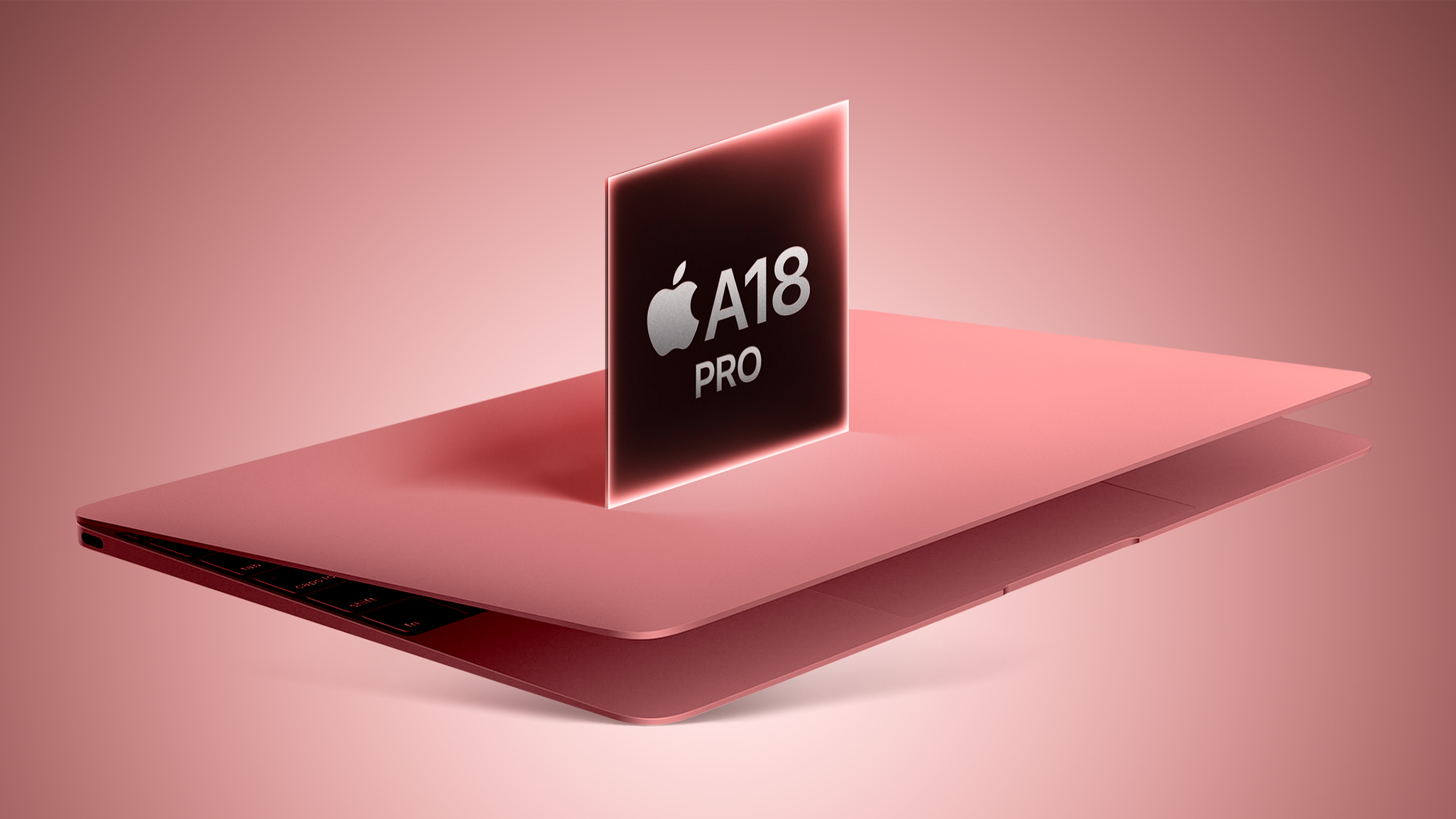
Apple is planning to use its A18 Pro chip in the MacBook, which is a chip that was first used in the iPhone 16 Pro. The A18 Pro is built on Apple's second-generation 3-nanometer process, featuring 8GB RAM and support for Apple Intelligence.
It's fast and efficient, and more than capable of handling day-to-day tasks. In Geekbench 6 benchmarks, the A18 Pro offers single-core CPU performance scores at the level of the M3 Ultra, and multi-core performance scores higher than the M1 chip that Apple used in the first Apple silicon MacBook Air. Metal scores that measure GPU performance are also similar to the M1 chip Metal scores.
The A18 Pro will be equivalent to the M1 for some tasks, and faster for other tasks. Apple no longer sells the M1 MacBook Air from its own store, but it has offered the machine through Walmart at a $599 price point.
Capabilities
With the A18 Pro chip, the low-cost MacBook would be able to do anything that can be done on an iPhone 16 Pro. It would be a suitable replacement for the low-cost iPad paired with a keyboard, and it would also support Apple Intelligence features.
As of now, an iPad is essentially the only option for a low-cost portable device that can serve as a computer, but the low-cost MacBook will add a solution that runs macOS instead of iPadOS.
Tasks like browsing the web, watching videos, creating documents, editing photos, and even light video editing would be no problem. A low-cost MacBook with A18 Pro chip could play all of Apple's iPad and iPhone games, including Apple Arcade titles, but it would not work well with high-end system intensive games.
It would also likely run apps like Final Cut Pro, but speeds for things like exporting video would not be as quick as with a more powerful Mac.
Apple probably won't go all out on ports, and the MacBook is likely to get just a single USB-C port, though two like the MacBook Air is also possible.
The A18 Pro chip is efficient, and there's a lot of space inside a 13-inch enclosure for a battery, so we could be looking at MacBook Air-level battery life or better. The MacBook Air's battery lasts for up to 18 hours when watching videos, or 15 hours when browsing the web.
Price
There are no specific details on price as of yet, but Bloomberg claims it will cost "well under $1,000." The MacBook Air is priced starting at $999, so the MacBook will need to be priced lower than that.
Apple has a 13-inch iPad Air that has a display in the same range rumored for the low-cost MacBook, and it's priced at $799. The iPad Air has a higher-end M-series processor though, so the low-cost MacBook could be priced below the iPad Air.
The closest iPad approximation for the chip is the iPad mini, which has an A17 Pro and is priced at $499. A price somewhere between $499 and $799 could make sense looking at Apple's existing product lineup.
Launch Timing
Apple is expected to launch the low-cost MacBook in the first half of 2026. Updates are planned for the MacBook Air in early 2026, and the low-cost model could launch sometime in that same timeframe.
If you're thinking about picking up a computer for lightweight tasks like document editing, web browsing, watching videos, and doing homework, you might want to wait to see what Apple has in store before buying a MacBook Air, an iPad, or a more affordable Windows machine or Chromebook.
Read More
For more information on Apple's cheap MacBook, we have a dedicated guide.
Article Link: Apple's 2026 Low-Cost A18 Pro MacBook: What We Know So Far
Last edited:


