
Got a tip for us?
Let us know
Become a MacRumors Supporter for $50/year with no ads, ability to filter front page stories, and private forums.
Apple's Website Redesigned With New Drop-Down Menu Bars and More
- Thread starter MacRumors
- Start date
- Sort by reaction score
You are using an out of date browser. It may not display this or other websites correctly.
You should upgrade or use an alternative browser.
You should upgrade or use an alternative browser.

thealkimist
macrumors regular
Curious, what specifially needs fixed? What's broken?
We should never want an interface redesign unless it's focused on fixing something that's broken, and even then those changes should be incremental, since Apple should be starting from a best-in-class platform well-honed from decades of learning.
Any wholesale change to a website or operating system or app is either:
A) an admission that you really had it completely wrong top-to-bottom before, so look at THIS! (the Microsoft Windows way of doing things and something Apple should never have to do).
B) an admission that you needed something fresh for the sake of something new (iOS7 cough, cough)
For me, I'd like a little of A) in the OS and iOS, semi-wholesale changes to fix certain vague and poor interface elements forced into practice by iOS7 and Yosemite and clinging on today, and which haven't been slowly reversed/fixed like some interface elements have been fixed over time (after Jony was booted)!
No, those are not the only reasons why product design decisions are made.

🥰 Pleasing to the eye. Never fails to impress. I miss the old Apple website in 2008. Simpler times!
View attachment 2155045
True story, two of the designers of that version were friends of mine and some of my suggestions are in the screenshot above but more so in the 2006-2007 site.
thealkimist
macrumors regular
Boring, lifeless. No risks were taken.
The biggest risk was their product lines were harder to navigate through for impaired users. This solution provides everyone a much more efficient way to get to where they want to go.

Tozovac
macrumors 68040
No, those are not the only reasons why product design decisions are made.
They aren't the only reasons, but I contend that most other reasons can be binned into either of those categories.
Given that Apple (used to be) is heralded as the "it just works" kingpin, seamlessly blending function with form, what other major decisions would drive a wholesale interface change that don't fall into function or flash/marketing, where, I contend the focus should always treat function first.
Good function supports good marketing; good marketing needs good (or improved) function.
Good marketing with reduced function is pointless.
thealkimist
macrumors regular
They aren't the only reasons, but I contend that most other reasons can be binned into either of those categories.
Given that Apple (used to be) is heralded as the "it just works" kingpin, seamlessly blending function with form, what other major decisions would drive a wholesale interface change that don't fall into function or flash/marketing, where, I contend the focus should always treat function first.
Good function supports good marketing; good marketing needs good (or improved) function.
Good marketing with reduced function is pointless.
This isn’t a wholesale change, albeit it’s a significant one concerning discoverability of product lines. And most product decisions are not wholesale changes at all, so they don’t really fit into either buckets you’ve established. But you can fit any product changes under the banner of establishing “value”, which is also a very loaded term that needs to be explained in each context.
But to go back to this particular update on Apple, this is a change that seems to me, to address discoverability issues for accessibility reasons - a domain that also goes very deep and wide in the world products and services.
Tozovac
macrumors 68040
This isn’t a wholesale change, albeit it’s a significant one concerning discoverability of product lines.
I agree!
And most product decisions are not wholesale changes at all, so they don’t really fit into either buckets you’ve established.
I agree with the first part of your sentence above, but you accidentally misinterpreted me; I wasn't bin all changes into two buckets; I binned wholesale changes into those buckets. When a developer tosses out all the bathwater and baby together wholesale, why else could it be other than to A) attempt to fix a major bunch of wrongs, or B) introduce something new and fresh, often wildly new and fresh in an attempt to attract customers?
My best example of A) is Microsoft Windows before before ripping off OSX into Windows 10 and 11.
Example of B) are fashion; musical groups reinventing themselves to stay fresh; McDonald's trying pizza; Jony Ive's iOS7 which didn't necessarily fix anything broken but was a platform for him to express his minimalistic ideals.

sjsharksfan12
macrumors 68030

contacos
macrumors 604
Their website is still awful. Too cluttered and at the same time confusing to navigate like it’s so hard to get to the accessories of different products and switch between them.
Also what on earth is this navigation. It doesn’t end. Too many clicks to finally see the price of a product as well. They need to merge the product info page with the buy now page basically turn it back into an actual store like 2008.
I basically navigate their page via google search results 😅
Also what on earth is this navigation. It doesn’t end. Too many clicks to finally see the price of a product as well. They need to merge the product info page with the buy now page basically turn it back into an actual store like 2008.
I basically navigate their page via google search results 😅
Attachments


fatTribble
macrumors 68030
I’ve always liked their website.
It‘s the Apple app that’s completely confusing.
It‘s the Apple app that’s completely confusing.

Tagbert
macrumors 604
Text is fast and efficient. Tiny icons that that are hard to distinguish are not needed in the navigation.Too small, too much text, not enough icons / images

Tagbert
macrumors 604
It looks like someone fixed that broken html tag. I don’t see that now. The page looks fine.View attachment 2155085I’m nitpicking, but this is modern Apple in a nutshell.
“> next to the Apple in the corner.
Buy Smart Home Devices & Accessories
Shop TV and home accessories from Apple. Explore Apple TV, HomePod, smart bulbs, sensors, and security. Buy online at apple.com and get free shipping.
www.apple.com


macos9rules
macrumors 6502
It looks like the interns already fixed it!View attachment 2155085I’m nitpicking, but this is modern Apple in a nutshell.
“> next to the Apple in the corner.

Canubis
macrumors 6502
Oh boy, this redesigned navigation is super annoying (if you use the website like before).
E.g. If you just want to click on any of the main tabs like "Mac" or "Watch", then wait for the page to load, then move your curso to any of the icons below, the moment you reached e.g the "MacBook Pro" icon suddenly the navigation bar expands. Worst case you click and it redirects you somewhere else… Usability nightmare!
E.g. If you just want to click on any of the main tabs like "Mac" or "Watch", then wait for the page to load, then move your curso to any of the icons below, the moment you reached e.g the "MacBook Pro" icon suddenly the navigation bar expands. Worst case you click and it redirects you somewhere else… Usability nightmare!
Tozovac
macrumors 68040
Amen. I can't stand when a page shifts after clicking something and you have to refocus your attention.Oh boy, this redesigned navigation is super annoying (if you use the website like before).
E.g. If you just want to click on any of the main tabs like "Mac" or "Watch", then wait for the page to load, then move your curso to any of the icons below, the moment you reached e.g the "MacBook Pro" icon suddenly the navigation bar expands. Worst case you click and it redirects you somewhere else… Usability nightmare!
These changes reek of a designer (or marketing) looking for something to change under the guise of "improvement" instead of actually fixing something that was broken.
A really bad update. It was so much easier to use before. Apple with Jony Ive had made products and services that looked and felt so much better than now. In 5 years apple is like Samsung. Just boring
Canubis
macrumors 6502
This new flyout navigation finally managed to get me so annoyed I needed a way to get rid of it.
I am sure there are better, more foolproof solutions, but here is my quick & dirty way of getting rid of it in Safari.
Paste below code into some text file and save it on your disk, e.g. as SafarCustomCSS.css.
Then go to Safari > Settings > Advanced > Stylesheet. There browse & select your newly created css file on your disk.
Caveat: as the custom css file will apply to ALL websites opened in Safari, the above snippet may possibly break functionality on other websites as well (though just incase they use same CSS class and ids as mentioned in the code above.)
Edit – safer solution: if you have the excellent Stop The Madness or a similar extension to add custom CSS to a page, you can limit the above CSS change to only apple.com – so no other websites will be affected. Just copy above CSS code into the "Custom Elements" section for www.apple.com:
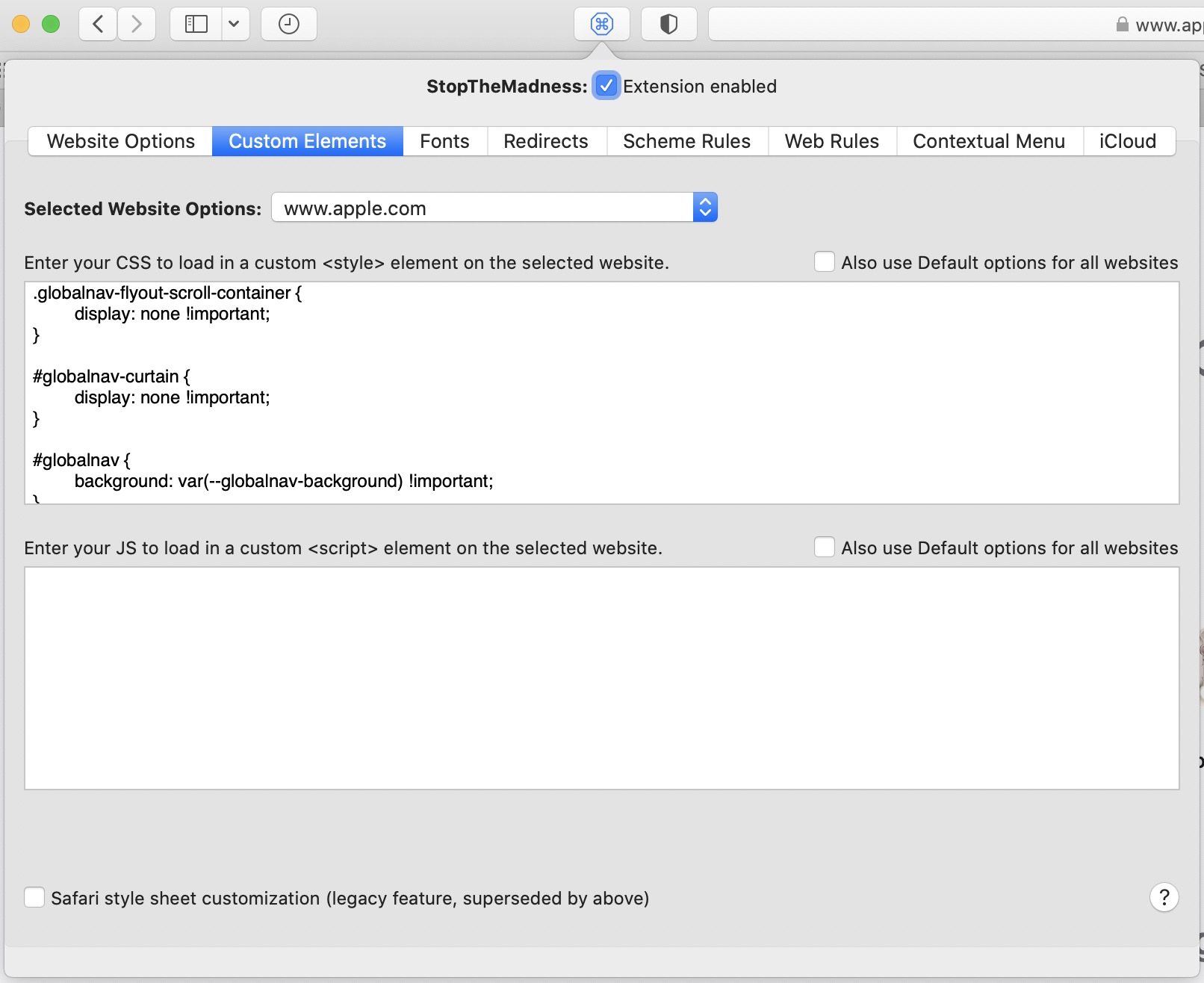
I am sure there are better, more foolproof solutions, but here is my quick & dirty way of getting rid of it in Safari.
Then go to Safari > Settings > Advanced > Stylesheet. There browse & select your newly created css file on your disk.
CSS:
.globalnav-flyout-scroll-container {
    display: none !important;
}

#globalnav-curtain {
    display: none !important;
}

#globalnav {
    background: var(--globalnav-background) !important;
}Edit – safer solution: if you have the excellent Stop The Madness or a similar extension to add custom CSS to a page, you can limit the above CSS change to only apple.com – so no other websites will be affected. Just copy above CSS code into the "Custom Elements" section for www.apple.com:
Last edited:

eveluvsrainbows
macrumors 6502a
I much prefer the fly-out navigation, and if this has potential to break other websites, there’s literally zero benefit of using this.This new flyout navigation finally managed to get me so annoyed I needed a way to get rid of it.
I am sure there are better, more foolproof solutions, but here is my quick & dirty way of getting rid of it in Safari.
Paste below code into some text file and save it on your disk, e.g. as SafarCustomCSS.css.
Then go to Safari > Settings > Advanced > Stylesheet. There browse & select your newly created css file on your disk.
CSS:.globalnav-flyout-scroll-container { display: none !important; } #globalnav-curtain { display: none !important; } #globalnav { background: var(--globalnav-background) !important; }
Caveat: as the custom css file will apply to ALL websites opened in Safari, the above snippet may possibly break functionality on other websites as well (though just incase they use same CSS class and ids as mentioned in the code above.)
I don’t know why you hate it but you’d be better off getting used to it instead of intentionally breaking Apple’s website along with other websites.
Canubis
macrumors 6502
Well great for you that you like it and thanks for telling me how to use MY computer. 😅I much prefer the fly-out navigation, and if this has potential to break other websites, there’s literally zero benefit of using this.
I don’t know why you hate it but you’d be better off getting used to it instead of intentionally breaking Apple’s website along with other websites.
I explained few posts above just one of the usability flaws of the new flyover navigation. It’s easily getting in the way of things one may want to click. Eg click on iPhone menu item and then try to click on any of the iPhone icons. Suddenly the flyover will appear out of nowhere and block your click. Possibly even kidnap your click and lead you somewhere else.
eveluvsrainbows
macrumors 6502a
That behavior does not happen for me on my computer. Are you sure it’s not a bug exhibited by the use of an older version of macOS and Safari? Newer versions of Safari support newer CSS rules and features that aren’t supported on older browser versions and could potentially cause problems like rendering or display issues, or even issues where display elements could accidentally trigger when using said older browser versions.Well great for you that you like it and thanks for telling me how to use MY computer. 😅
I explained few posts above just one of the usability flaws of the new flyover navigation. It’s easily getting in the way of things one may want to click. Eg click on iPhone menu item and then try to click on any of the iPhone icons. Suddenly the flyover will appear out of nowhere and block your click. Possibly even kidnap your click and lead you somewhere else.
Reason I’m saying this is because I saw the edit you made on the post I originally replied to, in order to mention Stop The Madness, and I saw that you’re using a pre-Big Sur version of macOS, where it still had the less thick and more gradient-y button controls.