

Become a MacRumors Supporter for $50/year with no ads, ability to filter front page stories, and private forums.

MacRumors

macrumors bot
Original poster


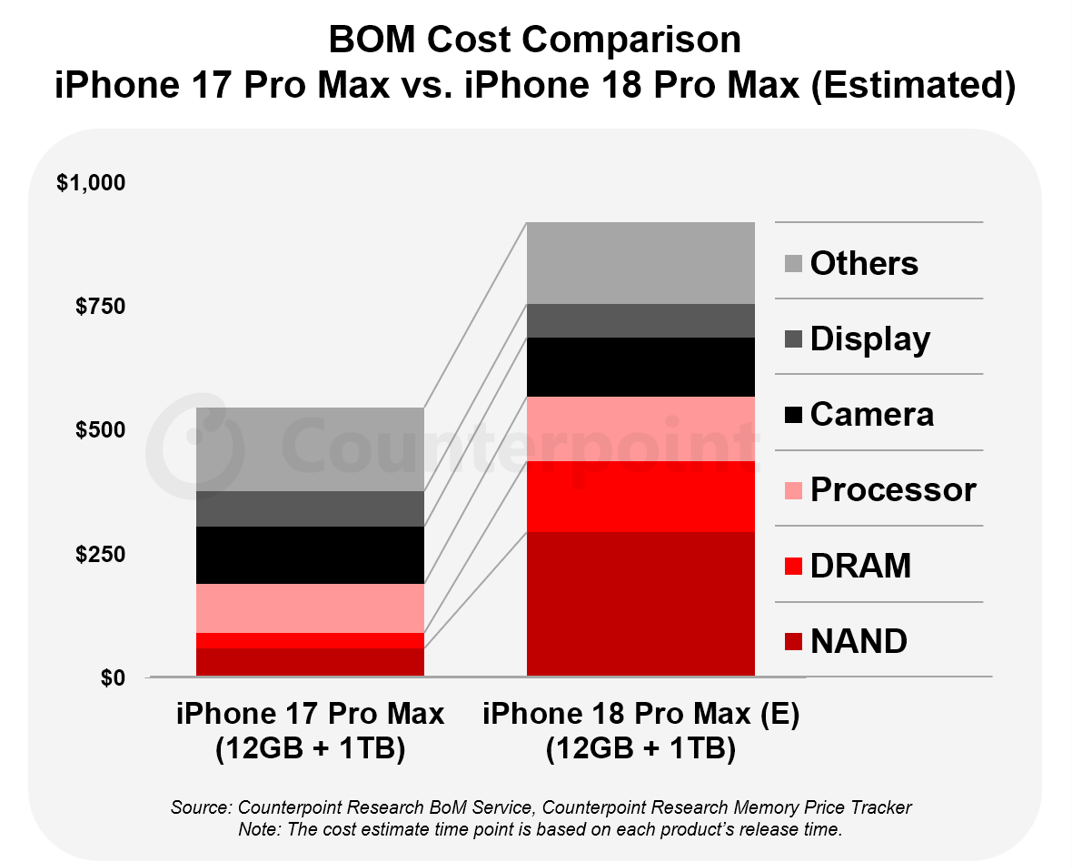
The bill of materials for the iPhone 18 Pro Max is expected to rise by nearly $300 compared to the iPhone 17 Pro Max, according to a new Counterpoint Research analysis.
iPhone-18-Pro-Deep-Red-Feature.jpg

The estimate covers the 1TB storage model. NAND flash costs for the device are said to exceed $250 on their own, a figure that would cover roughly half of the iPhone 17 Pro Max's entire estimated component cost. DRAM pricing is also climbing sharply, with both components facing pressure from a broader memory chip shortage tied to surging demand for AI hardware.

Apple's expected shift to a 2nm chip is described as the second-largest contributor to the cost increase. The iPhone 18 Pro is rumored to debut the A20 Pro, manufactured on TSMC's N2 process, which reportedly carries a steep premium in wafer pricing over the current N3P node used for the A19 Pro. Early yield ramp costs on a new process node typically add to per-unit chip pricing as well.

Counterpoint says display costs and other miscellaneous components may actually decline compared to the iPhone 17 Pro Max, partially offsetting the memory and chip increases. Camera costs are expected to rise slightly, which the firm attributes to new technology, likely a reference to the variable-aperture main camera rumored for the Pro models.
iphone-18-pro-max-counterpoint-bom.png


The report arrives weeks after Apple raised prices on 14 products, including every Mac and iPad, along with the Apple TV, HomePod, HomePod mini, and Vision Pro. Apple attributed those increases to the same memory chip shortage cited in the Counterpoint report, saying that the "supply-demand imbalance" driven by AI data center buildouts had made further price increases necessary. iPhone, Apple Watch, and AirPods pricing was left unchanged in that round of hikes, but the iPhone 18 Pro lineup is widely expected to be next.

The Wall Street Journal previously reported that the iPhone 18 Pro could start as high as $1,399, citing estimates that Apple's DRAM cost per unit could climb from $39 to $145 and its flash storage cost from $13 to $51. Apple CEO Tim Cook told the outlet that the company is "still working through" which devices will see price increases. Separately, IDC has estimated a $200 increase to the Pro and Pro Max models specifically, while Weibo leakers have separately suggested Apple could raise its Chinese starting price for the lineup by around 11%.

To manage the higher costs without giving up margin entirely, Apple is expected to apply different retail price increases across storage tiers rather than a flat increase across the lineup, concentrating the impact on higher-capacity models. Even with an average $200 retail price rise, Counterpoint still expects the iPhone 18 Pro Max to land at a slightly lower gross margin than the iPhone 17 Pro Max achieved in 2025.

The iPhone 18 Pro and iPhone 18 Pro Max are expected to launch alongside Apple's first foldable iPhone in the fall.

Article Link: iPhone 18 Pro Max Component Costs Could Rise Nearly $300
 
  • Wow
Reactions: Z-4195
Shall we go down memory lane?


Disproportionate Markups on the Consumer:

Micron's leadership took direct aim at how Apple passes costs to consumers. Executives pointed out that while memory prices have indeed risen due to the AI infrastructure boom, Apple is disproportionately multiplying that cost. As one executive noted, if a chip price moves up slightly, Apple uses that as justification to mark up retail prices by hundreds of dollars to protect its own high margins.
 
It will be interesting to see how Apple does the pricing. Tiered memory costs would mean lower end machines remain somewhat reasonably priced after an increase, at the expense of the higher end models. Spreading teh costs mean lower end models become more expensive than tehy need be, with their higher margins designed to makeup for lower ones at the high end.

Appe will protect its margins, just how aggressively and how is the question, along with are they willing to drop them slightly to protect sales and hope memory prices drop in the not too distant future.
 
  • Like
Reactions: BluefinTuna
That analysis seems wrong. A single 1TB NAND chip is nowhere near $250 in the quantities Apple buys.

At the retail level, a 1TB 2230 NVMe SSD is less than $200, and that is retail pricing, and includes a circuit board, controller, and a bunch of overhead for manufacturing, packaging and distribution. The chip itself in quantities that Apple would buy is nowhere near $250.

I think we are being misled or Apple needs better buyers.
 
It will be interesting to see how Apple does the pricing. Tiered memory costs would mean lower end machines remain somewhat reasonably priced after an increase, at the expense of the higher end models. Spreading teh costs mean lower end models become more expensive than tehy need be, with their higher margins designed to makeup for lower ones at the high end.

Appe will protect its margins, just how aggressively and how is the question, along with are they willing to drop them slightly to protect sales and hope memory prices drop in the not too distant future.
Lower end machine’s impossible with AI. What will need to happen, build a basic phone as today and the AI handheld device. No other option and will be up to us to decide what are our actual needs. Simple as that.
 
I meant the 1TB tier specifically, not the Pro Max in general.

Point taken, but even the 1TB tier is pretty popular. For the iPhone 16 that was between 5 and 7 million units. (Around 2.5% of all iPhone sales).

To answer your initial question of would they only analyze the highest? To get the most spectacular price difference. And why would they do that? Clicks. But, you don't need that answer since that's probably the point you were trying to make.
 
Sucks that the costs keep rising but a silver lining is that with each passing year there is less reason to upgrade as often. This is just the normal course many products take when they mature. So skip this year and save your pennies for next year's expensive purchase.
Although I mostly agree with your sentiments, nothing about the current situation seems normal. To quote Tim Cook,
This is a hundred-year flood, I've never seen anything like it in any area in over 40 years
 
Register on MacRumors! This sidebar will go away, and you'll see fewer ads.