
Got a tip for us?
Let us know
Become a MacRumors Supporter for $50/year with no ads, ability to filter front page stories, and private forums.
Ivy Bridge update may disappoint...
- Thread starter bill-p
- Start date
- Sort by reaction score
You are using an out of date browser. It may not display this or other websites correctly.
You should upgrade or use an alternative browser.
You should upgrade or use an alternative browser.

Thank you.Both of you are very silly.
Actually, I was generating hypotheses.You guy are both grumbling without looking at real information.
surjavarman
macrumors 6502a
I don't think anyone gives a flying poo about the CPU.
It's the thinner form factor and IPS retina display that matters. If the next mbp doesn't have anyone of those then yes then most will be disappointed with the update. I mean does anyone nowadays really need anything more than C2D unless you are a gamer? For the average user the C2D+SSD is just as fast as SB+SDD.
It's the thinner form factor and IPS retina display that matters. If the next mbp doesn't have anyone of those then yes then most will be disappointed with the update. I mean does anyone nowadays really need anything more than C2D unless you are a gamer? For the average user the C2D+SSD is just as fast as SB+SDD.
MadMitch89
macrumors regular
What of this new technology(?) that Apple has incorporated into the new iPad battery (almost doubling the size charge without doubling the size of the battery). Do you think this will make it to the new Macbook Pros and Airs and could this be used to offset the power drain of potential high resolution ('retina') displays?

wikus
macrumors 68000
I've got a late 2011 MacBook Pro. Ivy Bridge doesn't phase me at all. The only thing that entices me about Ivy Bridge is USB 3.0 but I don't have any USB 3 devices so it doesn't matter.
Broadwell however is what really interests me. I'd like to see my MacBook Pro be near silent at full speed and have 10+ hour battery life as well as having a proper graphics card by then. Portal in Windows 7 still runs like crap on my ATI 6750 when turned to max settings and 4X FSAA at 1680x1050 resolution.
If these laptop improvements prove to be modest at best in real world situations, I may just go back to a Mac Pro and use a REAL computer.
Broadwell however is what really interests me. I'd like to see my MacBook Pro be near silent at full speed and have 10+ hour battery life as well as having a proper graphics card by then. Portal in Windows 7 still runs like crap on my ATI 6750 when turned to max settings and 4X FSAA at 1680x1050 resolution.
If these laptop improvements prove to be modest at best in real world situations, I may just go back to a Mac Pro and use a REAL computer.
thundersteele
macrumors 68030
Nope, refurb doesn't count. I found a late 2011 refurb for $270 off, and an early 2011 refurb for ~$500 off. So the discount for the "old" model is still only $250.Actually, it's not that hard.
http://store.apple.com/us/product/FD318LL/A
There you go, that's $500 off the Early 2011 model. I have seen the base Early 2011 2.0GHz quad-core i7 for as low as $1300. That one is a little harder to find, but the higher-end models? $1500 is a good price point at which you'll find these machines more often than not.
And under Mac, I'd think the CPU is more important than the GPU, unless you are still rocking Intel GMA 3100.
I was actually able to find a new early 2011 model at amazon $400 off the original price ($1800, down from $2200 for the high-end model). If we take this as basis, it's 20% more cost for roughly 10% more performance. Seems acceptable, if money is not super tight!
Even if the GPU will probably be far superior to what is available today, the planned "retina" display upgrade will basically kill the additional power bringing performance to levels equivalent to what is currently in production!
It will be interesting to see how apple will market these new machines!
It will be interesting to see how apple will market these new machines!
thundersteele
macrumors 68030
What of this new technology(?) that Apple has incorporated into the new iPad battery (almost doubling the size charge without doubling the size of the battery). Do you think this will make it to the new Macbook Pros and Airs and could this be used to offset the power drain of potential high resolution ('retina') displays?
The new technology is called "make the iPad thicker, reduce the size of other internal components, and increase the weight by ~50 g." The new battery has increased in size about as much as it increased in capacity.
Nope, refurb doesn't count. I found a late 2011 refurb for $270 off, and an early 2011 refurb for ~$500 off. So the discount for the "old" model is still only $250.
I was actually able to find a new early 2011 model at amazon $400 off the original price ($1800, down from $2200 for the high-end model). If we take this as basis, it's 20% more cost for roughly 10% more performance. Seems acceptable, if money is not super tight!
Why don't they count? The current generation is still Late 2011, so Early 2011 should be the "old" model. Plus Apple's refurb has a good reputation so in either case, it's a valid alternative for those not looking to spend a lot on an upgrade.
And I suspect base Ivy would just be about equal to high-end Sandy, so you're paying 20% more for likely just a better GPU.
The new technology is called "make the iPad thicker, reduce the size of other internal components, and increase the weight by ~50 g." The new battery has increased in size about as much as it increased in capacity.
Uh... no. I don't think it's appropriate to discuss the new iPad here, but just to note: the new battery has 70% more capacity, going from 25WHr to 42.5WHr. ~50g is a 8.3% increase from the old battery, and 9.4mm compared to 8.8mm is a ~6% increase. It's actually not "about as much". If Apple could continue the trend, they would be able to stack 85WHr at just 18.8mm, or less than an inch.
But to put things in perspective, the current MacBook Pro 15 battery is 77WHr, at also less than an inch. So the improvement wouldn't be much for MacBook Pro, as opposed to general belief. I believe it was more the opposite, Apple took the battery tech in MacBook Pros and applied it to iPad.

ixodes
macrumors 601
Wonder how long the wait will be...
With the great majority of Apple's profit, focus, and buzz around iOS devices, it's no secret that everything else is secondary.
If we collapse our expectations and focus on other things, I'm sure at some point there will be movement on the computer side of Apples product line.
Maybe 🙂

Krazy Bill
macrumors 68030
There are more ways to add battery capacity. Remove the ODD and simply make it bigger. Of course there's that whole redesign thing. If the Pro line gets any thinner I don't think this will fly.But to put things in perspective, the current MacBook Pro 15 battery is 77WHr, at also less than an inch. So the improvement wouldn't be much for MacBook Pro,
Which leads me to believe they won't be thinner. Will need the extra juice (larger battery) for a new display.
There are more ways to add battery capacity. Remove the ODD and simply make it bigger. Of course there's that whole redesign thing. If the Pro line gets any thinner I don't think this will fly.
Which leads me to believe they won't be thinner. Will need the extra juice (larger battery) for a new display.
The Retina Display on the iPad is already estimated as consuming approximately 70% more power. The problem is mainly that the gap between each pixel got smaller, so less light could shine through, and so they had to double the backlight intensity just to get it to the same brightness as before.
Note, though, that's backlight for a 9.7" screen. The backlight for 13", 15" and 17" screens would undoubtedly consume a lot more, so it may not be a simple 70% increase but it may well be 100% - 150%.
Even if you were to take out the OD, battery capacity can only increase at most 40%, and that doesn't quite make up for the increased power consumption of the display.
So I don't believe Retina Display is viable from a battery life point of view. Of course, I don't doubt Apple is trying them out in their labs, but if anything, I'd be mighty disappointed to find out my next MBP only lasts 5 hours or less on battery.
The way I look at it, this'll only be possible if Apple were to take out the hard drive and dedicated GPU as well as soldering RAM to the board, and use Flash storage instead. That'll give a lot more room (100% more on the 15" MBP) for the battery, and it should compensate nicely for the increased power consumption even with a redesign. But that'll be too much compromise for comfort, I think.


teknikal90
macrumors 68040
I bought my MacBook soon as it came out (October)?
Used it maybe 20 times...(just for recording sessions)
iPad + iPhone ftw
Used it maybe 20 times...(just for recording sessions)
iPad + iPhone ftw

Mr. Retrofire
macrumors 603
...with a smaller ODD:It sounds like you should wait. They are only a few months away at this point, and all signs point to a redesign.
http://www.patentlyapple.com/patent...-working-on-a-thinner-macbook-pro-design.html
;-)
Mr. Retrofire
macrumors 603
Only thinner. It does make no sense to merge both.What does re-design mean? A merge of the Pro/Air or a slightly thinner Pro? I've waited this long so a few more months wouldn't hurt.
Apple has been pushing Intel for lower TDP processors. An ARM CPU would make a large difference in power consumption and heat.
http://www.zdnet.com/blog/apple/rumor-apple-dumping-intel-for-arm-processors-in-2013/10093
http://www.zdnet.com/blog/apple/rumor-apple-dumping-intel-for-arm-processors-in-2013/10093
Apple has been pushing Intel for lower TDP processors. An ARM CPU would make a large difference in power consumption and heat.
http://www.zdnet.com/blog/apple/rumor-apple-dumping-intel-for-arm-processors-in-2013/10093
I don't see that happening for at least 3-5 years. ARM is lightyears behind Intel. The only thing that makes sense would be some kind of ARM-Intel combo. Use ARM when doing light stuff like web browsing could extend the battery life. The Intel processor could kick in for heavy work.
Apple has been pushing Intel for lower TDP processors. An ARM CPU would make a large difference in power consumption and heat.
http://www.zdnet.com/blog/apple/rumor-apple-dumping-intel-for-arm-processors-in-2013/10093
ARM CPUs are nowhere near x86 CPUs, even the upcoming ARM15 ones have less than a third of the computing power of what is in the mainstream Macs. They offer more performance per watt but power consumption isn't everything and they lose efficiency once you scale past a certain point. Just like how Intel struggled to get Atom down to smartphone power levels, ARM will struggle to get CPUs as powerful as the current Intel lineup.
That and the fact that everyone would have to rewrite apps for ARM. Apple shifted to Intel not that long ago and that turned everything upside down, I'd rather they not do that again so soon.

Jaro65
macrumors 68040
...with a smaller ODD:
http://www.patentlyapple.com/patent...-working-on-a-thinner-macbook-pro-design.html
;-)
This would make the users who still want a built-in ODD happy. But what about some of us who want it gone? Making the MBP thinner and including this new and improved ODD may make it impossible for us to use the drive bay for a second HDD/SSD, as it would be too thin. I would not be pleased with that outcome.
Wrathwitch
macrumors 65816
Probably sooner or later in this century. But before that happens we should invent question marks.
LOL!!!
However, you aren't supposed to start a sentence with "but".
Either way, it was bloody funny to me for some reason!
ARM is lightyears behind Intel.
http://www.techradar.com/news/computing/how-arm-took-on-the-world-and-won-1067393
http://www.techradar.com/news/phone...vs-intel-the-next-processor-war-begins-920875
Processors in the PC are not that powerfull compared to what happens on real workstations.

AntJon82
macrumors member
wait and see
wait and see like alot are doing i have eraly 2011 13" and i want the new 2012 model but if the odd isnt still in the laptop im staying with what i have and just get a 16 gig mem kit
I want to buy a Macbook Pro now, but I know I'll be gutted when the new Ivy Bridge ones come out. What shall I do?
wait and see like alot are doing i have eraly 2011 13" and i want the new 2012 model but if the odd isnt still in the laptop im staying with what i have and just get a 16 gig mem kit
And that's why I said it may disappoint. TDP doesn't decrease, and neither does power consumption.
What TDP measures is how much heat the chip puts out on average, or how much heat Intel "thinks" it puts out on average. In Penryn's case, even though power consumption dropped, heat was still about relatively the same, but in exchange, IPC improved, and also frequency scaling improved.
Like you said, Anand's article makes it seem like power consumption isn't significantly different compared to Sandy.
Where is less power drain?
Regarding the top 2, do take note that they are hexa-core (6-core) processors as opposed to quad. That's why the difference is so large compared to the 2600K. Compare the highlighted part to the 2600K and you'll see the quad vs quad result. In which case, it's not much difference.
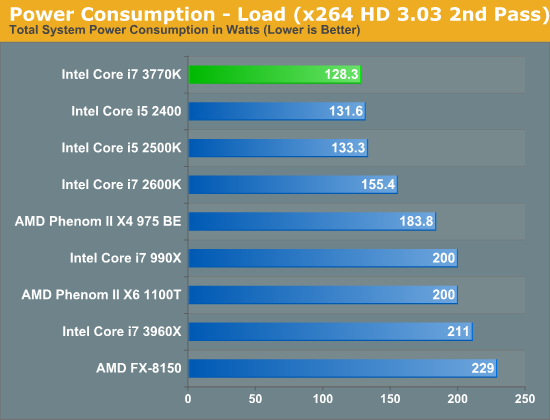
The intel i7 2600k is the high performance Sandy Bridge CPU which is slower than then i7 3770K ( Ivy Bridge ). Yet the Ivy Bridge CPU has less Power drain.