Become a MacRumors Supporter for $50/year with no ads, ability to filter front page stories, and private forums.
Maybe, but pure BT.2020 coverage is a massive technical hurdle for any high-brightness mini-LED, especially one running at 120Hz. Most 'Pro' HDR work today is still targeted at P3, where the XDR hits nearly 100%. If you need 95%+ of 2020, you're usually looking at $10k+ reference monitors, not a $3-4k desktop monitor.

Are you aware of similarly priced "pro" monitors that are hitting >95% BT.2020 for about the same price?
I believe the previous XDR did, at least it had BT.2020 profiles. The new one doesn't, hence, it's not suitable enough.

LG's and ASUS's OLED monitors also have proper BT.2020 support. Granted, they're 4K, but 32" and are significantly cheaper than the XDR display.
 
I believe the specs on the XDR specifically require an Apple Silicon-based machine and that it's not compatible with Intel Macs.

I haven't seen the specs specifically require Apple Silicon but rather just specifically mention only Macs with Apple Silicon. Which is an interesting conflict of information since no Apple Silicon Mac came with TB3 -- the earliest ones were USB4 while later ones have been TB4 and TB5. Only the Intel-based Macs had TB3.
 
Yes it's really bad that they don't support outdated hardware that came out decades ago and is nowhere close to what is required to drive that new product - how dare they?
Wait, this is called innovation. The old Nokia Communicator doesn't work with this display too I guess.

I don't think people are complaining about support for hardware that came out decades ago but rather Macs that came out as late as 2020 and/or were sold retail into 2023 (~ 3 years ago). Macs that can otherwise still run Tahoe.

Given that it somehow works with a MacBook Neo with its 10Gbps USB3 (a standard which literally did come out decades ago) this doesn't seem too much to ask.

The more general question I would have about this monitor is, does it use proprietary video signal formats or standards? Or will it accept a standard DP 1.4 over TB3?

If so and the only limitation is that Apple's proprietary software to control its special functions (like this color calibration) only works on Apple Silicon, that's a little less unreasonable. Still how hard would it have been to include support for the Intel side of Tahoe in the color calibration software and the drivers for these special functions?
 
Why does the XDR monitor only go UP in height relative to the standard Studio Display ... it can't go down in height? Its minimum height is the same as the standard Studio Display, and then it can only go up in height?? Sounds like a design flaw.
 
I wonder if the calibration is the same as on a MacBook Pro. You can open a professional calibration window already to calibrate the MacBook's display
 
The Studio Display XDR is looking better and better.

The standard Studio Display, however, desperately needs a 30% price cut to leave the realm of the ridiculous.
 
The bigger problem is not calibration, but the inability to give the display a clean video signal from software. For example, you'd ideally want DaVinci Resolve to be able to transmit a clean video signal directly to the display, without the OS in between, in order to have an image you can trust. It can be calibrated however well you want, if NightShift or TrueTone messes it up anyway. Even with those off, there are color profile layers that interfere on an app and OS level.

The solution currently is to use video monitor box, which allows software to directly generate a video signal without going through the OS. But it would be so cool if Apple came up with a way to do this directly.
 
  • Like
Reactions: tenthousandthings
It's great such amazing color tech and beautiful screen on the new Studio Display Xdr. Probably I'll buy one when I earn enough money.

But I hoped the regular Studio Display had some improvement beyond just the webcam and tb5 port.
 
I haven't seen the specs specifically require Apple Silicon but rather just specifically mention only Macs with Apple Silicon. Which is an interesting conflict of information since no Apple Silicon Mac came with TB3 -- the earliest ones were USB4 while later ones have been TB4 and TB5. Only the Intel-based Macs had TB3.
I guess we'll find out when someone is able to give it a direct test, but I posted the specs taken right off Apple's site. Perhaps it'll work but won't be officially 'supported'.
 
  • Like
Reactions: bzgnyc2
I believe the previous XDR did, at least it had BT.2020 profiles. The new one doesn't, hence, it's not suitable enough.

LG's and ASUS's OLED monitors also have proper BT.2020 support. Granted, they're 4K, but 32" and are significantly cheaper than the XDR display.
The original Pro Display XDR was P3-native. While it worked with content encoded in BT.2020, it only covered about 60-70% of the BT.2020 space (I couldn't find the exact number quickly, but that was a rough estimate from the chart on this site: https://www.fxguide.com/fxfeatured/behind-apples-mac-pro-editing-grading-and-hdr/). The new Studio XDR, of course, still supports BT.2020 profiles and color-managed workflows but moves the BT.2020 space to beyond 80%, which is a significant hardware improvement over the previous version.

Also, while the ASUS/LG QD-OLEDs are great for the price, they are 4K versus 5K, which can matter to some some people. Also, OLEDs have what's called an Auto Brightness Limiter (https://huaxianjing.com/what-is-automatic-brightness-limiter-abl-in-oled-screens/). This means that if you open a white window, the whole screen dims to a brightness level much lower than the reported maximum. The Studio XDR can sustain 1,000 nits across the entire screen indefinitely (at least as far as anyone can tell at this point), which OLEDs physically cannot do. If you're doing professional level HDR work, you might not want to use an OLED screen as a primary display.

It sounds like you're not going to buy the new XDR screen. That's fine, but it's an improvement over the older one in every way other than being smaller and only 5K instead of 6K. If you'd rather buy an OLED screen, buy one instead.
 
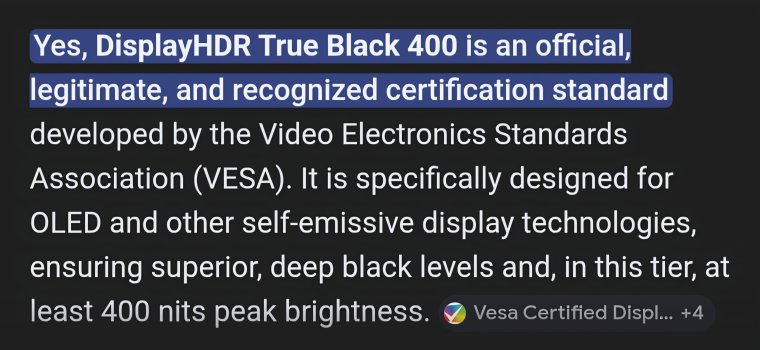
Is this rated under the True Black Standard?
No — VESA's “DisplayHDR True Black” is an OLED certification standard. It doesn’t apply here. I think marketing departments sometimes use True Black to refer to contrast ratios greater than about 1500:1, but as far as I know it's not an official standard.
 
Last edited:
This Studio Display XDR, and the Pro Display XDR that (kind of) preceded it, do they really get a lot of professional use? Seems like that is the intended use case with this pricing and features. But I feel like so many (especially Mac users on MR) would enjoy a nice 5K@120 display that isn't this intense of a price.
There are a lot of people in the market for a 5k or 6k display @120Hz, that costs roughly $1500 max.

Apple is on another planet with their display offerings.
 
I guess we'll find out when someone is able to give it a direct test, but I posted the specs taken right off Apple's site. Perhaps it'll work but won't be officially 'supported'.
I imagine that ”supported” means all functionality works.

So for example, if the camera or some future feature is dependent on the neural processing chip then they would rather say the fisplay is not supported rather then get complaints.

My guess anyway, because the video part should just be a question of connectivity standards and bandwidth.
 
Still doesn't support sufficient BT.2020. For a "Pro" display at this price point, and with such HDR capabilities, it makes no sense.
Maybe, but pure BT.2020 coverage is a massive technical hurdle for any high-brightness mini-LED, especially one running at 120Hz. Most 'Pro' HDR work today is still targeted at P3, where the XDR hits nearly 100%. If you need 95%+ of 2020, you're usually looking at $10k+ reference monitors, not a $3-4k desktop monitor.

Are you aware of similarly priced "pro" monitors that are hitting >95% BT.2020 for about the same price?
People interested in what Apple considers the competition should be looking at the EIZO ColorEdge CG2700X. That's a 16:9 4K 27" 500 nits 1450:1 contrast ratio with LED backlight that runs around $3,500. Similar coverage of BT.2020, a little over 80%. The older 31.1" ColorEdge CG319X is similar, at around $5,500.

One of the things you're paying for there is EIZO's trusted professional support software. There are decades of trust built up. Apple is trying to make inroads into that space, and it appears that they've learned some lessons from the Pro Display XDR.
 
  • Like
Reactions: neuropsychguy
No — VESA's “DisplayHDR True Black” is an OLED certification standard. It doesn’t apply here. I think marketing departments sometimes use True Black to refer to contrast ratios greater than about 1500:1, but as far as I know it's not an official standard.
It will only be official once Apple has it, right?
 

Attachments

  • Screenshot_20260310_191133_Chrome.jpg
    Screenshot_20260310_191133_Chrome.jpg
    621.3 KB · Views: 31
  • Love
Reactions: turbineseaplane
It will only be official once Apple has it, right?
I'm not sure what you mean -- the image you posted says exactly what I said -- "DisplayHDR True Black" is a standard for OLED. The Studio Display XDR is *not* OLED. There is a separate VESA standard for LCDs like the Studio Display(s), it's called "DisplayHDR" (without the “True Black” part) -- look it up:

 
Last edited:
I thought the "Full Calibration" function in the "Pro Display Calibrator" app already existed for the 32" Pro Display XDR? So this just adds the new 27" into the (2) supported hardware to be calibrated.
 
Interesting to hear about this. Surely they are excellent monitors. Think such capabilities will be enabled only in the not so near future.
 
  • Like
Reactions: mganu
The original Pro Display XDR was P3-native. While it worked with content encoded in BT.2020, it only covered about 60-70% of the BT.2020 space (I couldn't find the exact number quickly, but that was a rough estimate from the chart on this site: https://www.fxguide.com/fxfeatured/behind-apples-mac-pro-editing-grading-and-hdr/). The new Studio XDR, of course, still supports BT.2020 profiles and color-managed workflows but moves the BT.2020 space to beyond 80%, which is a significant hardware improvement over the previous version.

Also, while the ASUS/LG QD-OLEDs are great for the price, they are 4K versus 5K, which can matter to some some people. Also, OLEDs have what's called an Auto Brightness Limiter (https://huaxianjing.com/what-is-automatic-brightness-limiter-abl-in-oled-screens/). This means that if you open a white window, the whole screen dims to a brightness level much lower than the reported maximum. The Studio XDR can sustain 1,000 nits across the entire screen indefinitely (at least as far as anyone can tell at this point), which OLEDs physically cannot do. If you're doing professional level HDR work, you might not want to use an OLED screen as a primary display.

It sounds like you're not going to buy the new XDR screen. That's fine, but it's an improvement over the older one in every way other than being smaller and only 5K instead of 6K. If you'd rather buy an OLED screen, buy one instead.
Brightness isn’t as important in an OLED as it has near infinite contrast. Also, you wouldn’t want to look at a 2000nits screen for too long, it becomes uncomfortably bright.

But yes, I definitely won’t buy an XDR. I was looking to “upgrade” from my LG 32”OLED to an XDR, but with these specs and price, it makes no sense. And there will be more competing 5K and 6K screens coming onto the market this year that will be cheaper than the XDR. Apple will have to try again the next time around.
 
No — VESA's “DisplayHDR True Black” is an OLED certification standard. It doesn’t apply here. I think marketing departments sometimes use True Black to refer to contrast ratios greater than about 1500:1, but as far as I know it's not an official standard.
 
@abowlby -- I can't seem to reply to your post above (#48) -- sorry, I wasn't being clear. "True Black" can be used outside of the VESA specification, I thought perhaps that was what you were referring to. LG Display's "IPS Black" technology (the defining feature of which is a 2000:1 contrast ratio) is sometimes confused with True Black.

Regardless, the answer to your original question is still no, or just N/A.
 
Outdated hardware that still works and performs well for people and their current use cases? Doesn't the new Studio Display still use a panel that is 10 years old....?
You're missing the point. This was about the new features of the Studio Displays.
 
Register on MacRumors! This sidebar will go away, and you'll see fewer ads.