

Got a tip for us?
Let us know
Become a MacRumors Supporter for $50/year with no ads, ability to filter front page stories, and private forums.
The *complete* list of 6K / 32" monitors
- Thread starter displayator
- WikiPost WikiPost
- Start date
-
- Tags
- 6k display 6k retina monitor
- Sort by reaction score
You are using an out of date browser. It may not display this or other websites correctly.
You should upgrade or use an alternative browser.
You should upgrade or use an alternative browser.
- Status
- The first post of this thread is a WikiPost and can be edited by anyone with the appropiate permissions. Your edits will be public.

Measured AdobeRGB coverage of the LG UltraFine 6K (96 to >99%) is much higher as compared to the Dell U3224KB (90-92%).It’s probable there are small but meaningful improvements in the SS B1 (2025) panel over the SS A1 (2023) panel.
Mind you, that is totally lost on me since I only use the P3 colour gamut with my LG 6K.

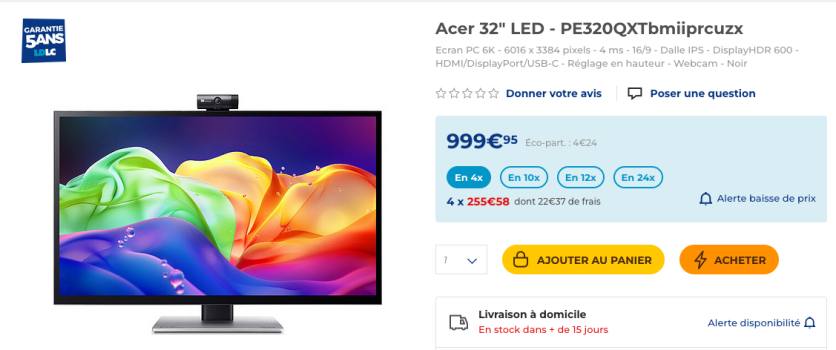
The acer PE320QXT got listed at french speciality retailers (Materiel.net and LDLC at least). No delivery date as of yet.
The Asus PA32QCV is also listed, but apparently at least one of the retailers got one batch in September, but no new stock since. I'm on the "email me if it comes back in stock" list.
The LG is available, but I find its port orientation stupid, and it's more expensive than the Asus.
Are there any review of the Acer PE320QXT ? All I can find are 3 videos from the time Computex anouncement.
The Asus PA32QCV is also listed, but apparently at least one of the retailers got one batch in September, but no new stock since. I'm on the "email me if it comes back in stock" list.
The LG is available, but I find its port orientation stupid, and it's more expensive than the Asus.
Are there any review of the Acer PE320QXT ? All I can find are 3 videos from the time Computex anouncement.
Attachments
Haven't seen this mentioned yet, but, Rtings did a review of the Asus ProArt 6K display:

 www.rtings.com
There's more positive than negative, but to me there's a deal-breaker, which is the overly-aggressive matte coating which apparently makes everything hazy/blurry.
The review says the display is still sharper than a 4K display, but if I'm going to pay four times as much for a 6K monitor, I want to be able to see all of those pixels clearly.
ASUS ProArt Display 6K PA32QCV Review
The ASUS ProArt Display 6k PA32QCV is a high-end 32-inch, 6k monitor geared towards content creators. It's the only 6k monitor in the ProArt Creator lineup, sitt...
www.rtings.com
There's more positive than negative, but to me there's a deal-breaker, which is the overly-aggressive matte coating which apparently makes everything hazy/blurry.
The review says the display is still sharper than a 4K display, but if I'm going to pay four times as much for a 6K monitor, I want to be able to see all of those pixels clearly.
All I know is one person in Canada got it and it works great at 6K with a Mac mini, so we know it's a legit Mac-compatible option, but I don't know if that monitor is running in 10-bit 4:4:4 or not, and I don't know the specific configuration of the Mac mini either. I also don't know how good their QA or warranty support are either.Did anyone here get one of those Tcoior monitors off Alibaba? $680 is extremely tempting...
However, if it were me and if I didn't already have the LG, I might have considered the Tcolor since it costs half of what the Kuycon costs, and doesn't rely on a remote control to change the settings. (The Tcolor has actual physical buttons.)

Any opinions on Samsung’s just-announced Odyssey G8 line of monitors? They are for gaming but I noticed that one model - the G8 G80HS - is a 32” IPS panel with 6K resolution running at 165 Hz.
Samsung PR news release - Odyssey G6 and G8 series gaming monitors
Samsung PR news release - Odyssey G6 and G8 series gaming monitors

This may be a rapid response to the preview of the ASUS ROG 5K 180Hz dual mode 165Hz/330Hz that went live last week. This Samsung dual mode 5K 180Hz/360Hz could be related to that “Fast IPS” panel. The fact this one has a 6K/3K cousin bodes well, assuming all of these make it into production.Any opinions on Samsung’s just-announced Odyssey G8 line of monitors? They are for gaming but I noticed that one model - the G8 G80HS - is a 32” IPS panel with 6K resolution running at 165 Hz.
Samsung PR news release - Odyssey G6 and G8 series gaming monitors
It will be interesting to see what choices Apple has made in this environment. Retina 5K and 6K ProMotion seem easily within reach, but true XDR backlighting still appears to be very expensive.
Last edited:
Any opinions on Samsung’s just-announced Odyssey G8 line of monitors? They are for gaming but I noticed that one model - the G8 G80HS - is a 32” IPS panel with 6K resolution running at 165 Hz.
Samsung PR news release - Odyssey G6 and G8 series gaming monitors
I copy pasted the table from that link you provided.
32" 6K models are
- G90XH
- G80HS
Ports of both appear to be only
- HDMI 2.1.
- DP 2.1
The 32" 4K G80SH appears to be the only one with USB-C 98W.
At those refresh rates I assume they're priced way higher than $1,299 ASUS PA32QCV & $1,999 LG 32U990A-S.
If Apple were to use the same panels as Samsung 32" 6K 165Hz displays then odds are we can see a significant up lift on the GPU performance for the next 6 years starting with the M5 Pro, Max & Ultra next year.
| Lineup | Size | Resolution | Panel | Refresh Rate | Dual Mode | Ports | Additional Features |
|---|---|---|---|---|---|---|---|
| Odyssey 3D (Model name : G90XH) | 32” | 6K (6,144 x 3,456) | IPS | 165Hz | 330Hz (Dual Mode 3K) | HDMI2.1. DP2.1 | Glasses-Free 3D, Eye Tracking, 2D→3D conversion |
| Odyssey G6 (Model name : G60H) | 27” | QHD (2,560 x 1,440) | IPS | 600Hz | 1,040Hz (Dual Mode HD) | HDMI2.1. DP 2.1 | FreeSync Premium Pro, G-Sync Compatible, HDR10+ Gaming |
| Odyssey G8 (Model name : G80HS) | 32” | 6K (6,144 x 3,456) | IPS | 165Hz | 330Hz (Dual Mode 3K) | HDMI2.1. DP2.1 | |
| Odyssey G8 (Model name : G80HF) | 27” | 5K (5,120 x 2,880) | IPS | 180Hz | 360Hz (Dual Mode QHD) | HDMI2.1. DP2.1 | |
| Odyssey OLED G8 (Model name : G80SH) | 32” | 4K (3,840 x 2,160) | QD-OLED | 240Hz | 240Hz | HDMI2.1. DP2.1 (UHBR20), USB-C(98W) | Glare Free, VESA DisplayHDR TrueBlack 500, HDR10+ Gaming |
Last edited:
Any opinions on Samsung’s just-announced Odyssey G8 line of monitors? They are for gaming but I noticed that one model - the G8 G80HS - is a 32” IPS panel with 6K resolution running at 165 Hz.
Samsung PR news release - Odyssey G6 and G8 series gaming monitors
Yes, all apart from one are IPS panels, it doesn’t state the backlighting, if it is edge lit, mini LED or just LED. But a lot of 5K and 6K screens which is great to see. I think the design is a bit bland apart from the 3D one.
Obviously everybody is just going to turn it off and never use it, but man, that glasses-free 3D technology sounds like a recipe for dizziness and motion sickness.Any opinions on Samsung’s just-announced Odyssey G8 line of monitors? They are for gaming but I noticed that one model - the G8 G80HS - is a 32” IPS panel with 6K resolution running at 165 Hz.
Samsung PR news release - Odyssey G6 and G8 series gaming monitors
The principle behind glasses-free 3D is quite old. I saw it at CeBIT 2006 or thereabouts. However, this process severely limits the effective resolution of the monitor because every few rows or columns of pixels have to be rendered from a different perspective to create the 3D effect. The higher the resolution of the display, the better, but 6K should be sufficient for a WQHD 3D image. So you definitely won't get 3D with 6K.Obviously everybody is just going to turn it off and never use it, but man, that glasses-free 3D technology sounds like a recipe for dizziness and motion sickness.
One thing that doesn’t seem to have made it (yet) is the 5K 120Hz OLED panel Samsung teased last year.Yes, all apart from one are IPS panels, it doesn’t state the backlighting, if it is edge lit, mini LED or just LED. But a lot of 5K and 6K screens which is great to see. I think the design is a bit bland apart from the 3D one.
Last edited:
You're thinking of displays with built-in parallax barriers or lenticular filters, which is not this.The principle behind glasses-free 3D is quite old. I saw it at CeBIT 2006 or thereabouts. However, this process severely limits the effective resolution of the monitor because every few rows or columns of pixels have to be rendered from a different perspective to create the 3D effect. The higher the resolution of the display, the better, but 6K should be sufficient for a WQHD 3D image. So you definitely won't get 3D with 6K.
This Samsung "technology" is apparently just head and eye tracking that displays a different image on the [regular] screen depending on where your head/eyes are.
Sounds vomit-inducing to me.
One thing that doesn’t seem to have made it (yet) is the 5K 120Hz OLED panel Samsung teased last year.
Yes, it does seem that OLED ate mainly stuck at 4K, or now even going backwards to 1440 for increased FPS. Tandem OLED 5K or 6K would be amazing to see, built in doubt ludicrously expensive.
No, that's not what I mean. Head and eye tracking will actually reduce the effective resolution because either the rows or the columns (depending on the technology) will have to be used for different perspectives per eye. That's why this type of 3D technology will only work for a single person in front of the display. This is acceptable for PC monitors, but less than ideal for TVs.You're thinking of displays with built-in parallax barriers or lenticular filters, which is not this.
This Samsung "technology" is apparently just head and eye tracking that displays a different image on the [regular] screen depending on where your head/eyes are.
Sounds vomit-inducing to me.
"Different perspectives per eye" is only a thing if there's a mechanical mechanism to ensure that each eye is seeing different sets of pixels. A mechanical mechanism like a parallax barrier or lenticular filter, like I mentioned in my previous post.No, that's not what I mean. Head and eye tracking will actually reduce the effective resolution because either the rows or the columns (depending on the technology) will have to be used for different perspectives per eye. That's why this type of 3D technology will only work for a single person in front of the display. This is acceptable for PC monitors, but less than ideal for TVs.
From the Samsung press release, there's no indication that this new monitor has either.
I am not talking about a mechanical mechanism because that's legacy technology!"Different perspectives per eye" is only a thing if there's a mechanical mechanism to ensure that each eye is seeing different sets of pixels. A mechanical mechanism like a parallax barrier or lenticular filter, like I mentioned in my previous post.
From the Samsung press release, there's no indication that this new monitor has either.
That is the Samsung solution:
How it works:
- A built-in camera continuously tracks the position of the viewer’s eyes in real time.
- The display dynamically adjusts the image output so that each eye receives a slightly different perspective.
- This creates a convincing depth effect without the need for glasses.
Advantages:
- Significantly improved depth perception
- Stable 3D effect even when the viewer moves
- Reduced ghosting and visual artifacts
- Higher cost due to sensors and processing requirements
- Increased computational load
- Typically optimized for a single viewer
Ergo:
The system knows exactly where your eyes are
• It renders only two perspectives, precisely for you
• No need to “waste” pixels on other viewing angles
This results in:
• Significantly higher effective resolution per eye (but not the native resolution of the Display)
• Less crosstalk
• Sharper image
Without a mechanical mechanism to ensure that each eye is seeing a different set of pixels, how would "each eye [receive] a slightly different perspective"?I am not talking about a mechanical mechanism because that's legacy technology!
...
- The display dynamically adjusts the image output so that each eye receives a slightly different perspective.
With the monitor that's in front of your face right now, i.e., one that doesn't have a special filter, aren't both your eyes seeing all the pixels?
Like, is it possible to display a black pixel on your screen that only your left eye can see but not your right eye?
The answer is no. And because the answer is no, there's no way an image can be displayed on your monitor in such a way that "each eye receives a slightly different perspective."
If there were a way to do this, then you could take a screen shot of such an image and post it and everybody who saw your post and looked at it from a certain angle would see a 3-D image, regardless of what monitor they were using to view your post.
But that's not a thing.
The stuff you saw at CEBIT back in 2006 was dependent on a special filter on the monitor that apparently you weren't aware of, but which is necessary for the technology to work.
If you have any questions about what I've posted here then please PM me because I already feel awkward about having derailed this thread.
You're stuck in the technological past. My tip: Read up on how this type of 3D visualization works. Then you'll understand what I've written better!Without a mechanical mechanism to ensure that each eye is seeing a different set of pixels, how would "each eye [receive] a slightly different perspective"?
With the monitor that's in front of your face right now, i.e., one that doesn't have a special filter, aren't both your eyes seeing all the pixels?
Like, is it possible to display a black pixel on your screen that only your left eye can see but not your right eye?
The answer is no. And because the answer is no, there's no way an image can be displayed on your monitor in such a way that "each eye receives a slightly different perspective."
If there were a way to do this, then you could take a screen shot of such an image and post it and everybody who saw your post and looked at it from a certain angle would see a 3-D image, regardless of what monitor they were using to view your post.
But that's not a thing.
The stuff you saw at CEBIT back in 2006 was dependent on a special filter on the monitor that apparently you weren't aware of, but which is necessary for the technology to work.
If you have any questions about what I've posted here then please PM me because I already feel awkward about having derailed this thread.
I PM'ed you about this but I don't know if you get notifications for those. Anyway, I'm happy to read up on how my understanding of this stuff is outdated and wrong. Can you give me a link or a search term I should be using to find what you're talking about? I can't exactly google "this type of 3D visualization."You're stuck in the technological past. My tip: Read up on how this type of 3D visualization works. Then you'll understand what I've written better!
How would the tariffs impact these Chinese models? Surely they get slammed?
That Tcoior looks too good to be true.
That Tcoior looks too good to be true.
There is at least one Mac user that is successfully using the Tcolor 6K but I don’t know the details of the Mac other than it is a Mac mini, and I don’t know the configuration details of the Tcolor monitor either.How would the tariffs impact these Chinese models? Surely they get slammed?
That Tcoior looks too good to be true.
Personally I think the Kuycon costs too much unless you absolutely need a glossy screen.
Few will willingly spend >$1.3k for 32" 6K.Tandem OLED 5K or 6K would be amazing to see, built in doubt ludicrously expensive.
Being PCMR is very expensive.
32” 6K tandem OLED would sell extremely well at $2000. However, such a beast wouldn’t be as low as $2000.Few will willingly spend >$1.3k for 32" 6K.
Register on MacRumors! This sidebar will go away, and you'll see fewer ads.