
Got a tip for us?
Let us know
Become a MacRumors Supporter for $50/year with no ads, ability to filter front page stories, and private forums.
Why Apple's Foldable iPhone May Be Smaller Than Expected
- Thread starter MacRumors
- Start date
- Sort by reaction score
You are using an out of date browser. It may not display this or other websites correctly.
You should upgrade or use an alternative browser.
You should upgrade or use an alternative browser.


I'm not sure what data you would be able to find that would corroborate the notion that Apple is "sinking" outside the United States, but I would love to take a look at it if you could link it!Apple just can’t match 7 generations of foldables on the 1st try. Wait 3 generations to have a semi mature product. Apple is sinking outside USA.

klasma
macrumors G4
That was my initial thought after the diagonals first leaked in spring. However, the resolutions leaked later indicate that the outer screen will be closer to 3:2 and not the same aspect ratio as the inner screen.My guess is the aspect ratio is going to be the square root of 2 (1 : 1.1414...). It's the same aspect ratio used on A4/A5 paper around the world. This aspect ratio allows for the two screens to have the exact same proportions/aspect ratios (the inside screen just needs to be turned 90 degrees sideways). This would allow whatever you are looking at on the front screen to keep those proportions and be unchanged when you open the phone.
Maybe it can still fit if the outer screen has a status line the inner screen doesn’t have, or something along those lines.
Considerably wider than a 17 pro max? That’s not going to sit well in a front jeans pocket. Maybe a back pocket, but it’s going to get bent.
It may not fit in a lot of cars’ built-in wireless charging trays either.
The 5-6 mm wider than the 17 Pro Max the rumours indicate will probably be fine for most people who are already fine with the Pro Max. For me the problem with the Pro Max has never been the width but rather the height, many pockets on dress pants seem to be quite shallow.
klasma
macrumors G4
For example, Apple limits the kinds of apps one is allowed to run on iPhones and iPads. They force specific UI themes like Liquid Glass. They limit the functionality you can bind to button presses. For example, you can’t use the action button for push-to-talk functions.That’s so untrue. Examples?

Arran
macrumors 603
Good point. I started checking the depth of pockets before I buy any kind of pants or shorts (17PM owner here)The 5-6 mm wider than the 17 Pro Max the rumours indicate will probably be fine for most people who are already fine with the Pro Max. For me the problem with the Pro Max has never been the width but rather the height, many pockets on dress pants seem to be quite shallow.

owlcreektech
macrumors newbie
I was able to get a refurbished Microsoft Surface Duo for $325 and I am glad I did. Loved the little book style and the dual or one large unfolded screen (still use it). They never added an external screen, but if true that this is what the iFoldable will be, I am all in. iPad mini will be the closest form factor to try it out.
Apple's first foldable iPhone, rumored for release next year, may turn out to be smaller than most people imagine, if a recent report is anything to go by. According to The Information, the outer display on the book-style device will measure just 5.3 inches – that's smaller than the 5.4-inch screen on the iPhone mini, a line Apple discontinued in 2022 due to poor sales. The report has led some people to wonder why Apple would settle on such a compact form factor.
Using The Information's reported dimensions, content creator Ben Geskin has shared some images and video of a printed version of the device (embedded below) that help envision what it could look and feel like in the hand. They also hint at Apple's design strategy, suggesting it is related to an unavoidable trade-off between the outer and inner displays of a book-style foldable.
A taller, phone-like outer screen generally leads to a more square inner panel once unfolded, which can be awkward for many types of content, like videos and two open windows in Split View. Conversely, a more rectangular inner display that better supports multi-window use inevitably forces the outer display to become wider or smaller, making it less comfortable to hold and less conventional in use.
Reports suggesting Apple has opted for a roughly 4:3 aspect ratio on the inner display strongly suggest Apple is favoring the latter approach. A 4:3 inner display would allow Apple to more easily transfer established multitasking features from iPadOS into a foldable form. Here the unfolded state becomes the main mode of use, prioritizing a lightweight, ultra-portable iPad experience over a stretched-out smartphone.
That said, the iPhone Fold in its closed state is likely to feel more like a smaller everyday phone than other foldables on the market. Compare the rumored 5.3-inch outer screen size with the Samsung Galaxy Z Fold 7, which has a 6.5-inch front display, or the Google Pixel Pro Fold, whose cover screen comes in at 6.3 inches. Indeed, the iPhone Fold's front display would be smaller than almost all current major foldables, suggesting Apple is deliberately diverging from the "outer screen as primary phone" philosophy.
When choosing size, Apple will of course have a very deliberate product strategy in mind. While Samsung and Google largely treat the cover display on their foldables as a full-time smartphone screen, Apple may see the device's folded state as a secondary experience, suited to notifications, quick replies, and other glanceable interactions, while reserving the main experience for when the device is unfolded.
However, software too has its limits. If users expect to browse, type extensively, or use third-party apps in the folded state, no amount of interface refinement will fully overcome a physically smaller canvas. That's what makes the comparison to the iPhone mini so notable – especially for a device expected to command a price premium of anywhere between $2,000 and $2,500, which would make it Apple's most expensive ever iPhone.
Ultimately, the rumored dimensions suggest Apple is betting on the value of the unfolded experience rather than the comfort of the folded one. The company seems willing to accept a smaller, less conventional outer display if it ensures the inner display can shine at the system and app level. If users come to think of the device not as a larger iPhone, but as an iPad that happens to fold into a pocket, the design trade-offs start to look far more intentional, and far more Apple-like.
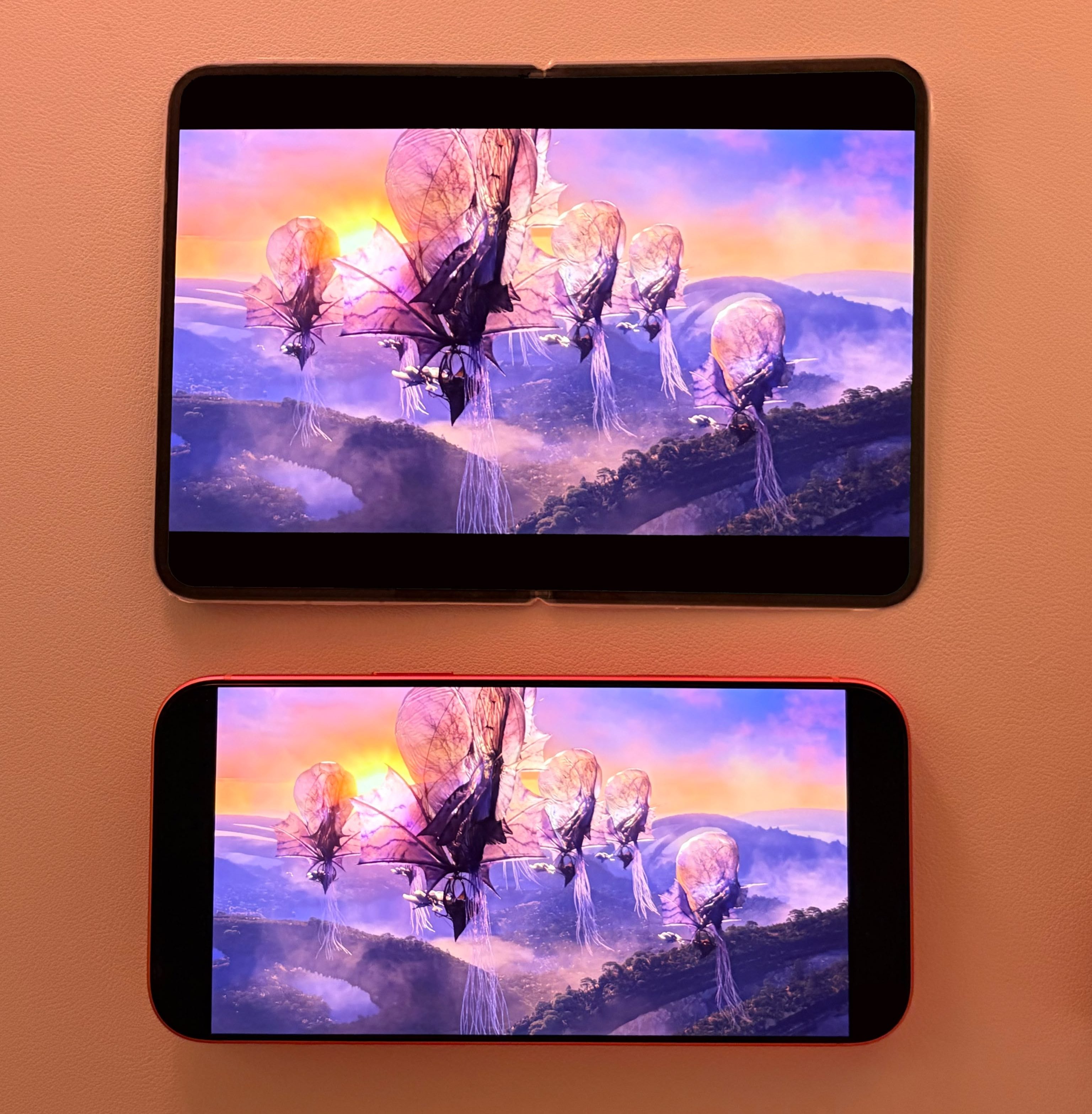
16:9 video playback on 7.7-inch display vs. 6.9-inch iPhone 17 Pro Max display (image credit: @BenGeskin).
What do you think of the alleged dimensions of Apple's rumored foldable iPhone? Let us know in the comments. The "iPhone Fold," which some are calling it, is expected to launch alongside the iPhone 18 Pro models in September 2026.
Article Link: Why Apple's Foldable iPhone May Be Smaller Than Expected

Apple's first foldable iPhone, rumored for release next year, may turn out to be smaller than most people imagine, if a recent report is anything to go by. According to The Information, the outer display on the book-style device will measure just 5.3 inches – that's smaller than the 5.4-inch screen on the iPhone mini, a line Apple discontinued in 2022 due to poor sales. The report has led some people to wonder why Apple would settle on such a compact form factor.
Using The Information's reported dimensions, content creator Ben Geskin has shared some images and video of a printed version of the device (embedded below) that help envision what it could look and feel like in the hand. They also hint at Apple's design strategy, suggesting it is related to an unavoidable trade-off between the outer and inner displays of a book-style foldable.
A taller, phone-like outer screen generally leads to a more square inner panel once unfolded, which can be awkward for many types of content, like videos and two open windows in Split View. Conversely, a more rectangular inner display that better supports multi-window use inevitably forces the outer display to become wider or smaller, making it less comfortable to hold and less conventional in use.
Reports suggesting Apple has opted for a roughly 4:3 aspect ratio on the inner display strongly suggest Apple is favoring the latter approach. A 4:3 inner display would allow Apple to more easily transfer established multitasking features from iPadOS into a foldable form. Here the unfolded state becomes the main mode of use, prioritizing a lightweight, ultra-portable iPad experience over a stretched-out smartphone.
That said, the iPhone Fold in its closed state is likely to feel more like a smaller everyday phone than other foldables on the market. Compare the rumored 5.3-inch outer screen size with the Samsung Galaxy Z Fold 7, which has a 6.5-inch front display, or the Google Pixel Pro Fold, whose cover screen comes in at 6.3 inches. Indeed, the iPhone Fold's front display would be smaller than almost all current major foldables, suggesting Apple is deliberately diverging from the "outer screen as primary phone" philosophy.
When choosing size, Apple will of course have a very deliberate product strategy in mind. While Samsung and Google largely treat the cover display on their foldables as a full-time smartphone screen, Apple may see the device's folded state as a secondary experience, suited to notifications, quick replies, and other glanceable interactions, while reserving the main experience for when the device is unfolded.
However, software too has its limits. If users expect to browse, type extensively, or use third-party apps in the folded state, no amount of interface refinement will fully overcome a physically smaller canvas. That's what makes the comparison to the iPhone mini so notable – especially for a device expected to command a price premium of anywhere between $2,000 and $2,500, which would make it Apple's most expensive ever iPhone.
Ultimately, the rumored dimensions suggest Apple is betting on the value of the unfolded experience rather than the comfort of the folded one. The company seems willing to accept a smaller, less conventional outer display if it ensures the inner display can shine at the system and app level. If users come to think of the device not as a larger iPhone, but as an iPad that happens to fold into a pocket, the design trade-offs start to look far more intentional, and far more Apple-like.
16:9 video playback on 7.7-inch display vs. 6.9-inch iPhone 17 Pro Max display (image credit: @BenGeskin).
What do you think of the alleged dimensions of Apple's rumored foldable iPhone? Let us know in the comments. The "iPhone Fold," which some are calling it, is expected to launch alongside the iPhone 18 Pro models in September 2026.
Article Link: Why Apple's Foldable iPhone May Be Smaller Than Expected
Surface Duo anyone? Loved mine it was great attached to ‘Gaming Lens Mount’ attached to a Sony DualSense . If this a similar aspect ratio with no visible crease and decent APU, it could be an awesome gaming (albeit expensive) handheld.
Apple's first foldable iPhone, rumored for release next year, may turn out to be smaller than most people imagine, if a recent report is anything to go by. According to The Information, the outer display on the book-style device will measure just 5.3 inches – that's smaller than the 5.4-inch screen on the iPhone mini, a line Apple discontinued in 2022 due to poor sales. The report has led some people to wonder why Apple would settle on such a compact form factor.
Using The Information's reported dimensions, content creator Ben Geskin has shared some images and video of a printed version of the device (embedded below) that help envision what it could look and feel like in the hand. They also hint at Apple's design strategy, suggesting it is related to an unavoidable trade-off between the outer and inner displays of a book-style foldable.
A taller, phone-like outer screen generally leads to a more square inner panel once unfolded, which can be awkward for many types of content, like videos and two open windows in Split View. Conversely, a more rectangular inner display that better supports multi-window use inevitably forces the outer display to become wider or smaller, making it less comfortable to hold and less conventional in use.
Reports suggesting Apple has opted for a roughly 4:3 aspect ratio on the inner display strongly suggest Apple is favoring the latter approach. A 4:3 inner display would allow Apple to more easily transfer established multitasking features from iPadOS into a foldable form. Here the unfolded state becomes the main mode of use, prioritizing a lightweight, ultra-portable iPad experience over a stretched-out smartphone.
That said, the iPhone Fold in its closed state is likely to feel more like a smaller everyday phone than other foldables on the market. Compare the rumored 5.3-inch outer screen size with the Samsung Galaxy Z Fold 7, which has a 6.5-inch front display, or the Google Pixel Pro Fold, whose cover screen comes in at 6.3 inches. Indeed, the iPhone Fold's front display would be smaller than almost all current major foldables, suggesting Apple is deliberately diverging from the "outer screen as primary phone" philosophy.
When choosing size, Apple will of course have a very deliberate product strategy in mind. While Samsung and Google largely treat the cover display on their foldables as a full-time smartphone screen, Apple may see the device's folded state as a secondary experience, suited to notifications, quick replies, and other glanceable interactions, while reserving the main experience for when the device is unfolded.
However, software too has its limits. If users expect to browse, type extensively, or use third-party apps in the folded state, no amount of interface refinement will fully overcome a physically smaller canvas. That's what makes the comparison to the iPhone mini so notable – especially for a device expected to command a price premium of anywhere between $2,000 and $2,500, which would make it Apple's most expensive ever iPhone.
Ultimately, the rumored dimensions suggest Apple is betting on the value of the unfolded experience rather than the comfort of the folded one. The company seems willing to accept a smaller, less conventional outer display if it ensures the inner display can shine at the system and app level. If users come to think of the device not as a larger iPhone, but as an iPad that happens to fold into a pocket, the design trade-offs start to look far more intentional, and far more Apple-like.
16:9 video playback on 7.7-inch display vs. 6.9-inch iPhone 17 Pro Max display (image credit: @BenGeskin).
What do you think of the alleged dimensions of Apple's rumored foldable iPhone? Let us know in the comments. The "iPhone Fold," which some are calling it, is expected to launch alongside the iPhone 18 Pro models in September 2026.
Article Link: Why Apple's Foldable iPhone May Be Smaller Than Expected
I have plenty of apps on my phone that aren't using an LG theme/design. Unless you are meaning the OS itself, in which case that's just kind of how operating systems have worked this whole time. You get what they ship, and if you don't like it you can use something else that will almost surely have things you don't like about it either lol. It makes sense to me that you wouldn't allow someone to use the action button for push-to-talk functions, because then the action button would be doing push-to-talk, and not whatever you programmed the button to do, unless you are meaning you just want to be able to do whatever you want in any conceivable way, in which case you should just build your own phone so it has exactly what you want it to have.For example, Apple limits the kinds of apps one is allowed to run on iPhones and iPads. They force specific UI themes like Liquid Glass. They limit the functionality you can bind to button presses. For example, you can’t use the action button for push-to-talk functions.

robertosh
macrumors 65816
Thanks for the pointer. In any case, even if the app is flexible (using all available space) does not mean that is doing a good use of the space.They've been laying the groundwork for this for years, so if apps aren't optimized by the time this thing launches, that will be squarely on the developer.
Those aren’t “physical” limitations. LOL. I’m NOT require to do anything in those case. I’d rather have startac form factor and screens.For example, Apple limits the kinds of apps one is allowed to run on iPhones and iPads. They force specific UI themes like Liquid Glass. They limit the functionality you can bind to button presses. For example, you can’t use the action button for push-to-talk functions.
Last edited:
klasma
macrumors G4
Everyone is different. For me the cutoff was between the iPhone 5 and 6. The 6 was just a tad bit too wide for me to be used comfortably one-handed. The mini barely works.I comfortably use my 16PM one handed, have rather average size hands, and am not nearly coordinated enough to play a sports ball. Could you be holding it wrong?
Comfortable means that you can hold the phone in your palm, with the finger tips firmly holding the opposite edge, while the thumb can reach all UI elements without having to loosen your grip.

klasma
macrumors G4
…or even just applying some basic thought on what the leaked measurements imply. What you would normally expect from tech journalists.It's really frustrating that there's no one on either of these sites looking at their own commenters and forums.

TSteffen
macrumors newbie
I guess I really don't know what I'm missing here. I was interested in a fold iPhone before, I am a man with not particularly large hands, so I can kinda use my iPhone pro max one handed if I don't mind risking the fumble. And I mostly fits in my pockets, awkwardly. And only has a fair amount of black space at the end of the screens when watching videos.
But now I can have more of all of that? Wow. That's super not amazing. 4:3 will be super great for watching re-runs of Mr. Ed in all its glory. Not really what I'm looking for TBH. I wanted easier to carry and use with one hand, and then fold out to a useful screen size. Not a weird pocket square.
I feel like I am missing that finer points of the design. Feel fee to point them out to me if you see my misunderstanding.
But now I can have more of all of that? Wow. That's super not amazing. 4:3 will be super great for watching re-runs of Mr. Ed in all its glory. Not really what I'm looking for TBH. I wanted easier to carry and use with one hand, and then fold out to a useful screen size. Not a weird pocket square.
I feel like I am missing that finer points of the design. Feel fee to point them out to me if you see my misunderstanding.

ConfusedChris
macrumors 6502
A6 sized, unfolding to A5, then A4.
“Introducing, the all new iSO216!”
It had better re-enable landscape mode Home screen.
“Introducing, the all new iSO216!”
It had better re-enable landscape mode Home screen.

ScanTheNavian
macrumors 6502
klasma
macrumors G4
The 16:9 iPhone SE (2022) is still a fully supported Apple device for 3-4 more years, and isn’t that far apart in terms of aspect ratio:This looks like it'll be a roughly 2:3 aspect ratio when closed, which a lot of apps might not be geared for.
And in terms of size, the iPhold outer screen would be larger in every dimension:

turbineseaplane
macrumors Penryn
Apple knows best, even when they don't.
This should be on a t-shirt

blairh
macrumors 604
Stop using your phone with one hand. It's much easier with two.I guess I really don't know what I'm missing here. I was interested in a fold iPhone before, I am a man with not particularly large hands, so I can kinda use my iPhone pro max one handed if I don't mind risking the fumble. And I mostly fits in my pockets, awkwardly. And only has a fair amount of black space at the end of the screens when watching videos.
But now I can have more of all of that? Wow. That's super not amazing. 4:3 will be super great for watching re-runs of Mr. Ed in all its glory. Not really what I'm looking for TBH. I wanted easier to carry and use with one hand, and then fold out to a useful screen size. Not a weird pocket square.
I feel like I am missing that finer points of the design. Feel fee to point them out to me if you see my misunderstanding.
4:3 will be ideal for video on this device.
The pocket fit will be just fine.


pdaholic
macrumors 68020
I appreciate the rumored numbers, but like I said in my post, that last photo in the article makes it look "hardly larger."Don’t know what you classify as “hardly larger” but based on the rumours 16:9 content will have a 54% larger display area on the Apple foldable than the 17 Pro Max and almost 14% larger than the Z Fold 7.
But these are all just rumors, so it doesn't really matter at this point.

macduke
macrumors G5
Dear MacRumors, do you read your own forum? Since May 2025 this has been pretty clear and iZac already made some amazing renders back then in this thread: https://forums.macrumors.com/threads/rumoured-iphone-fold-size-concept-drawing-and-renders.2456447/
View attachment 2590312
His renders have been going viral now and sites are even reporting them as leaked CAD files.
View attachment 2590311
Also other users have 3D printed models based of these months ago. So, you have your own forum full of information which is completely ignored, but when someone on X posts a paper printout based on this information it gets posted to the homepage. That's very difficult to understand...
I was thinking the same thing. But the writers here don’t really read the forums. I also designed some similar mockups even earlier of an iPhone that unfolds into an iPad mini, many years ago. Can’t remember if I posted them here or elsewhere, and I’m not even sure if I got around to actually doing it because it was pretty rough and I wanted to make a nicer 3D render but didn’t know how to use things like Blender back then. I mean, I think this was over 10 years ago? I remember working out the math for it all and it was very similar ratios to this, kinda like a BlackBerry aspect ratio. And I had this idea that you could possibly make the keyboard less tall if you had wider tap targets for each key. And you could skip the front facing camera on the outer display since it would have one inside, but I doubt they do that. Would make it look really clean, though. But the main reason I designed it that way was to make videos larger and to basically have it transform into iPadOS when open. And that seems like the direction things are headed. My argument for it was universal apps, and how the strength of Apple’s platform vs. Android was their tablet apps actually being designed for tablets instead of a lot of blown up phone apps and them being bundled as universal apps which would make it much easier to switch modes.
Lounge vibes 05
macrumors 603
Keep in mind that Apple has been working on dynamic app sizes for years.As older phones with smaller screen sizes drop off in usage, developers get more comfortable assuming a certain minimum display size, and roughly the same aspect ratio across them which seems to have settled to about 21:9. This looks like it'll be a roughly 2:3 aspect ratio when closed, which a lot of apps might not be geared for. Picture your typical Tiktok video on this thing, with either black bars on the sides or the top and bottom cropped off.
It’s partially what makes windowing on the iPad even possible.
To be honest, I don’t have a huge understanding of how it works because I’m not a developer, but my understanding is that it is nowhere near as difficult to optimize for a screen size as it was in 2012 or 2014.
But more to your point, if someone is watching video content and it’s not something they’re just giving a quick glance at, isn’t the entire point of the foldable that you can…open it up to a much bigger (and in the case of the Apple version) naturalcomfortable aspect ratio?
This does raise an interesting point though, if iOS 27 is really just adding support for foldable devices and cleaning up the bugs, could we see the folding iPhone introduced at WWDC?
This would allow developers to make dedicated apps for it over the summer beta test, and would also give WWDC26 more of a story than “They fixed bugs and ended Intel support, yeh.”

milkrocket
macrumors regular
turbineseaplane
macrumors Penryn
Too big. The Razr is what Apple should be looking to recreate.
I can’t even begin to describe how excited I would be if that were being rumored.