
Got a tip for us?
Let us know
Become a MacRumors Supporter for $50/year with no ads, ability to filter front page stories, and private forums.
Anyone Use a Cordless Nailgun?
- Thread starter Huntn
- Start date
- Sort by reaction score
You are using an out of date browser. It may not display this or other websites correctly.
You should upgrade or use an alternative browser.
You should upgrade or use an alternative browser.

For only pressurizing this unit two times I was amazed at how wet the air was when I purged the tank. And after it was empty, water dripped out. Thanks!
Just curious, how much did your kit cost? Mine was $220. It came with two guns, a 15 gauge finish nailer and an 18 gauge brad nailer. So far the guns work well. The compressor builds to 140psi, the manual says the guns need 70 psi to funtion, and I can shoot about 10 nails before it kicks back on. This Hitachi compressor has a turn purge valve, very easy to operate. My only concern would be that the parts of the gun that hold the nails appears to be made of plastic. I guess this might be an issue. How about the DeWalt guns?
I actually got it as a gift, sorry. I've only used the nailer once (I actually just wanted a compressor, but it was a Christmas deal with the kit, cheaper than the compressor alone). So I don't recall the cost. But yes, the nails are held on with a metal bracket. However, I don't think I'd be too worried about the plastic unless you were a contractor pushing thousands of nails day in and day out. The work is done up in front, the plastic just holds the nails.
As far as how it works? Well, I'm not an expert, but it did everything I asked it to do. I used it as a brad nailer for some trim, worked well along with an old long hose I've had for a while. Had the compressor in the garage and the hose draped across the house. It's nice to not have the headache of a noisy compressor. (Although, the dewalt compressor is surprisingly quiet, but it still makes noise!)
I'd love to have a garage compressor like the other poster mentioned. But man they don't come cheap!

mtbdudex
macrumors 68040
For the Paslode, where is the battery? The ones I've seen in the store, the battery is at the end of the handle.
Yep - in the handle, and it lasts all day long, never had it quit out on me.

designs216
macrumors 65816
I found that painful to watch. I don't know why but after watching this video it brought to mind, one of my favorite displays of using a nailgun in an unorthodox manner in The Island (Movie) when a nailgun was used to staple a bad guy's hand to door. Also found this interesting Movies Tagged With Nail Gun list. 🙂
Here we go. Here's my favorite nail-gun-in-movie clip.
BTW, have you considered renting this sort of seldom-used equipment?

Here we go. Here's my favorite nail-gun-in-movie clip.
BTW, have you considered renting this sort of seldom-used equipment?
Wait a minute, I remember that scene and now that I have a nail gun I have to ask was that a battery powered unit? And did he press it against the guys head prior to pulling the trigger? And where were his safety glasses? I still like The Island application better. 😛
I've not checked the cost of daily rental, but I assume it's in the range of $15-20 a day. I have a large project that involves many rooms and I'm just not that efficient. For my situation it's just easier to own the tool.
Last edited:
designs216
macrumors 65816
I've not checked the cost of daily rental, but I assume it's in the range of $15-20 a day. I have a large project that involves many rooms and I'm just not that efficient. For my situation it's just easier to own the tool.
Yeah, you're probably right. The gun will make the quarter-round easier, especially under counter overhangs and you'll have no cat-faces to patch. Good luck.

notjustjay
macrumors 603
I would consider renting larger air tools, like a framing nailer or a good quality flooring nailer, but a pin nailer is so inexpensive (and so handy!) that if you've got a compressor, you might as well own one.
And yeah, those movie clips are definitely missing something important...
And yeah, those movie clips are definitely missing something important...
I would consider renting larger air tools, like a framing nailer or a good quality flooring nailer, but a pin nailer is so inexpensive (and so handy!) that if you've got a compressor, you might as well own one.
And yeah, those movie clips are definitely missing something important...
It would be hard to go back... 🙂

Try this bad boy. You can put up panelling from the comfort of your easy chair.
View attachment 393126
Hah!
I was putting up some chipboard dividers in my attic today for beefing up my insulation (to keep the blown in stuff out of where I walk). I got some roofing nails for the job, could not easily get the nails to set in the board, hit my thumb on the first nail and then immediately went and got my nail gun. A below in headwork. 😛
Last edited:
Never mind, I found it: Power Source: air-powered
I'm liking my nail gun so much, I've been browsing around at framing nailers. I found this Stanley Bostitch U/F33PT Round Head 1-1/2-inch to 3-1/2-inch Framing Nailer on Amazon, but I don't see where it says what powers it? Would it be safe to assume pneumatic although it does not show a pneumatic connector? I know there are gas powered guns as in ignited gas, not pneumatic.
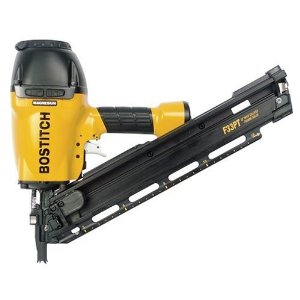
I'm liking my nail gun so much, I've been browsing around at framing nailers. I found this Stanley Bostitch U/F33PT Round Head 1-1/2-inch to 3-1/2-inch Framing Nailer on Amazon, but I don't see where it says what powers it? Would it be safe to assume pneumatic although it does not show a pneumatic connector? I know there are gas powered guns as in ignited gas, not pneumatic.
Last edited:
As an Amazon Associate, MacRumors earns a commission from qualifying purchases made through links in this post.
notjustjay
macrumors 603
It's got the same air fitting as every other nail gun, it's just hidden in that picture behind the black clip.
Slippery slope... ! 🙂
I would just caution you to be careful when using larger nailguns. They have the potential to ricochet or exit the wood in unexpected places (because nails can follow the grain of the wood). Once you start getting into the higher-powered nailguns, you also start to hear all the horror stories.
Keep both hands well clear of wherever you plan to fire the nail, use the safety features, don't "bump-fire", and take your time.
Slippery slope... ! 🙂
I would just caution you to be careful when using larger nailguns. They have the potential to ricochet or exit the wood in unexpected places (because nails can follow the grain of the wood). Once you start getting into the higher-powered nailguns, you also start to hear all the horror stories.
Keep both hands well clear of wherever you plan to fire the nail, use the safety features, don't "bump-fire", and take your time.
Last edited:
It's got the same air fitting as every other nail gun, it's just hidden in that picture behind the black clip.
Slippery slope... ! 🙂
I would just caution you to be careful when using larger nailguns. They have the potential to ricochet or exit the wood in unexpected places (because nails can follow the grain of the wood). Once you start getting into the higher-powered nailguns, you also start to hear all the horror stories.
Keep both hands well clear of wherever you plan to fire the nail, use the safety features, don't "bump-fire", and take your time.
I assume for framing, I'd want a round headed nail gun? Do the framing nail guns have a mechanism that requires they be pressed against the wood to fire? I assume they do.
Thanks!
Last edited:
notjustjay
macrumors 603
I assume for framing, I'd want a round headed nail gun? Do the framing nail guns have a mechanism that requires they be pressed against the wood to fire? I assume they do.
Thanks!
I couldn't tell you about the benefits or applications of round head vs clipped head, other than to say that the framing nailer I used was a clipped-head variety. Fun and fast, but like firing a real gun, you learn to respect its power and potential danger!
Most of these nailguns operate the same way, with a safety switch that must have pressure applied to it, and then the trigger. The safest way to operate the gun is in that exact order -- you position the gun where you want the nail to be inserted, press the gun down firmly on the surface to activate the safety, then pull the trigger to shoot the nail. Framing nailers work the same way.
However, most also have a "bump fire" mode which works the exact opposite way: you hold down the trigger, and then you repeatedly move the nailgun to where you want the nails to shoot, and every time the pressure switch is triggered, the gun shoots a nail. It's great for rapidly shooting a bunch of nails down an edge, every 12 inches for example. Just hold down the trigger and bounce the nailer down the line, bump-bump-bump.
The problem is, as you may discover when you use this mode, sometimes you accidentally double-bounce the gun off the surface (instead of "bump" it's more of a "bu-bump") and that will cause two nails to get shoot into almost exactly the same spot. Where will the second nail go? That's hard to predict; if you're lucky it will sink in parallel to the first one, but it might also bounce right off the first one and go flying, or it might crack the wood and start following the grain, bending along the way. You'll sometimes see that happen when you fire a nail and see that it exits the wood in a direction you didn't expect.
There is a similar risk if you are trying to shoot a nail, say, through a hole in a metal plate, and you miss the hole and send the nail right into the plate. It could bounce off and go flying.
The bigger framing nails are shot at higher power and can do much more damage if the errant nail ends up flying into your hand or worse, back up into your face. Also, the bigger nailers are heavier, increasing the risk that as your arm gets tired, you start positioning it less accurately.
That's why I would caution not to use bump-fire mode (at least at first); slow down, take your time, position the nailer exactly where you want it, take a moment to make sure your hands are clear, then fire away.
I couldn't tell you about the benefits or applications of round head vs clipped head, other than to say that the framing nailer I used was a clipped-head variety. Fun and fast, but like firing a real gun, you learn to respect its power and potential danger! ...
I read that some locals require round head nails for framing because they hold better? Thanks for all the other advice. I checked out framing nailers at the hardware store and holy smokes, they look like heavy brutes!

CrickettGrrrl
macrumors 6502a
Had to think of this thread a couple days ago when I used my old Porter-Cable finish nailer & pancake compressor on shoe moldings. 🙂 It's over 7 years old now I think, and split it with my brother who had it for the past 9 months. I unscrewed the little valve at the bottom of the compressor to release the moisture and found a little rust mixed in, thanks bro! So definitely don't get lazy about discharging the compressor if you want it to last. My brother also got a framing nailer to use --but I haven't used it, scary. I've used the pancake compressor with a paint gun too on large mural projects although not the most ideal type of compressor for that, but it really helped in a pinch.
Attachments

mtbdudex
macrumors 68040
Those framing guns that shoot 3 1/2 " nails can be deadly.
Back when I was framing my basement walls I was toeing some nails in mid wall height with my dad holding on other end....so stupid on my part 1 nail instead of going into the stud went flying just past my dad.
I'd never forgive myself if something happened, lesson learned for me and shared for others, always be aware.
Back when I was framing my basement walls I was toeing some nails in mid wall height with my dad holding on other end....so stupid on my part 1 nail instead of going into the stud went flying just past my dad.
I'd never forgive myself if something happened, lesson learned for me and shared for others, always be aware.
Trust me on this. I buy sell and use Nail Guns all the time mostly pneumatic but also battery at times and I know Ryobi's are not the greatest at times but go get yourself a Ryobi airstrike 18 gauge Battery nailgun....anout 150$ Right now for last year's model. A great deal and the gun works great. You do not need a 15 gauge nailer or even 16. And a 23 will almost certainly be too small. So, an 18 gauge is perfect when you shoot your nails try to shoot your nails at an angle so they make little X's as you go across the wood if that makes sense ........let say you tip the gun to the right so that the nail shoots in angling to your left and then you reverse right next to it so you make a little "x" with the nails.....then move down by the foot and do it again. At the end of the wood turn the gun so is parallel with the wood so you wont split it .... The x style is not necessary but is helpful as it holds better
Welcome to the MacRumor forums! I assume you are referencing using an 18 gauge for trim work not framing?Trust me on this. I buy sell and use Nail Guns all the time mostly pneumatic but also battery at times and I know Ryobi's are not the greatest at times but go get yourself a Ryobi airstrike 18 gauge Battery nailgun....anout 150$ Right now for last year's model. A great deal and the gun works great. You do not need a 15 gauge nailer or even 16. And a 23 will almost certainly be too small. So, an 18 gauge is perfect when you shoot your nails try to shoot your nails at an angle so they make little X's as you go across the wood if that makes sense ........let say you tip the gun to the right so that the nail shoots in angling to your left and then you reverse right next to it so you make a little "x" with the nails.....then move down by the foot and do it again. At the end of the wood turn the gun so is parallel with the wood so you wont split it .... The x style is not necessary but is helpful as it holds better
millerj123
macrumors 68030
So, we should ask how your kit held up over the past 5 years, is it still in use?Welcome to the MacRumor forums! I assume you are referencing using an 18 gauge for trim work not framing?
Yes it is. I still love it. 🙂 I’ll be using it on the bathroom project. In my previous post I asked the question, because I don’t believe a 15 gauge nailer would suffice for framing, the nails are not heavy enough.So, we should ask how your kit held up over the past 5 years, is it still in use?
There is a place around the tub area that has to be built up. It’s not a lot, but I’ve elected to use wood screws there. I’ll post some pics in this thread: https://forums.macrumors.com/threads/bathroom-remodel-feb-2018.2107947/
i avoid battery tools as much as possible. Just buying corded tools or pneumatic. Own a craigslist Porter-Cable finish pancake compressor. actually use the compressor a lot.
-the batteries them selves will change technology or dimensions and you have to toss a perfectly good tool because the battery became obsolete super expensive. Change battery tech and you have to update the charger too
-i just do the maintenance thingy, so every 9mo i pull the battery device out and it is totally needing a complete charge. where i can immediately use a corded device.
ya wood screws are the way to go.
nail gun safety; you guys watch too much TV...
-the batteries them selves will change technology or dimensions and you have to toss a perfectly good tool because the battery became obsolete super expensive. Change battery tech and you have to update the charger too
-i just do the maintenance thingy, so every 9mo i pull the battery device out and it is totally needing a complete charge. where i can immediately use a corded device.
ya wood screws are the way to go.
nail gun safety; you guys watch too much TV...
Last edited:


Mousse
macrumors 601
As long as you get the 34° DA-style nails that most 15 gauge nail guns use then you'll be fine. There is the FN-style nails that only Bostitch (and probably Makita) uses as far as I know.Actually Hitachi does have branded nails, but thanks for the info! I'll check it out once I get the nailgun.
I'm helping my brother with a sun room addition to my house and brought a Hitachi 15 gauge nail gun off Amazon for $119. Gotta put in the owner sweat equity to reduced the $$$ spent.

rhett7660
macrumors G5
I have a Dewalt, similar version to this one if not this one, with an air compressor that I bought at a local store on sale. It has been one of my favorite purchases. It is a finishing nail gun that I use for all my baseboard, crown molding, and the other little projects. I didn't need a large one for actual framing, so this one fit the bill. You can get it on sale usually for under a $100 which is what I did and have been using it for the past three years without an issue.
Glad to hear it worked out. The Hitachi setup should last you for years to come. You have what a lot of pros have found to be a great combo - 15 for baseboard and heavier trim elements, and 18 for quarter round and thinner stock.
Wood screws are great for smaller framing jobs. I’ve found deck screws to be worth the extra expense, as the heads tend to strip out less frequently, and the heads don’t pop off as readily.
Also, you had expressed some concern over the plastic parts on the guns. Did they ever give you any trouble? I’d expect not, but just curious.
Wood screws are great for smaller framing jobs. I’ve found deck screws to be worth the extra expense, as the heads tend to strip out less frequently, and the heads don’t pop off as readily.
Also, you had expressed some concern over the plastic parts on the guns. Did they ever give you any trouble? I’d expect not, but just curious.