
Got a tip for us?
Let us know
Become a MacRumors Supporter for $50/year with no ads, ability to filter front page stories, and private forums.
Apple Drops Windows 7 Boot Camp Support in New Mac Pro
- Thread starter MacRumors
- Start date
- Sort by reaction score
You are using an out of date browser. It may not display this or other websites correctly.
You should upgrade or use an alternative browser.
You should upgrade or use an alternative browser.
not when it comes to apple's pro strategy. youre asking them to support a scenario (Windows 7, non-virtualized) that doesnt fit a wide use case. that some of you are gamers and simply want it doesnt mean bo-diddly, because thats not the use case the MP is marketed for.
by "you" I hope you don't me mean. I'm not a gamer. I don't have a new Mac Pro nor am I in the market for one. But I do think that those affected have a right to complain if they want to. Even if they are a small minority. Being inconvenienced it being inconvenienced. If only YOU were affect by some change in the OS, would you not voice your opinion? I think you would. I don't think you'd speak in hyperbole. But I'd bet (as would I) that you would speak up.
Hurting/benefiting whom? Apple or consumers? Do you have enough information to offer an intelligent opinion?
Desupport of windows 7 is only applicable (for now) to late 2013 Mac Pros. So yeah, of the 35 who want to buy a new Mac Pro, they no longer have the option to boot into windows 7 though I suppose parallels and vmware would still be an option. But considering only 12 of those people care about windows 7...
You want me to offer you an intelligent opinion and yet throw me a "fact" out of thin air. Ok.

mdelvecchio
macrumors 68040
We're a software house that does major banking and financial institution backends.
we have moved to VM's for some things where the overhead doesn't impact. We're not an SQL house. We use Progress software, which runs in a very different manner. its extremely IO intensive and absolutely takes a hit via virtualization. For example, these database system tend to run a lot of system code directly connected to the databases shared memory and can be extremely RAM and CPU intensive.
ive updated my orig post to remove "SQL" and replace w/ "data". i work for a household-name energy company and we have an immense amount of time-series data, but as ive posted on another reply this data lives in our servers (not somebody's MP). these servers are virtualized running atop blade servers...yes you may lose some performance in VM over standard, but the fact that you can hot-swap failed drives or throw more hardware resources at a bottlenecked server eliminates that shortcoming.
What I'm just trying to say is that it's not simple, especially in a Professional environment, that this workstation is aiming ftowards to jsut throw a blanket statement like "just vitualize it". that is NOT always the suitable solution.
fair, but the discussion you & i are having (server farms) is slightly different than the one here (MP not supporting Win7 natively). nobody is dependent on a MP workstation running in bootcamp to maintain their org's backend data structure....

KdParker
macrumors 601
Even as a Windows fan, I wouldn't use Windows 8 if they paid me. It's a shame that Apple's dropping Windows 7 now, as this likely means future MacBooks won't support it either.
I use windows all the time and don't mind Windows 8. Not sure why there is so much hatred for it.
yup. its faster and snappier than windows 7. there is literally not a single reason to choose win 7 over win 8.
Aside the user interface; lack of basic functionality. Invasive GUI; perverse Desktop experience?
There are multiple reasons why you should NOT use Windows 8 & once more; the rest of the planet agree.
Windows 8 is going down in the history books as another ME, Vista Microsoft release. 9 will see the return of traditional desktop computing.

Michael Goff
Suspended
I think the issue is that windows 8 adds basically zero redeeming features while being buggier and more of a resource hog than windows 7.
Buggier and more of a resource hog? Is that why there are fewer crashes on Windows 8 and it uses fewer resources idling?
Game performance? http://www.hardocp.com/article/2013/11/24/battlefield_4_windows_7_vs_81_performance_review/5
Other tests: http://www.techspot.com/review/561-windows8-vs-windows7/page2.html
Idling:
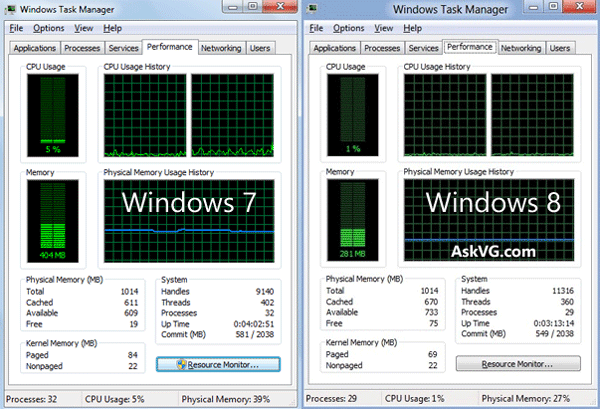
Stability:

----------
Aside the user interface; lack of basic functionality. Invasive GUI; perverse Desktop experience?
There are multiple reasons why you should NOT use Windows 8 & once more; the rest of the planet agree.
Windows 8 is going down in the history books as another ME, Vista Microsoft release. 9 will see the return of traditional desktop computing.
You can use the desktop the same in 8 as in 7, it can be done. You can set it up to where hitting the "Super" key just pulls up an app list that you can search through.
Also, if you think Microsoft is dumping the Metro UI? I have bridge to sell you.
Edit: Also... what functionality is missing? How is the GUI invasive?
Edit 2: Traditional computer sales have been down year by year, even before Windows 8 was being beta tested by people.

dumastudetto
macrumors 603
Is anyone still using Windows? Like seriously?
Everyone I know is either using mobile devices like an iPhone or iPad, Retina MacBooks, with a few iMacs thrown into the mix. Literally everyone I know who were Windows users has given up on that platform. Windows 8 was the final straw for a lot of people.
Everyone I know is either using mobile devices like an iPhone or iPad, Retina MacBooks, with a few iMacs thrown into the mix. Literally everyone I know who were Windows users has given up on that platform. Windows 8 was the final straw for a lot of people.
mdelvecchio
macrumors 68040
But I do think that those affected have a right to complain if they want to. Even if they are a small minority. Being inconvenienced it being inconvenienced.
i have my doubts that the usual whiners here are actual nMP owners that are financially harmed by their workstation's inability to load win7 natively. and since this is a pro workstation, that's the market apple is steering for...which determines what they spend their money on supporting or not supporting. that some people on a rumor site dont like it or wish they could play games in win7 instead of 8 just doesnt factor into their decision-making.
also -- hate to burst any bubbles, but being vocal on a rumors site isnt going to change the cource of *any* unsatisfactory decision from apple.

9 will see the return of traditional desktop computing.
When Vista was the most recent Windows operating system people like you said that 7 was going to be some sort of an XP second edition. 🙄

pubwvj
macrumors 68000
Ugh. What a bad decision. Windows 7 is bad enough but Windows 8 is far worse. Apple should simply allow legacy support and boot all past CPM, DOS, Windows, MacClassic, MacOSX, iOS operating systems or better yet roll the wrapper on programs so that all programs will work under MaciOS, the new unified BorgMac operating system that runs on all Mac hardware. Then we would have true legacy access to all our data backwards and forwards.

AppleScruff1
macrumors G4
Is anyone still using Windows? Like seriously?
Everyone I know is either using mobile devices like an iPhone or iPad, Retina MacBooks, with a few iMacs thrown into the mix. Literally everyone I know who were Windows users has given up on that platform. Windows 8 was the final straw for a lot of people.
That's odd, over 350 million Windows pc's were sold last year, and that was a bad year. I wonder which version of Windows most of them had? 🙄

LordVic
Cancelled
ive updated my orig post to remove "SQL" and replace w/ "data". i work for a household-name energy company and we have an immense amount of time-series data, but as ive posted on another reply this data lives in our servers (not somebody's MP). these servers are virtualized running atop blade servers...yes you may lose some performance in VM over standard, but the fact that you can hot-swap failed drives or throw more hardware resources at a bottlenecked server eliminates that shortcoming.
fair, but the discussion you & i are having (server farms) is slightly different than the one here (MP not supporting Win7 natively). nobody is dependent on a MP workstation running in bootcamp to maintain their org's backend data structure....
i know, we're mostly talking thoereticals now. But to me, If i choose that the best practice for me is to run on barebones for testing purposes, it irks me when i get hardware home, that the hardware vendor puts arbirtrary blocks on what I can or cannot do on that hardware.
this mentality of mine applies everywhere. I buy a phone for example, that hardware, if it supports running something should not be limited to onyl one OS for example because the person making the hardware for their own profit purposes demanded that I only run their OS.
The Mac pro is essentially a fancy SFF computer, that has amazing hardware potential. Don't tell me that my win7 testing now must be crippled in performance because Apple arbitrarily decided it doesn't want me running Windows 7.
I would never use a Mac pro for a server. I know that. I hope most people know that. But I would LOVE a Mac pro for my workstation test platform. Unfortunately Openedge doesn't support OSx. It is Windows or *nix only. A lot of my testing is trying to figure out the best configuration settings for the servers, as well as often doing CPU and IO intensive testing activities.
Removing Windows 7 bootcamp from Mac Pro has been the last nail in the coffin for me for my Mac Pro plan. I preffer OSx in many aspects to windows for my personal use. But, I recognise that my professional use still requires Windows 7. this limitation has put the Pro completely out of the question.
Many corporations we deal with have gone the Virtualization route. Many do it well and dont have a lot of issues with the overhead, And some have. I just finished an upgrade project for a very large overseas institution who decided that for 2014, they would ditch the server infrastructure they had before and move to an entirely virtualized setup. even with 5 year newer hardware, after claiming to us "we know what we're doing, we have several million dollars worth of equipment and expertise working on it"... we found there was a 20-30% performance degradation over their previous setup.
then I just finished another implementation that was so small that a single core Xeon was more than sufficient for their transactional needs.
I guess the whole point i'm trying to say is that there's no "right" answer. but hardware vendor imposing limitations on the software side of things is never better for the consumer because it limits their options and capabilities. in this case, in what is supposed to be a workstation computer, cutting windows 7 out, which is still the primary Enterprise platform, is bad and really doesn't help Apple move more Mac Pro's out the door. Somewhere, some accountant probably decided that keeping staff working on supporting Win7 wasn't profitable anymore compared to the volume of sales and they just decided to nix it instead. there's nothing WRONG with that. just expect the sales to adjust accordingly.
p.s. iThis chain of conversation is actually quite good and I've enjoyed it. A welcome break from the Typical Mac Rumours "Reality distortion field" that occurs.
Last edited:

baryon
macrumors 601
Well that sucks, so long Windows then I guess! It's not like Microsoft is ever going to make a decent version of Windows anymore anyway, so Win 7 will become obsolete soon and there will be nothing to replace it. I assume Windows 9 won't be like Windows 7.
We use Windows 8 at work on our server and good lord! It's unusable. The constant switching between Metro and Windows is unbearable, many things can only be accessed by searching for it and the whole thing just sucks, from the UI to the bundled utilities and apps. It's a convoluted mess of menus and more menus in menus that lead you in circles and wizards with obscure names that make you feel like you're trying to run the Large Hadron Collider. Want to add a user? Guess what, Control Panel > Administrative Tools > Active Directory Users and Computers. Holy Baby Jesus on a Stick! If you figure that out without Google...
We use Windows 8 at work on our server and good lord! It's unusable. The constant switching between Metro and Windows is unbearable, many things can only be accessed by searching for it and the whole thing just sucks, from the UI to the bundled utilities and apps. It's a convoluted mess of menus and more menus in menus that lead you in circles and wizards with obscure names that make you feel like you're trying to run the Large Hadron Collider. Want to add a user? Guess what, Control Panel > Administrative Tools > Active Directory Users and Computers. Holy Baby Jesus on a Stick! If you figure that out without Google...
I use windows all the time and don't mind Windows 8. Not sure why there is so much hatred for it.
It's bandwagon. You have to hate it, if you don't, you are not cool.
Is anyone still using Windows? Like seriously?
Everyone I know is either using mobile devices like an iPhone or iPad, Retina MacBooks, with a few iMacs thrown into the mix. Literally everyone I know who were Windows users has given up on that platform. Windows 8 was the final straw for a lot of people.
You need to get out more. Like seriously.
Windows 8 has more market share than all OS X versions combined.

ArtOfWarfare
macrumors G3
Even as a Windows fan, I wouldn't use Windows 8 if they paid me. It's a shame that Apple's dropping Windows 7 now, as this likely means future MacBooks won't support it either.
Are you someone that has actually spent a considerable amount of time with OS X and Windows 8 and chose Windows 7 over both, or are you just someone who mostly has spent time in Windows 95 - 7 and have determined Windows 7 was the best of them?
I'm just curious what people see in it - I rarely find anyone who has actually spent time with OS X (or any *nix) and decided that Windows was better.
Michael Goff
Suspended
Is anyone still using Windows? Like seriously?
Everyone I know is either using mobile devices like an iPhone or iPad, Retina MacBooks, with a few iMacs thrown into the mix. Literally everyone I know who were Windows users has given up on that platform. Windows 8 was the final straw for a lot of people.
Over a billion people use Windows. :|
ArtOfWarfare
macrumors G3
Is anyone still using Windows? Like seriously?
Everyone I know is either using mobile devices like an iPhone or iPad, Retina MacBooks, with a few iMacs thrown into the mix. Literally everyone I know who were Windows users has given up on that platform. Windows 8 was the final straw for a lot of people.
Yes. You should try to get out a bit more. Big corporations and governments still use Windows. Lots of old people use Windows. Some young people still use Windows.
Michael Goff
Suspended
Are you someone that has actually spent a considerable amount of time with OS X and Windows 8 and chose Windows 7 over both, or are you just someone who mostly has spent time in Windows 95 - 7 and have determined Windows 7 was the best of them?
I'm just curious what people see in it - I rarely find anyone who has actually spent time with OS X (or any *nix) and decided that Windows was better.
Windows 8 is faster and more efficient than OS X these days. Wasn't always the case. Also, gaming is generally better on Windows (likely due to DirectX being more optimized than OpenGL). Programs on both systems, on average, tend to get better support (and more bugfixes) on the Windows side.

gnasher729
Suspended
Care to explain Apple? Seriously people don't drop $3,000+ on computers so you can weed out the features you're too lazy to support. This pisses me off.
Shouldn't you be ten times more pissed off with Microsoft for creating a new operating system that is so bad that you are pissed off with Apple for not supporting the previous version?
Who even has room for a Boot Camp partition on their SSD anyway? A VMware image is way more compact.
Usually, people consider their requirements, then they determine the system/configuration they need.
If they need a 1tb hard drive to boot from, then you need a 1 tb drive. If the only system options are SSD, well, you get a 1 tb SSD drive to go with your mac.
Picking your solution before you figure out your requirements is a pretty good way to find yourself with insufficient resources.

FakeWozniak
macrumors 6502
I expect it is part of some licensing agreement between Apple and Microsoft. Surely someone is going to post the instructions for installing Windows 7. I expect VMWare or Parallels will still support it.
Michael Goff
Suspended
I expect it is part of some licensing agreement between Apple and Microsoft. Surely someone is going to post the instructions for installing Windows 7. I expect VMWare or Parallels will still support it.
Why are people saying this?
A sale of Windows 7 is still money for Microsoft. They likely couldn't care less if you bootcamp into Windows 8 or 7. :|
willcapellaro
macrumors 6502
For all 3 people out there who will buy this exotic mac in order to run windows exclusively: sorry, you have to run the latest version.
Yeah but is that support going to be pulled at some point?
Besides the people who can afford them for personal computing, the big market is companies that will deploy these in numbers. IT Managers will want to know how much hassle/risk it will be to have some Windows presence.
I've worked at one place where everyone got a PC with a software profile, but the design department got Mac Pros with that PC software profile as a VM. We had to use the VM for the office suite. Supposedly it was cheaper that way.
Anyways, to that IT department, how that VM was deployed was critical. Pure VM versus bootable Partition that can be run through a VM would be a consideration...
Personal studio computer owners like me don't want to have the rug pulled out from us on things that are usually a given. With Apple nothing is a given I guess.