Become a MacRumors Supporter for $50/year with no ads, ability to filter front page stories, and private forums.
Anyone with more than half a brain cell knew, before this even premiered, that Tim rushed this out the door to try and cement his “legacy.” Well, it cemented his legacy alright; as a man who’ll charge exorbitant amounts of money for half-baked products. Meanwhile, software bugs continue to go unfixed, and now we have to live with the bastard progeny of these space goggles’ design language on all our devices.

Color me unimpressed. Like so many executives and politicians, they inherit a good thing, don’t understand why it worked, and proceed to **** all over it, ruining things for nearly everyone else.

Disgusting.
 
It needs to be at a much lower price point to be successful. Also availability should expand. It is still not available in my country.
 
I have yet to see one outside of an Apple Store.
I have yet to see the one at my Apple Store even used. I just keep seeing that black box on the table next to it and hope it is a Keurig machine only to be disappointed every time.

1c037a8e-6409-487d-8add-cd99952e0bf3.jpg
 
This device revolutionized my level of physical activity, even amidst the challenges I faced in my personal life. I am deeply grateful for this device, as it has significantly contributed to my overall health and well-being. I eagerly anticipate the evolution of this product with the introduction of an enhanced digital assistant. While I appreciate the improvements, I believe that the form factor and price point could be further refined to better meet the needs of users.
 
  • Like
Reactions: anticipate


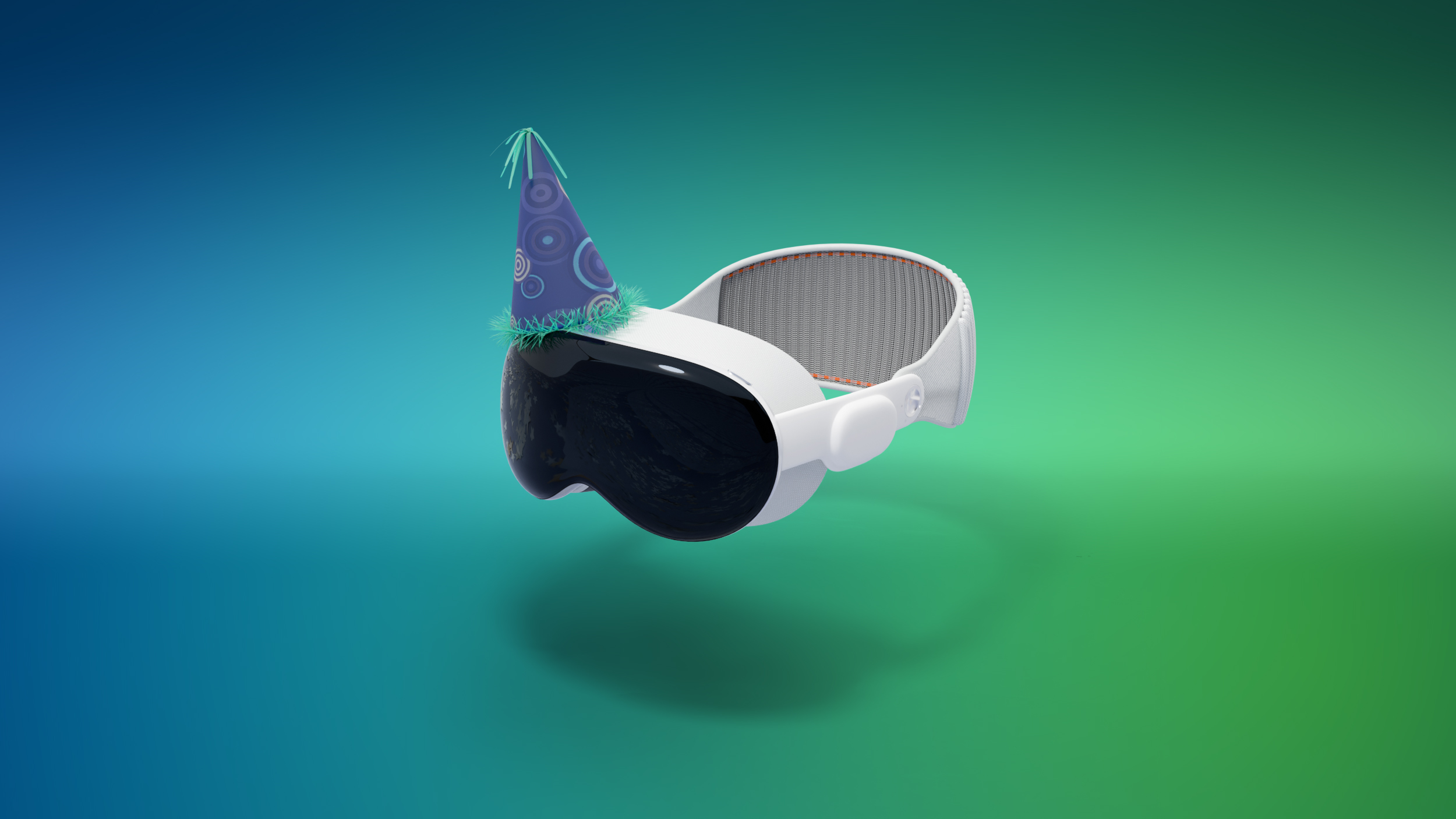
Apple's original Vision Pro spatial computing headset launched two years ago today.

Apple-Vision-Pro-Turns-One-Feature.jpg

Apple's work on a head-mounted device was the subject of rumors for many years before the Vision Pro's announcement. By the early 2020s, those reports had converged around the idea that Apple was preparing a high-end mixed-reality headset positioned as a new form of general-purpose computer.

Apple finally revealed the Apple Vision Pro in June 2023 during its annual Worldwide Developers Conference (WWDC), marking the company's first major new hardware platform announcement since the Apple Watch. In its initial announcement, Apple described Vision Pro as its first "spatial computer," introducing visionOS, a new operating system designed around three-dimensional app windows controlled by eye tracking, hand gestures, and voice input. The device combined dual micro-OLED displays with a total of roughly 23 million pixels, advanced sensor arrays, and custom silicon, including the M2 chip and a dedicated R1 chip for real-time sensor processing. Apple also announced a starting price of $3,499 in the United States and said the product would launch in early 2024.

The Vision Pro launched in the United States on February 2, 2024. Initial reviews broadly praised the visual quality, eye- and hand-tracking accuracy, and technical ambition of the product, while also noting its high price, physical weight, limited battery life, and a comparatively small library of software designed specifically for spatial computing. Following the launch, Apple gradually expanded Vision Pro availability to additional countries and continued to update visionOS with new features in 2024 and 2025.

The headset was never expected to be mass-market from day one, according to Apple. Even so, enthusiasm reportedly cooled far faster than anticipated. The latest report on the matter was published earlier this month by the Financial Times, claiming that the Vision Pro is still failing to catch on.

Roughly a year and a half after the initial release, Apple introduced an updated Vision Pro model featuring the M5 chip, representing the first hardware revision of the device. The M5 chip enabled 10% more rendered pixels, a refresh rate of up to 120Hz, better responsiveness, and up to an extra hour of battery life. Apple also introduced a counterweighted Dual Knit Band designed to improve comfort.

Reports suggest that there are now no Apple Vision headsets in active development, with the company's focus pivoting decisively to smart glasses. Soon after launch, Apple was believed to have shifted focus to a lower-cost "Vision Air," designed to bring spatial computing to a wider audience through a lighter and cheaper headset, while also planning a redesigned Vision Pro 2 for later in the decade.

By mid-2024, that plan appeared to change and the company's once-ambitious multi-year roadmap for the Vision Pro is said to have unraveled. A report from The Information said Apple had suspended development of the redesigned Vision Pro, redirecting resources toward the cheaper model, which itself later slipped amid cost and design challenges.

Supply-chain reports suggested Apple was winding down production of the first-generation Vision Pro due to weak demand and excess inventory, with the company pivoting to a chip refresh to use up stockpiled components. A year later, Bloomberg reported that Apple also paused work on the lower-cost headset, shifting its focus toward smart glasses, potentially leaving no next-generation headset hardware in active development.

Article Link: Apple Vision Pro Launched Two Years Ago Today

Apple Vision Flop
I guess none of you naysayers have used this to watch movies. Its replaced theaters for me, it’s superior and it’s the very best accessory for long flights. Expensive yes, but it’s been well worth it for me.
 
No, it isn't. From a gaming standpoint yes the Meta Quest is much better. But for everything else, the Vision Pro is miles ahead of the Quest, and its not really close and I say that as someone who's owned both.
This, in a nutshell, summarizes the main problem the AVP has: the lack of a viable use case. As a niche product, for development, training and, possibly, certain medical uses, it could be successful, as those sectors can pay the price for the capabilities. That would, of course, remove it from the consumer market, which seems to be Apple's target these days.

As a gaming device, it's completely overpriced. No matter the quality, few gamers are going to spend $3000+ for a game machine, certainly not enough to make it a profitable segment for Apple.

The same applies as a media consumption device, where it runs into an additional obstacle: it is a single user device. Had VisionOS come out on day one with the ability to create separate user accounts and allow it to be shared within a family, it may have had a [small] chance of catching on. Even then, how many people want to keep their media consumption a single user experience (apart from VR porn)?

Ultimately, the AVP is a wearable device, and wearable devices are, by their nature, optimized for use by one person. Wearable devices won't sell in quantity at a price point over $1000 unless they provide extraordinary value (should the day come that the Apple Watch can be a noninvasive blood glucose monitor, they could pretty much name their price). I suspect [hope] that the AVP is a technology proof of concept, whose technologies will be incorporated in the Apple Glasses product.

For those who think the product is a total waste of Apple resources, remember the Newton.
 
The AVP is not for everyone; for those who keep trashing it, have you used it extensively, or have you ever used it? For me, the AVP is a game-changer. I use it to play games, watch movies, hold meetings, collaborate with others virtually, watch shows and movies with other people from around the world, I joined a book club and meet virtually, and use it on the go and in complete privacy. Use it to make PowerPoint presentations and so many other things. You get out is it what you put into it, open your mind, the possibilities are unlimited.
 
This, in a nutshell, summarizes the main problem the AVP has: the lack of a viable use case. As a niche product, for development, training and, possibly, certain medical uses, it could be successful, as those sectors can pay the price for the capabilities. That would, of course, remove it from the consumer market, which seems to be Apple's target these days.

As a gaming device, it's completely overpriced. No matter the quality, few gamers are going to spend $3000+ for a game machine, certainly not enough to make it a profitable segment for Apple.

The same applies as a media consumption device, where it runs into an additional obstacle: it is a single user device. Had VisionOS come out on day one with the ability to create separate user accounts and allow it to be shared within a family, it may have had a [small] chance of catching on. Even then, how many people want to keep their media consumption a single user experience (apart from VR porn)?

Ultimately, the AVP is a wearable device, and wearable devices are, by their nature, optimized for use by one person. Wearable devices won't sell in quantity at a price point over $1000 unless they provide extraordinary value (should the day come that the Apple Watch can be a noninvasive blood glucose monitor, they could pretty much name their price). I suspect [hope] that the AVP is a technology proof of concept, whose technologies will be incorporated in the Apple Glasses product.

For those who think the product is a total waste of Apple resources, remember the Newton.
It's the perfect device to develop for the Apple Glasses that dont exist. Except for a major issue - no one knows when or if the Apple Glasses will exist, so why bother developing for it..... this is my quandary at least. No way am I wasting that amount of time and money on pure vapourware.
The usual lack of transparency from Apple vs their competition is going to hurt them in this area I feel. I know what Google and Meta are doing, but we have no idea what Apple is doing.

I was about to pull the trigger the other week, and have decided against it. This was cemented by Apples inability to demonstrate [despite 3 separate attempts] the virtual display, within their flagship store. This tells you everything you need to know.
 
  • Like
Reactions: triptolemus
The Vision Pro is in effect a prototype of a future glasses-based AR OS that is the closest you can get using modern technology. Talking about it as a standalone product is fair, since Apple is selling it as one, but any kind of broad analysis of VisionOS or the idea of spatial computing isn't meaningful if you act like this is the end-state of the technology--I am absolutely certain that if Apple didn't intend VisionOS to eventually run on AR glasses, the product never would have gotten out the door. Somewhat uncharacteristically they decided to build what they could and actually ship it to start to get something into the world 5-10 years before the technology is really there.

It's not a great analogy, but it's a little like looking at the Apple I. The Apple I was a bare circuit board that didn't even come with a case, cost a little under $4000 in modern terms, and was unusable to anyone outside hardcore hobbyists, but it was a functioning computer in an era where those didn't exist for home users.

I have a 2nd generation, and can say two things about it:

From the perspective of "this is a developer/bleeding-edge adopter prototype of a future AR OS that will be in a pair of glasses":

It's definitely early tech, but it is impressively polished for what it is, is trying very hard to be an actually useful tool if you have a use for what it does, and when it gets stuff right it really does feel kind of like magic. The experience of looking at a thing, pinching your fingers together, and dragging that thing around your room with just your bare hands and eyes is the sci-fi future I was promised as a child. And it does a mind-bogglingly good job of locking objects in physical space regardless of how much you move around--I genuinely can't figure out how it does some of that. I can also wear it without getting motion sickness, which I can't say for any VR headset I've ever used before.

What I can't say is whether there's actually a future in a future spatial OS. I suspect so, once it's built into your glasses, but only as a sort of auxiliary computer. I can imagine a future where we all use spatial OS glasses instead of cell phones all the time--I guess that means a future staring blankly into space in front of us instead of at our hands--but we shall see.

From the perspective of a device I own today:

I do use mine. Mostly for work, but there have been more than one occasion where I stood up from my laptop with 2nd monitor and put the Vision Pro on because it could do what I needed better than the traditional devices. It isn't perfect at those tasks--I want a wider field of view and better resolution, in particular--but the ability to have a screen effectively as large as I could possibly want, and/or more windows arranged around me than is physically possible with all but the most bonkers monitor setup is a real-world actual use today.

Worth $3500? Not to the vast majority of people, but as a pro who sometimes needs huge amounts of screen real estate for work, travels, and works from cramped remote offices with some regularity, there is currently no other technology on the market that can do what it does, period. Admittedly, I'm most frequently using it as a display, not a computer, but it's still a thing it's useful for.
 
A year after launching, the iPhone and the iPad were redesigned on their 2nd generation. It's not a good sign when a big new standalone product that uses a different big OS doesn't get the same treatment, even after 2 years.
 
The concept is great, but the tech is not quite there yet. It needs to be much, much smaller and cheaper to be ubiquitous.
 
What's annoying is many of us said this from the start and were ruthlessly warned, suspended, and otherwise rudely handled for daring to question the ascension of what has turned out to be the worst flash in the pan since the iPod HiFi.

Overengineered, overpriced, niche market, low sales in this sector to begin with, and all other headsets are basically cheap bargain bins to get any sort of sale.

Meta Quest 3 is boring.

Vision Pro would be amazing if people bought it or devs found a way to make money on it. Yet again, capitalism proves itself with market dictating success over group desires or agendas.

Mine sits in a closet collecting dust for the random rainy Saturday when I boot it up to watch a movie on the moon or a mountain. Such a shame. The thing is truly special and incredible. But all the apps are "Make a Widget!"

And it's difficult to drink with it on, much less smoke a cigarette. The camera is just slightly high so you end up missing your mouth. Changes the routing for drinking anything.

From a tech standpoint, 9/10 product. From a long term use standpoint, 2/10. Sharing it is impossible, the Guest feature barely functioned for me. Plus I smoke so many people didn't like the smell.

And battery life just murdered it. My Twitch stream thought it was really cool I was playing a game on my Vision Pro with my Mac as the desktop on it using a mouse and keyboard.

But for the price, I can get a monitor.
 
  • Like
  • Love
Reactions: jlnr and cateye
For what use cases though?

As a giant screen for movies/game streaming/my PC it does a fine job with native apps for most things. Resolution is as sharp as my eyes can see and 360 content looks great. Passthrough Res is as high as I need.

I have cool work apps that let me physically walk through a 1:1 Architectural model with other users who also have the headset with everything synced between us.

And it has Tetris Effect which by itself almost justifies the entire existence of VR platforms.

Vision Pro is better at being a giant pin-sharp display for a Mac but I struggle to think of much else it's genuinely better at or that at the very least justifies the increased cost.

For every use case outside of gaming the Vision Pro crushes the Meta Quest. It's really not even close. Yeah a lot of it is for media consumption but it has real world work applications that are awesome. it's far from perfect but saying the Quest is 95% as good as it is a massive stretch. I'd say, again outside of gaming, the quest is 50% as good as the Vision Pro.

But a lot of people just want these for gaming so the Quest is always going to win because it's so much less expensive and has a massive head start in gaming over the VP.
 
The Vision Pro, taken solely as a media consumption device, is really beyond incredible. It really is something to behold. My friend let me watch about an hour of the F1 movie on it recently and it is an experience that few could imagine. It’s literally like you are there in the movie as the movie encompasses your entire vision.

The problem is the price. It’s just too expensive to be used as a television. Especially when you can get an 4k OLED 77 inch TV for almost half the price in some cases.

I still think for people who value the videophile niche and of course can stomach the price it can be a truly extraordinary experience
I paid $2000 for my 65" oled and I've barely touched it since buying the vision
 
  • Like
Reactions: anticipate
Man, I really do love my face computer. And I think I use it a lot more than most people do (uh, that doesn't say much?). It makes me so sad that, well, by and large, I think the idea of "this portends something much bigger, greater from AAPL...this is just the dev platform and early adopter discovery tool" is, at best, on ice. I mean, I can't say I disagree, as AAPL appears to be stumbling over itself uncontrollably just trying to release an AI or Siri that is even remotely modern/useful....so it's the right call to not rush to those things if the table stakes/core is eroding, it's just sad...I love my AVP, and will continue using it, but two years on, it's really sad that it hasn't grown in any meaningful way or had a perceptable indirect effect even.
 
Register on MacRumors! This sidebar will go away, and you'll see fewer ads.