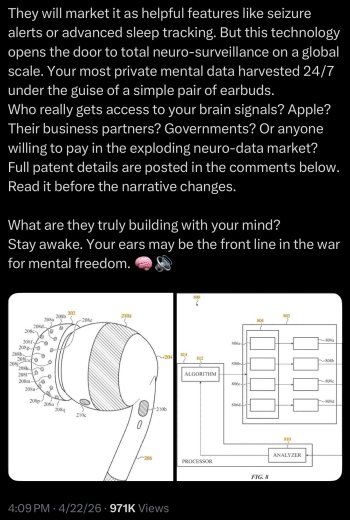
Sensors on different Apple Headphones + features:
∙ Accelerometer (motion/head movement)
∙ Gyroscope (head orientation/rotation)
∙ Dual beamforming microphones (inward + outward facing)
∙ Skin-detect sensors (wear detection, replaces IR in Pro 2)
∙ Barometric vent sensor (pressure equalization)
What they actively transmit to iPhone:
∙ Head orientation, rotation rate, acceleration (real-time)
∙ Wearing state (in/out of ear, which ear)
∙ Ambient sound decibel levels (continuous)
∙ Acoustic seal quality (fit detection)
∙ Microphone audio (calls, Siri, ANC processing)
- - -
What Apple infers from that data:
∙ Steps and gait patterns
∙ Cumulative loud sound exposure / hearing risk
∙ Full audiogram (hearing threshold per frequency per ear)
∙ Hearing loss classification and progression over time
∙ Respiratory rate (research-confirmed, not yet a user-facing feature)
∙ Heavy breathing / exertion state (same)
∙ Breathing patterns from speech audio (same)
What the data reveals beyond the obvious:
∙ Biological age trajectory
∙ Vascular health indicators (via hearing pattern)
∙ Neurological integrity
∙ Lifetime noise exposure history
∙ Asymmetric conditions (one ear worse than the other can flag lesions or circulatory issues)
That’s just surface information with 5 minutes of research. 🧐
∙ Accelerometer (motion/head movement)
∙ Gyroscope (head orientation/rotation)
∙ Dual beamforming microphones (inward + outward facing)
∙ Skin-detect sensors (wear detection, replaces IR in Pro 2)
∙ Barometric vent sensor (pressure equalization)
What they actively transmit to iPhone:
∙ Head orientation, rotation rate, acceleration (real-time)
∙ Wearing state (in/out of ear, which ear)
∙ Ambient sound decibel levels (continuous)
∙ Acoustic seal quality (fit detection)
∙ Microphone audio (calls, Siri, ANC processing)
- - -
What Apple infers from that data:
∙ Steps and gait patterns
∙ Cumulative loud sound exposure / hearing risk
∙ Full audiogram (hearing threshold per frequency per ear)
∙ Hearing loss classification and progression over time
∙ Respiratory rate (research-confirmed, not yet a user-facing feature)
∙ Heavy breathing / exertion state (same)
∙ Breathing patterns from speech audio (same)
What the data reveals beyond the obvious:
∙ Biological age trajectory
∙ Vascular health indicators (via hearing pattern)
∙ Neurological integrity
∙ Lifetime noise exposure history
∙ Asymmetric conditions (one ear worse than the other can flag lesions or circulatory issues)
That’s just surface information with 5 minutes of research. 🧐