Slightly disappointed with this article. When I saw the title, I was expecting to see the comparison of each generation, from M1 "to" M5. What I really saw was M1 "and" M5.


Got a tip for us?
Let us know
Become a MacRumors Supporter for $50/year with no ads, ability to filter front page stories, and private forums.
Five Years of Apple Silicon: M1 to M5 Performance Comparison
- Thread starter MacRumors
- Start date
- Sort by reaction score
You are using an out of date browser. It may not display this or other websites correctly.
You should upgrade or use an alternative browser.
You should upgrade or use an alternative browser.

Apple has proven to overcome challenges several times, so I'd have no doubt that they would have found a way to exist if Apple silicon didn't exist. Lots of advances in competing platforms, or were those advances in response to Apple's own efforts with silicon? One must wonder...
Yeah perhaps, but it's the foundation to EVERYTHING they make today other than services. It's not just a differentiator, it makes their products undeniably better than everything else on the market until everyone catches up a year later.
I honestly doubt Apple would be relevant today much less a Mag Seven company. Apple Silicon gives them a true moat, for devices and everything they make. Which is why I think it is foolish when people regurgitate the "Apple is behind in AI" nonsense. No one is behind in Ai, the race has not even begun. And it's like Apple have their own Nvidia in their back pocket, because today's LLM's are just beta software in the DOS, or basic stages of development, and with the open source nature of LLMs today, anyone, such as Deep Seek in China or anyone who really wants to have jump right in, they can. Nvidia doesn't need an LLM to be the biggest player in AI, likewise with Apple Silicon, when the race eventually begins, Apple can absolutely be a major player in AI, and that's thanks to Apple Silicon.
Soooo M5 is 2X-2.5X from M1. NOT 6X….
The iPad Pro 12.9 M1 512 is the single best piece of hardware I’ve ever bought in my entire life. It’s worth its weight in rare earth minerals tenfold. I will sell a kidney to buy a new one! Metaphorically…
iPadOS is still SEVERELY lacking, especially in file handling. And cloud "stuff" has just started to work somewhat properly (if you use others than iCloud, which is just extremely slow at everything).
The only thing is that it was equipped with too little memory from the get go and a 2x would probably have made it feel snappier on some ofte heavier software. But I haven’t really noticed it until recently..so that might be poorer optimisation.
I got mine replaced on warranty because of dead spots on the screen. What I think I’ll do is sell this one privately and get a Pro 13 1TB, JUST for the RAM. And the weight savings. Mostly weight savings actually.
What I have noticed though is that local storage on the iPad isn’t as important on the iPad as the iPhone. I’d actually rather have a 256 iPad and a 1TB iPhone. BUT RAM is way more important on the iPad than iPhone.
The iPad Pro 12.9 M1 512 is the single best piece of hardware I’ve ever bought in my entire life. It’s worth its weight in rare earth minerals tenfold. I will sell a kidney to buy a new one! Metaphorically…
iPadOS is still SEVERELY lacking, especially in file handling. And cloud "stuff" has just started to work somewhat properly (if you use others than iCloud, which is just extremely slow at everything).
The only thing is that it was equipped with too little memory from the get go and a 2x would probably have made it feel snappier on some ofte heavier software. But I haven’t really noticed it until recently..so that might be poorer optimisation.
I got mine replaced on warranty because of dead spots on the screen. What I think I’ll do is sell this one privately and get a Pro 13 1TB, JUST for the RAM. And the weight savings. Mostly weight savings actually.
What I have noticed though is that local storage on the iPad isn’t as important on the iPad as the iPhone. I’d actually rather have a 256 iPad and a 1TB iPhone. BUT RAM is way more important on the iPad than iPhone.

Indeed same here with the M5 iPad Unless there something I can’t live without on the next iPad I probably wait tell the M7 or M9 to upgrade the M5 is pointed at people that don’t have or thinking on getting there 1st iPad but if the M1 still work great for you then I probably hold out tell the M7 or M9 iPad Pro buy that time people with the M1 and M2 iPads will be in for a big upgradeMy M1 MBP is still running great. I'm really struggling to find a reason to upgrade.
- 6× faster CPU/GPU performance——>
- M1 single-core - 2,320
- M5 single-core - 4,263
- ——> if I do the math that’s just the double speed and not six times faster!!! right???
Still happy with my M1 Mac Mini. Capable of running macOS26 means security updates till 2028, which is a good moment to get a M6 Mac Mini.

The other option is using lab grown diamonds.It's already happening. Graphene.

Superfast diamond-laced computer chips now much closer to reality thanks to 'quantum breakthrough'
Scientists have vastly reduced the temperatures and conditions needed to grow special diamonds for computing, making faster and more efficient computing chips a more realistic proposition.
It’s still carbon like graphene, just a different arrangement of the carbon atoms.
It looks like carbon may be the next element after silicon.
M1 laptop was severely overengineered and overpowered. I had a 2020 intel MPB, got an M1 for a new job. It was super quiet, didn't get hot when running youtube in chrome and i only had to charge it twice during a 5 day work trip abroad. When I got home, by 10 month old £2,200 MPB felt like an agricultural tractor.🤣 6 months later i replaced the intel one with a 13 inch MBP with 512GB storage and 16GB RAM.
Today I run a tech startup using the very same M1 laptop. I also create youtube videos for a hobby and it does so very well. Editign videos off a Samsung T7 SSD feels as fast as using an internal machine. What a machine!! I have never done a fresh reinstall, yet it's still as fast and snappy as it was when new. Battery life is still awesome too!🥰

Today I run a tech startup using the very same M1 laptop. I also create youtube videos for a hobby and it does so very well. Editign videos off a Samsung T7 SSD feels as fast as using an internal machine. What a machine!! I have never done a fresh reinstall, yet it's still as fast and snappy as it was when new. Battery life is still awesome too!🥰

Same, I use it for Blender and some rendering sometimes but it works beautifully. It was an upgrade to my maxed out 2013 Macbook Pro and I can honestly see it lasting longer, its most likely lack of updates in a few more years that will kill it, I can't quite see how opencore team will be able to continue their good work.M1 Max is still over kill
"6x CPU/GPU performance" yet the benchmarks show 2x. Ugh. The only thing I hate more than exaggeration is exaggeration when it's not necessary. 😐 That 2x is still 15% improvement a year, with single-thread performance included in that, something that was pretty hard to come by for a long time before M1.
You can see the true performance improvement in the "2.1x code compiling". Everything else is software optimization.
You can see the true performance improvement in the "2.1x code compiling". Everything else is software optimization.
Intel Macs are noisy, run hot and have poor battery life.Does anybody need faster than an Intel Mac?

Similar here (although with 1Tb storage). Can’t see any reason to upgrade anytime soon. My 3rd generation iPad Air will be next for an upgrade and/or AirPod Pro 1s.The (base) M1 MBA is amazing. The M5's numbers are impressive, but aside from "using" the CPU and GPU I don't do any of the other things listed. That's why I'm typing this from my (base) M1 MBA with no plans to upgrade. (I can wait till the MBA gets an OLED display. 🤤 )
… and probably heavier.Intel Macs are noisy, run hot and have poor battery life.
Of course, but you have a point. Perhaps your question would have been better phrased as “Do most users need faster than an Intel Mac”? I recently got my wife a used 2015 15-inch MBP, put in a new battery and it’s more than sufficient for any of her requirements.Does anybody need faster than an Intel Mac?
My 2020 MBA (8/512/8-core) is my daily workhorse and still serves me well. Other than day-to-day admin, my main uses are home studio recording in GarageBand and Logic Pro, and occasional light video editing in FCP. An M5 replacement would be nice but I really don’t need it. Same for my 2021 5th Gen iPad Pro 12.9.
Does anybody need faster than an Intel Mac?
For my work the biggest issue was the energy usage of the intels in the Mac form factor:
- Super loud jet engine noise while working
- Scorching hot, not comfortable when using in lap and damaging furniture
- Battery wouldn’t last half a workday
Overall made me really dislike the devices I bought, despite being new.
The speed improvement was also welcome. Removed waiting and ”mind wandering sessions” while compiling code. Now I just iterate and see the changes live.
Slightly disappointed with this article. When I saw the title, I was expecting to see the comparison of each generation, from M1 "to" M5. What I really saw was M1 "and" M5.

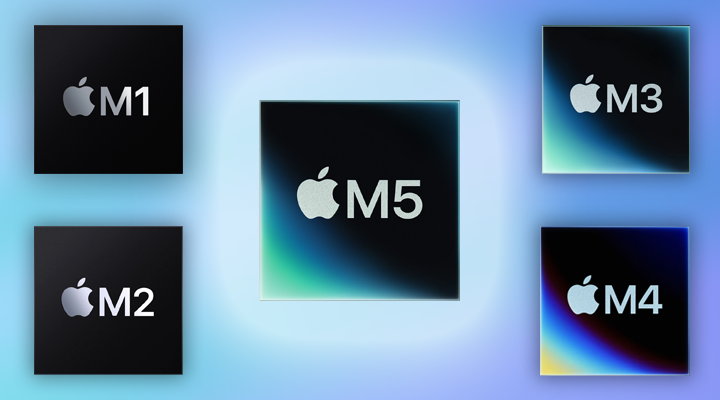
M1 vs M2 vs M3 vs M4 vs M5 - Low End Mac
With the release of the new M5 MacBook Pro and iPad Pro on October 22nd, we’re 5 generations into the Apple Silicon lineup, marking half a decade since Apple Silicon became available for consumers. . . . Although the new chip was announced quietly, it’s hard to remain silent about something – it...
 lowendmac.com


Still use an M1 Pro MBP every day, only issue I have is an aged battery.
How long did you have that for?
M1 Pro still works incredibly well. No stuttering or issues for office work, zooms, and some occasional game.

Apple Silicon was the best thing to ever happen to the Mac.
Today marks the fifth anniversary of the Apple silicon chip that replaced Intel chips in Apple's Mac lineup. The first Apple silicon chip, the M1, was unveiled on November 10, 2020. The M1 debuted in the MacBook Air, Mac mini, and 13-inch MacBook Pro.
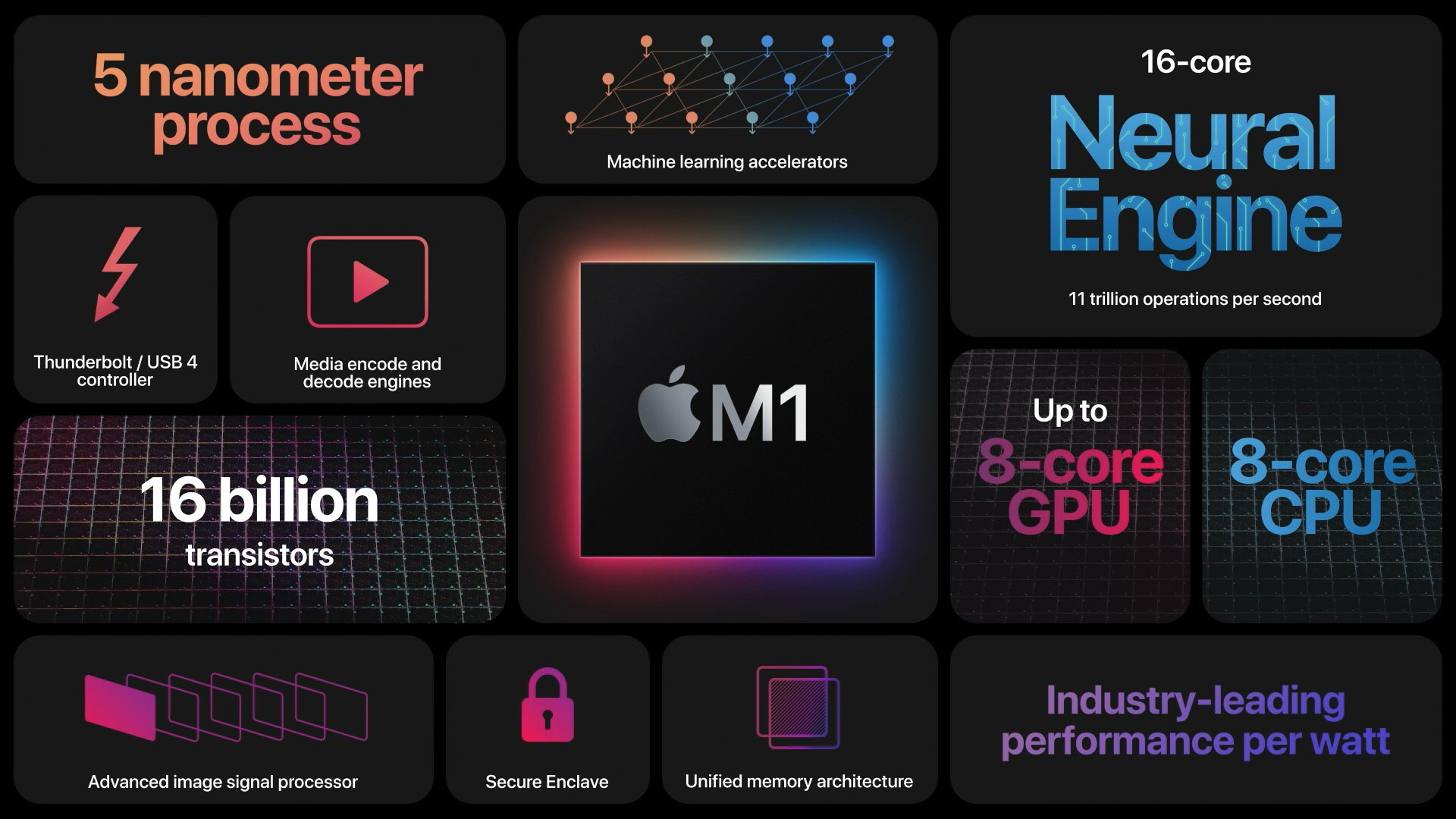
The M1 chip was impressive when it launched, featuring the "world's fastest CPU core" and industry-leading performance per watt, and it's only improved since then. We've had five total generations of Apple silicon chips, with the M5 unveiled in the 14-inch MacBook Pro just last month.
Here's how the M5 measures up to the M1, per Apple's M5 specs:
Geekbench comparison scores:
- 6× faster CPU/GPU performance
- 6× faster AI performance
- 7.7× faster AI video processing
- 6.8× faster 3D rendering
- 2.6× faster gaming performance
- 2.1× faster code compiling
Both CPU and GPU performance have increased significantly over the past five years, and Apple has boosted AI and gaming performance too with add-ons like hardware-accelerated ray tracing and an ever-improving Neural Engine.
- M1 single-core - 2,320
- M5 single-core - 4,263
- M1 multi-core - 8,175
- M5 multi-core - 17,862
- M1 Metal - 33,041
- M5 Metal - 75,637
M1 Chip M5 Chip Made with TSMC's 5nm process (N5) Made TSMC's third-generation 3nm process (N3P) Based on A14 Bionic Pro chip from iPhone 12 Based on A19 Pro chip from iPhone 17 Pro 8-core CPU, 8-core GPU 10-core CPU, 10-core GPU 3.2 GHz CPU clock speed 4.61 GHz CPU clock speed No integrated Neural Accelerators Integrated Neural Accelerator in every GPU core No ray tracing engine Third-generation ray tracing engine No dynamic caching Second-generation dynamic caching Support for up to 16GB unified memory Support for up to 32GB unified memory 68.25 GB/s unified memory bandwidth 153 GB/s unified memory bandwidth
Apple sold Apple silicon Macs alongside Intel Macs for three years, but phased out the final Intel Mac in June 2023 when the 2019 Mac Pro was discontinued. Now all of Apple's devices have Apple chips, and we're even hitting the end of the road for Intel Mac software support. Intel Macs won't get software updates after macOS Tahoe.
Over the next five years, Apple silicon chip technology will continue to evolve. Apple supplier TSMC is already working on 2nm chips that could make an appearance as soon as 2026, offering a 10 to 15 percent speed improvement and a 25 to 30 percent power reduction. 1.4nm chips could follow as soon as 2028 for even more power and efficiency.
Article Link: Five Years of Apple Silicon: M1 to M5 Performance Comparison

If Apple don't support the M1 based Mac's for 10 years with macOS releases (or longer) they need to seriously be called out anytime they try to wave the green flag. They are extremely capable machines even 5 years on and it would be bad to see the M1 become landfill because Apple decide at say 7 years you need an M2 or newer for no reason.
The M5 base already does.I'm still waiting for M-whatever Pro to outperform M1 Max.
Will it be M5 Pro or M6 Pro?
I bought the M1 iMac when it came out. Perfect for my needs then and still meets my needs now and will probably keep doing for a good few years. And as long as it keeps working and getting software updates, then there is no need to replace it.
Today marks the fifth anniversary of the Apple silicon chip that replaced Intel chips in Apple's Mac lineup. The first Apple silicon chip, the M1, was unveiled on November 10, 2020. The M1 debuted in the MacBook Air, Mac mini, and 13-inch MacBook Pro.
The M1 chip was impressive when it launched, featuring the "world's fastest CPU core" and industry-leading performance per watt, and it's only improved since then. We've had five total generations of Apple silicon chips, with the M5 unveiled in the 14-inch MacBook Pro just last month.
Here's how the M5 measures up to the M1, per Apple's M5 specs:
Geekbench comparison scores:
- 6× faster CPU/GPU performance
- 6× faster AI performance
- 7.7× faster AI video processing
- 6.8× faster 3D rendering
- 2.6× faster gaming performance
- 2.1× faster code compiling
Both CPU and GPU performance have increased significantly over the past five years, and Apple has boosted AI and gaming performance too with add-ons like hardware-accelerated ray tracing and an ever-improving Neural Engine.
- M1 single-core - 2,320
- M5 single-core - 4,263
- M1 multi-core - 8,175
- M5 multi-core - 17,862
- M1 Metal - 33,041
- M5 Metal - 75,637
M1 Chip M5 Chip Made with TSMC's 5nm process (N5) Made TSMC's third-generation 3nm process (N3P) Based on A14 Bionic Pro chip from iPhone 12 Based on A19 Pro chip from iPhone 17 Pro 8-core CPU, 8-core GPU 10-core CPU, 10-core GPU 3.2 GHz CPU clock speed 4.61 GHz CPU clock speed No integrated Neural Accelerators Integrated Neural Accelerator in every GPU core No ray tracing engine Third-generation ray tracing engine No dynamic caching Second-generation dynamic caching Support for up to 16GB unified memory Support for up to 32GB unified memory 68.25 GB/s unified memory bandwidth 153 GB/s unified memory bandwidth
Apple sold Apple silicon Macs alongside Intel Macs for three years, but phased out the final Intel Mac in June 2023 when the 2019 Mac Pro was discontinued. Now all of Apple's devices have Apple chips, and we're even hitting the end of the road for Intel Mac software support. Intel Macs won't get software updates after macOS Tahoe.
Over the next five years, Apple silicon chip technology will continue to evolve. Apple supplier TSMC is already working on 2nm chips that could make an appearance as soon as 2026, offering a 10 to 15 percent speed improvement and a 25 to 30 percent power reduction. 1.4nm chips could follow as soon as 2028 for even more power and efficiency.
Article Link: Five Years of Apple Silicon: M1 to M5 Performance Comparison
I'm still waiting for M-whatever Pro to outperform M1 Max.
Will it be M5 Pro or M6 Pro?
The M4 Pro already beats the M1 Max with 24 GPU cores by a healthy margin in all metrics and is within 1% of the unbinned 32 GPU-core version in Metal. The base M5 is already quite close in GPU power to the 24 GPU-core M1 Max, and CPU is getting close to being twice as fast.
Register on MacRumors! This sidebar will go away, and you'll see fewer ads.