
Got a tip for us?
Let us know
Become a MacRumors Supporter for $50/year with no ads, ability to filter front page stories, and private forums.
Linux Discussion
- Thread starter maflynn
- Start date
- Sort by reaction score
You are using an out of date browser. It may not display this or other websites correctly.
You should upgrade or use an alternative browser.
You should upgrade or use an alternative browser.

Yep, the same. It was mostly an economic decision for the gpu, and a performance/energy consumption/heat decision on the cpu. So I largely backed into a very compatible Linux build all by accident.My rig is running all AMD so no worries for me on that front. 😛


S.B.G
Moderator emeritus
My choices were purposeful. I had read about issues with nVidia on Linux and so avoided it. Not that the issues are terrible and cannot be overcome, but I chose to go the AMD route because everything I read said AMD was the easier route with fewer issues. That's been the case for me, too.Yep, the same. It was mostly an economic decision for the gpu, and a performance/energy consumption/heat decision on the cpu. So I largely backed into a very compatible Linux build all by accident.
I have run an nVidia GPU on Linux for a while just to try it out and I had zero problems with it.
The bigger issue between AMD and nVidia on Linux is more with the hardcore open source crowd, like Richard Stallman and the Free Software Foundation. They want everything open source and no proprietary software or drivers. nVidia drivers are not open source, at least that was the case the last time I looked into it a few years back.
I'm all for open source projects, but at the end of the day the reality is that some programs, or drivers, are not open source and you'll still need to run it to get your stuff done.
I had issues with nvidia and linux years past. PopOS was one of the first distros that made installing/configuring nvidia easy, as its pre-baked into the install.My choices were purposeful. I had read about issues with nVidia on Linux and so avoided it. Not that the issues are terrible and cannot be overcome, but I chose to go the AMD route because everything I read said AMD was the easier route with fewer issues. That's been the case for me, too.
I had not considered Linux for a few years, so building this desktop a while back, and selecting amd was serendipitous
Last edited:
I stumbled upon this article yesterday and I have to say the author is on target regarding a number of suppositions.
Linux desktop hardware support is still broken, and that's why adoption keeps failing
A for instance, CachyOS is the current media darling, and they've done a great job with the distro. I think it has many upsides when compared against EndeavourOS and Arch. But Its marketed as a windows replacement for gamers.
That's all well and good, until that gamer finds his OBS doesn't work, or work as well as windows. Or an update borked his system. Going to reddit you see some folks telling the people to use chroot and change over to the lts kernel.
There was one person who didn't want to the limine boot manager to "stomp" on his EFI so he removed it, and can't figure out why his system isn't booting. Not knocking the poor soul, just pointing out that there are barriers to wide spread Linux adoption that I don't think will ever be overcome.
Linux desktop hardware support is still broken, and that's why adoption keeps failing
A for instance, CachyOS is the current media darling, and they've done a great job with the distro. I think it has many upsides when compared against EndeavourOS and Arch. But Its marketed as a windows replacement for gamers.
That's all well and good, until that gamer finds his OBS doesn't work, or work as well as windows. Or an update borked his system. Going to reddit you see some folks telling the people to use chroot and change over to the lts kernel.
There was one person who didn't want to the limine boot manager to "stomp" on his EFI so he removed it, and can't figure out why his system isn't booting. Not knocking the poor soul, just pointing out that there are barriers to wide spread Linux adoption that I don't think will ever be overcome.
Unfortunately, many Linux users have grown up in the "Free as in freedom, Free as in beer" years and expect ALL software to be open source and without cost. And that has worked very well for the most part. Making utilities and even large programs that change very little over the years and that can find new maintainers as the old ones age out has been a good recipe.The bigger issue between AMD and nVidia on Linux is more with the hardcore open source crowd, like Richard Stallman and the Free Software Foundation. They want everything open source and no proprietary software or drivers. nVidia drivers are not open source, at least that was the case the last time I looked into it a few years back.
I'm all for open source projects, but at the end of the day the reality is that some programs, or drivers, are not open source and you'll still need to run it to get your stuff done.
But, for new and fast changing applications that take tons of work and have to be usable immediately, not with a promise of some future date, that script will not work. The old and ignored MAN page with "I really need to write this someday" as the only entry will not be acceptable to a non-nerd. Good software takes time and programmers, no matter how dedicated to Linux that they are, have to eat. And their families probably would like a roof and clothes.
And that is where the mindset has shoved Linux into a hole. Back in the day, Borland made a Linux version of their super compiler suite, Delphi, called Kylix, and could give it away but not sell it. Scrivener made a Linux version of their top-end writing program and found the same problem. Linux users would not buy it. "Software should be free! I'm not paying for it."
The old days of writing a program and giving it to the world in the expectation that in return I can get your software without cost is not going to work with the bulk of users. With us Linux nerds yes, but for Joe Schmo expecting to click on an icon then playing the game or using the utility...
Back to Windows or Mac.
Last edited:
S.B.G
Moderator emeritus
Agreed. I doubt these things will ever be overcome. The nature of Linux is fractured with so many people and groups doing their own thing that it is not conducive to major standardization.there are barriers to wide spread Linux adoption that I don't think will ever be overcome.

eltoslightfoot
macrumors 68040
Yeah it's like every time I turn around, there is another distro because some people were fed up with distro "x". It reminds me of this XKCD: (https://xkcd.com/927/)Agreed. I doubt these things will ever be overcome. The nature of Linux is fractured with so many people and groups doing their own thing that it is not conducive to major standardization.

lowendlinux
macrumors 603
Nothing I've seen in the Linux community over the last 15 or so years indicates that they desire widespread adoption at the consumer level. Sure there are consumer distro's that seek that out, blog posts, and social media, but in general the thing is meh. When I started really getting Linux in 2005 there was hope for widespread adoption but that has long past.
Last edited:

splifingate
Contributor
apt-get on a Debian distro still works every time
Aye; apt is pretty smart.
That being said, dnf in Fedora handles things expertly.
I was weaned on Debian--most of my infrastructure uses apt--but I've grown agnostic.
Gentoo-then-Funtoo was my go-to for a long period until Daniel decided to go off the reservation again 🤷♂️
I originally decided to use Fedora because Donato is using it, and his LLM stuff is unparalleled 🙂
I figured that RedHat had long fixed the RPM disaster, but even way back in the day had I not moved to Debian for the package manager, I would have probably found a different distro after the announcement that version 9 would be the last of the free releases. Never did understand why they did that - RH was the 800 pound gorilla back then and the consumer versions had to have brought in lots of newbies to Linux. Kind of being the Neo of the Linux world.That being said, dnf in Fedora handles things expertly.
I've been attempting to install/configure Hyperland. I opted to use gnome boxes to ensure my current system was untouched/stable.
With that said, its been a frustrating mess.
First issue - gnome boxes. I think the short comings and lack of actual features of that hypervisor are biting me in the backside, whether we're talking about cutting/pasting between host/vm (I tried documented solution but that failed), the display resolution in the VM is such that I think hyperland is struggling, the performance and mouse/keyboard capture is also giving me issues. Long story short, using a VM for testing in this specific case is hurting more then helping
The other issue, is that once installed, I had a completely empty hyprland.conf file. From the YTs and other online documents, there seems to be a default configuration file that is more robustly filled out, including keybindings, monitor settings, default programs, etc. I got none of those, and while I can install/edit the file, I've largely not made any progress.
I think my next attempt is install it on my desktop, first installing sddm, so I can have both cohabitat, and then switch back and forth, as needed.
With that said, its been a frustrating mess.
First issue - gnome boxes. I think the short comings and lack of actual features of that hypervisor are biting me in the backside, whether we're talking about cutting/pasting between host/vm (I tried documented solution but that failed), the display resolution in the VM is such that I think hyperland is struggling, the performance and mouse/keyboard capture is also giving me issues. Long story short, using a VM for testing in this specific case is hurting more then helping
The other issue, is that once installed, I had a completely empty hyprland.conf file. From the YTs and other online documents, there seems to be a default configuration file that is more robustly filled out, including keybindings, monitor settings, default programs, etc. I got none of those, and while I can install/edit the file, I've largely not made any progress.
I think my next attempt is install it on my desktop, first installing sddm, so I can have both cohabitat, and then switch back and forth, as needed.
lowendlinux
macrumors 603
Brodie Robertson on YouTube is/was a pretty big Hyperland fan boy so he might have some configs on his channel.I've been attempting to install/configure Hyperland. I opted to use gnome boxes to ensure my current system was untouched/stable.
With that said, its been a frustrating mess.
First issue - gnome boxes. I think the short comings and lack of actual features of that hypervisor are biting me in the backside, whether we're talking about cutting/pasting between host/vm (I tried documented solution but that failed), the display resolution in the VM is such that I think hyperland is struggling, the performance and mouse/keyboard capture is also giving me issues. Long story short, using a VM for testing in this specific case is hurting more then helping
The other issue, is that once installed, I had a completely empty hyprland.conf file. From the YTs and other online documents, there seems to be a default configuration file that is more robustly filled out, including keybindings, monitor settings, default programs, etc. I got none of those, and while I can install/edit the file, I've largely not made any progress.
I think my next attempt is install it on my desktop, first installing sddm, so I can have both cohabitat, and then switch back and forth, as needed.
Thanks, I'll take a lookBrodie Robertson on YouTube is/was a pretty big Hyperland fan boy so he might have some configs on his channel.
splifingate
Contributor
I figured that RedHat had long fixed the RPM disaster, but even way back in the day had I not moved to Debian for the package manager, I would have probably found a different distro after the announcement that version 9 would be the last of the free releases. Never did understand why they did that - RH was the 800 pound gorilla back then and the consumer versions had to have brought in lots of newbies to Linux. Kind of being the Neo of the Linux world.
The Devs probably wanted to enjoy a decent supper 😉
I'm not familiar with the politics of the situ, but dnf really seems more intelligent.
My first attempt at hyperland was largely a failure. The tutorials I followed had a starting hyprland.conf file that looked very different then mine. I tried to compensate (I'm always compensating, which is why I drive a truck 😳) and I used a fully formed hyprland.conf. Since that fully configured conf file had specific apps, settings that were not compatible, or installed in my system, it failed.
So I restored my system, thanks to snapper, and I'm restarting. This time with more research, so hyprland starts off with a blank conf file, at least for my system. So I manually added items, like the monitor line to allow me to adjust the resolution and scaling.
I also found a really good tutorial YT, its a 2 hour video, and I'm only about 20 minutes into the video, but I have largely an installed hyperland windows manager. The upside of manually, and slowly making each configuration change, I'm installing muscle memory with the key combinations and getting used to how a tiling windows manager behaves over a floating window DE functions.
The jury is still out on whether I'll stick with it, but I'll give it more time, and I'll continue through the YT, as its insightful, and helpful.
So I restored my system, thanks to snapper, and I'm restarting. This time with more research, so hyprland starts off with a blank conf file, at least for my system. So I manually added items, like the monitor line to allow me to adjust the resolution and scaling.
I also found a really good tutorial YT, its a 2 hour video, and I'm only about 20 minutes into the video, but I have largely an installed hyperland windows manager. The upside of manually, and slowly making each configuration change, I'm installing muscle memory with the key combinations and getting used to how a tiling windows manager behaves over a floating window DE functions.
The jury is still out on whether I'll stick with it, but I'll give it more time, and I'll continue through the YT, as its insightful, and helpful.

CasualFanboy
macrumors 6502a
What's the draw of hyperland for you?The jury is still out on whether I'll stick with it, but I'll give it more time, and I'll continue through the YT, as its insightful, and helpful.
Oh, I've been trying all different desktop environments, mostly in a VM (gnomeboxes), so as not to touch my existing environment. I've installed/played with KDE, Cosmic XFCE, windowmaker. Some left me impressed, some not so much.What's the draw of hyperland for you?
As per my earlier post, I tried installing/configuring hyperland in GnomeBoxes but it was a struggle. I spent more time just trying to get the basic terminal working. The virtual monitor/resolution and hyperland was not playing nice. I just gave up on that approach and instead install sddm and run hyperland and gnome side by side.
I've been following a tutorial guide, and its been an interesting journey. One one hand, I can see this being something that works well for me, but on the other hand with nearly 40 years of floating windows (windows 2.0 came out in 1997), its hard to make such an abrupt change in how you use your computer.
Fun fact, windows 1.0 was tiling, and with floating windows in the next version, it felt so modern, yet with tiling window environments we're back to the original UI of windows
I'm about an hour into the 2 hour YT, though the YTer spent a considerble amount of time configuring kitty, and zsh. I was left unimpressed with zsh, though its a lot more configurable then bash. I think fish maybe a nice middle ground.

Steve Adams
macrumors 68020
Just read a new report that Linux is losing ground again on Steam as Microsoft is reversing many of its dumb moves it did. It's focusing on making windows 11 more streamlined, removing copilot from places it's not needed, cleaning up the code behind the scenes and just making it better.
I have noticed on all my windows systems that they are more responsive than before since we got the latest update and it's just a better experience. My wife's low powered dell is running much better since the last windows update too. The code changes make a big effect on older lower spec'ed systems.
I have noticed on all my windows systems that they are more responsive than before since we got the latest update and it's just a better experience. My wife's low powered dell is running much better since the last windows update too. The code changes make a big effect on older lower spec'ed systems.
I'm still working with hyperland, and there's definitely elements of a tiling windows manager that seem to strike a chord with me.
One of the hurdles for me to over come is the that its not a full Desktop Experience, like Gnome. In fact installing hyperland gives you only one option. Super+Q to start up your terminal. Nothing else. Hopefully you've already installed the kitty terminal so that Super-Q.
Hyperland (and presumably other Tiling WMs) is keyboard centric, you're rewarded for using with a highly effecient workflow. Since I'm using my desktop for fun, and home stuff, I don't think the advantages are as pronounced as it would be for someone using it for work.
There are elements, of Gnome that I like more, and I find myself switching back and forth, but I'm still not done configuring hyperland, its largely a work in progress.
So prior to Feb 2026, we see Linux floating around the 2 and 3 percent mark. Then March, it jumps up to 5.33%, such a wide swing looks more like an aberration then a trend. April, and May show more realistic numbers.
What we do see is a slow quiet erosion of Windows market share, its too soon to proclaim that windows has turned things around. In fact the Windows increase between April and May is only .38% Far from encouraging and could be explained as statistical noise or random sampling error
.
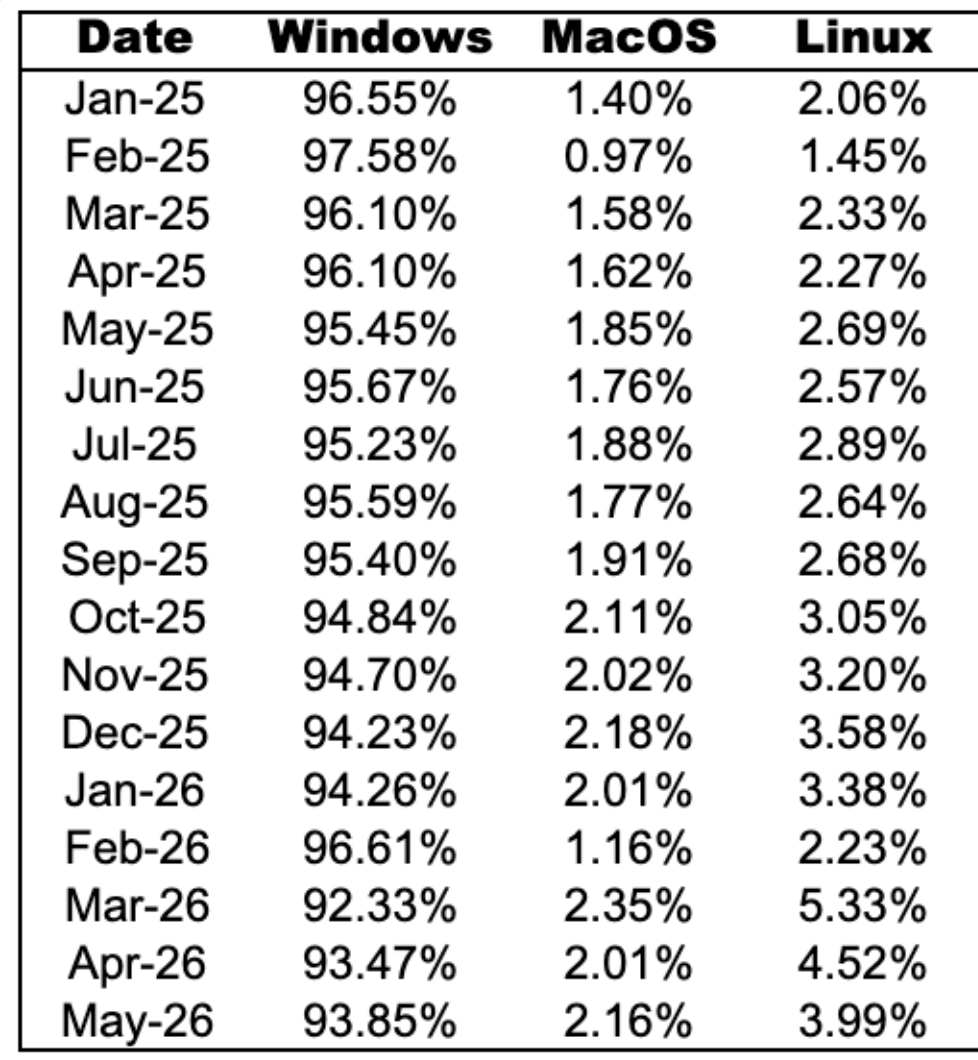
Edit: let me explain how Steam arrives at these numbers. This isn't the actual total population of steam users, that Valve condenses into a nice pretty graph, it prompts random users for permission to participate in the survey. Depending on who is asked is very much as part of the reason the numbers look the way they do. They could be randomly excluding one platform and thus the numbers are a bit skewed.
Also keep in mind that the Windows numbers actually include a large portion of macos participants. When using Crossover in macos, you're counted as a windows user, not macos. Its kind of messy but overall, its really the only thing we have to determine who's using what.
One of the hurdles for me to over come is the that its not a full Desktop Experience, like Gnome. In fact installing hyperland gives you only one option. Super+Q to start up your terminal. Nothing else. Hopefully you've already installed the kitty terminal so that Super-Q.
Hyperland (and presumably other Tiling WMs) is keyboard centric, you're rewarded for using with a highly effecient workflow. Since I'm using my desktop for fun, and home stuff, I don't think the advantages are as pronounced as it would be for someone using it for work.
There are elements, of Gnome that I like more, and I find myself switching back and forth, but I'm still not done configuring hyperland, its largely a work in progress.
Not really, the percentage changes are such that no trend can be ascertained as of yet. I have a thread in the games forum that documents the Steam's hardware survey month to month and March's large Linux numbers were such that many people proclaimed the doom of windows but I mentioned its possibly an aberration.Just read a new report that Linux is losing ground again on Steam as Microsoft is reversing many of its dumb moves
So prior to Feb 2026, we see Linux floating around the 2 and 3 percent mark. Then March, it jumps up to 5.33%, such a wide swing looks more like an aberration then a trend. April, and May show more realistic numbers.
What we do see is a slow quiet erosion of Windows market share, its too soon to proclaim that windows has turned things around. In fact the Windows increase between April and May is only .38% Far from encouraging and could be explained as statistical noise or random sampling error
.
Edit: let me explain how Steam arrives at these numbers. This isn't the actual total population of steam users, that Valve condenses into a nice pretty graph, it prompts random users for permission to participate in the survey. Depending on who is asked is very much as part of the reason the numbers look the way they do. They could be randomly excluding one platform and thus the numbers are a bit skewed.
Also keep in mind that the Windows numbers actually include a large portion of macos participants. When using Crossover in macos, you're counted as a windows user, not macos. Its kind of messy but overall, its really the only thing we have to determine who's using what.
Last edited:
Steve Adams
macrumors 68020
Taken from article. 3 months decline.
Turning to Linux, which has made impressive strides over the past few months, the operating system peaked at 5.33% back in March before dipping to 4.52% in April. Now, in May, Linux accounts for 3.99% of Steam users.
Turning to Linux, which has made impressive strides over the past few months, the operating system peaked at 5.33% back in March before dipping to 4.52% in April. Now, in May, Linux accounts for 3.99% of Steam users.
I don't understand your pointTaken from article. 3 months decline.
Turning to Linux, which has made impressive strides over the past few months, the operating system peaked at 5.33% back in March before dipping to 4.52% in April. Now, in May, Linux accounts for 3.99% of Steam users.
Steve Adams
macrumors 68020
The point is that Microsoft is starting to reverse what gamers were complaining about and moving back. I do think the SteamBox is dead in the water, and SteamOS being touted as the saviour of gaming is not going to happen either. Linux in other aspects of computing would grow exponentially if software builders would take it more seriously, but I think the revenues are not there to do it. Most Linux users want free software. I, for one, would pay for affinity etc on Linux if I could.
Maybe, but I think its premature to make such a statement.The point is that Microsoft is starting to reverse what gamers
Two months of increases is not long enough to proclaim that microsoft has righted the ship imo. Only with time will we know if this is a trend or just statistical anomalies given how valve collects the samples.
You are free to believe it is, its no skin off my nose, one way or another.