*** Full disclosure: My Apple tools do not use Tahoe or IOS 26. Neither have I used Tahoe or 26. And I have never personally seen them in action. My MacIntel MBP is on still on Big Sur 11.7.10 and my 13mini is still on IOS 18.6.2.actually this digression into what constitutes a valid criticism is enlightening , aesthetics will always be subjective I fear , but functionality depends on the design specification - a fully functional implementation of a design may fall short of the functionality envisioned (or desired) by the user leading to the question who is misleading who. I admit I tend to blame marketing but users are also capable of self delusion. you of course will decide for yourself on whatever basis you determine is appropriate. enjoy (no I haven't upgraded to Tahoe simply because I see no compelling reason to do so)
My comment on Tahoe is not informed by personal experience, and is without merit to those who have hands on experience.
Even so...
I am retired now but I spent many, many years writing advertising creative briefs, marketing-focused creative briefs, and product planning briefs.
But as I read your comments... you made me recall my creative brief writing days. And you made me wonder about the creative briefs that resulted in Tahoe and IOS26.
Every bad creative brief that I have seen - if it and the output that resulted from it were approved despite being substandard - they always resulted in a message / promotion / product that was objectively compromised in some form, and that failed to achieve in the market place what the business needed it to achieve. I only ever saw bad creative briefs get approved:
1 - when the ego of the approving executive was more important than the brand or the business or the customer or the market data.
2 - when the approving executive was not one single person but a committee of people with disparate objectives and agendas.
Unfortunately, this happens quite a lot. Of course, you can have a great creative brief that results in a great message / promotion / product, and it may still do poorly in the market place due to other exogenous factors. I am not going there.
Effective creative briefs must set a very clear vision/mission with measurable and concretely defined boundaries, meanings, mandates, guidelines and rules for what is to be created. If one assumes that the designers/creatives actually follow the directives within the brief, then one can expect a creative output that will closely resemble the vision set forward in the brief after one or two revisions.
However, a weak brief with unclear vision or with undefined boundaries, mandates, and such... the output should never be approved as it would not pass user acceptance testing / user experience testing / customer satisfaction testing. Bad briefs that result in bad products that are pushed to market anyway end up dividing the customer base and hurting the business. And the company spends lots of time, and warranty labor and OpEx afterwards, doing damage control, doing product recalls, or releasing .1/.2/.3/.4 corrective software releases. (Half of my career was spent in Technology marketing in San Fran and Seattle, and the other half in marketing and product planning in the auto industry.) The tech company I worked for only released software updates for security issues, post launch. Prior to the Gold Master label being placed on the final iteration of software, they did hundreds if not thousands of hours of "hackathons" with employees, customers and partners to break the code and ID any bugs pre-launch. They did not release new betas of the same, already-launched code to correct what should have been caught prior to launch... because they caught stuff prior to launch. Beta was a name applied to new software code, not a name applied to a bandaid for the latest attempt to correct already released code.
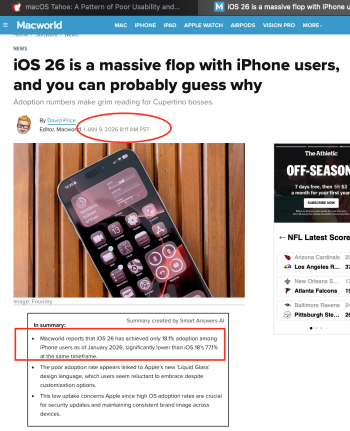
So, I truly wonder about the quality of the creative briefs behind Tahoe and IOS26 - and the quality of the executives that approved them. Especially when I think of the attached IOS26 article. I will assume that Tahoe download rates will be similar when that data is reported.