Become a MacRumors Supporter for $50/year with no ads, ability to filter front page stories, and private forums.
You were running an x86 operating system with UTM in emulation mode on an iPad? I wonder whether the same setup would be faster on a Mac, even with the same processor. Probably not, but one never knows until one tries.
Indeed, I was curious to see whether it was usable. It was not.

I expect it would be faster on a Mac, but with low hope of it being usable. The good news is that doing so on a Neo should not be much worse than on a higher end laptop...
 
Thanks, perhaps I will give VMware Fusion a go, though speed is not important and don‘t do any games.

My main use of UTM is running other versions of macOS…how is Fusion for that?
Fusion on Intel Macs was great for running older versions of macOS. With the switch to ARM, you could go back as far as macOS has M series support. Anything older and you are in emulation territory rather than virtualization and back to UTM.
 
I would "upgrade" to a MacBook Pro 13 2020 with the 10th gen i7. These are dead cheap, still good, runs macOS 26 and will recieve security updates until october 2028.
This way you will get another 2 years of not really changing anything and ample time to prepare for your ARM transition, which you now know is inevitable.
Perhaps pick up a used M1 computer too, and start learning what works and what not. Mac mini M1s should be cheap, or an MBA M1.
 
  • Like
Reactions: jchap
You're just itchy for a new Mac. Curb your enthusiasm--they don't need your money! Get a blue plastic case if you're tired of silver. Plenty on Amazon, and some really cool ones!

Don't buy new!
I don’t think they are, they don’t sound particularly enthusiastic about having to purchase a new computer.

- Battery in the Pro is getting to be a problem (only 90 minutes on Teams calls)
- Touch Bar is flickering
- General age-related concerns (Intel chip)
This doesn’t sound like anyone who is particularly ‘itchy’ for a new computer, they just need a new computer because the old one is getting old.

If you really want an OS upgrade, you can install OpenCore Legacy. Only works on Intel Macs.
Not really a viable solution anymore, OCLP is barely supported on Tahoe, and will not be supported at all going forward. Best case scenario is being stuck on Sequoia, with several broken drivers, and which will stop receiving security updates next year. Not exactly a recommended solution.
 
  • Like
Reactions: conmee
Office 2019 should work on Tahoe, but it will stop working with MacOS 28. MacOS 27 will be the last year that Rosetta apps are supported. Given how old Office 2019 is, it will truly reach its end of life with MacOS 28. MSFT stopped providing updates for Office 2019 years ago.

Typically, I would say 8GB of RAM would be fine, but then you mentioned Parallels. I could not imagine running a VM with only 8GB. I ran a Windows 11 VM on 16GB of RAM and it was not happy. It worked, but it was not happy.

If you plan on keeping the machine for as long, if not longer, than your Intel Pro, I would likely opt in for a MacBook Air.
Office 2019 has been moved to Apple Silicon by a 2021 or 2022 update, so even after Tahoe this will continue to work.
 
  • Like
Reactions: conmee
I sell tech, and if I went by what you just said here I’d say you will be fine with a Neo. If you still aren’t sure then gat a MacBook Air. If your Office 2019 is by subscription then it can just be transferred to your new device. If not then you’ll have to purchase a new version of Microsoft Office Home.

A lot of people often dismiss the Neo because of how they define a normal workload. Editing 4K video as a profession might be their normal workload, but thats not the normal workload of the average user. You can edit 4K video on a Neo and it will do it well enough, but thats not its intended primary use case. If you need that kind of machine, which you obviously don’t, then the Neo isn’t the right device.

And as far as I know you can run Parallels on the Neo or any other Silicon Mac if thats what you really want.
This is very true. For most people a Neo would work just fine.
 
  • Like
Reactions: boppin
Excuse my ignorance but what is UTM

A virtualization app that uses Apple's Hypervisor framework to run ARM native virtual machines, or uses QEMU to run just about any operating system on an emulated machine with a large choice of processors.
 
  • Like
Reactions: eltoslightfoot
Not really a viable solution anymore, OCLP is barely supported on Tahoe, and will not be supported at all going forward. Best case scenario is being stuck on Sequoia, with several broken drivers, and which will stop receiving security updates next year. Not exactly a recommended solution.
If Apple maintains its traditional security updates policy, Sequoia will continue being supported until sometime in fall 2027. In my opinion, that's not a bad timeline for someone who wants to have their Intel Mac receiving Sequoia security updates (via OCLP) for a good while longer before purchasing a 2027 model MacBook Neo or Air, or MacBook Mini.
I haven't encountered any broken drivers running my 2017 MacBook Pro on OCLP Sequoia, and only a couple of minor glitches running OCLP Sequoia on my 2017 27" iMac. It's a viable option to squeeze another ~17 months of "secure" life from an old Intel Mac if the computer's hardware itself still meets a user's personal needs.
 
Last edited:
Easy. Buy Neo but keep Pro. You will have best of both worlds. Neo is not capable of adequate Windows installation, while you still can install full Windows on your Intel MacBook. I noticed that it is always better to buy new tech but also keep old, this way in case something doesn’t work as expected you have a backup device that can still do everything just fine
 
I am sick of basic silver too. 16gb of is not much either. But the new unified rams work much better. That said the intel will last one or 2 more years. So keep it. The NEO 2 will supposedly have an A19-PRO chip in it which will support 12gb of ram. That is only 4gb behind the 16gb so not bad. Should be 2027 hopefully. Or at least wait until WWDC and see if they announce it.

BTW any know when is WWDC?

I had basic silver, then got a space grey with work but then after that I upgraded my own and went back to silver..

I do like the colours but I think silver is timeless
 
@Scott Baret I went through this exact same exercise before upgrading my 2019 Intel MBP (16" i9 8-core 64GB 5500M 8GB VRAM). The reason I remained on Intel for so long was the need to run x86 VMs. I finally went with a new MBP once work no longer required x86, but some lessons along the way are applicable to the Neo you are considering.

Net-net: The Neo will be fine for your use case, but keep in mind a few caveats about Parallels/VMs.

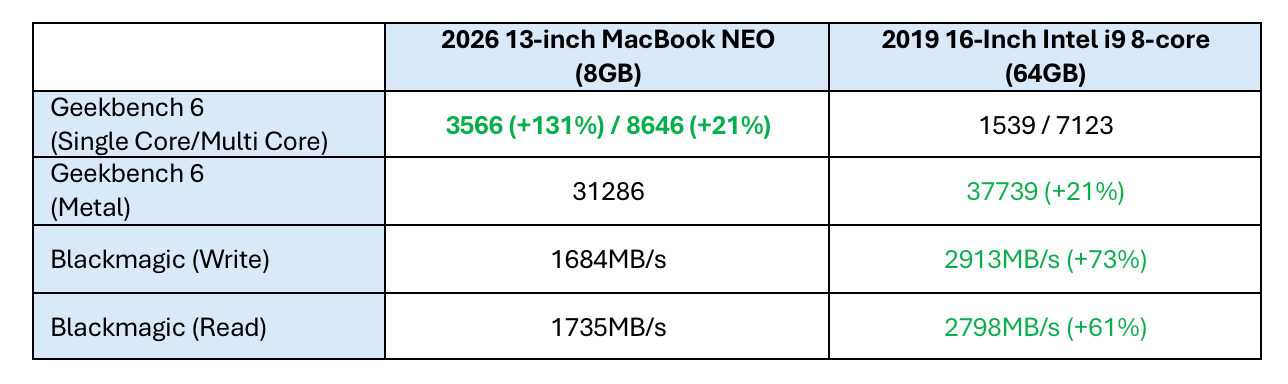
In general, the MacBook Neo will outperform a fully loaded 2019 Intel MBP for daily tasks. For GPU-intensive tasks, depending on the GPU, the Intel MBP might have a slight edge (Neo will wipe the floor with your MBP if you only have Intel Integrated Graphics). But for sustained workloads, the Neo advantage disappears quickly when it has to throttle and will not be able to keep up with the Intel MBP (but then again, the Neo won’t sound like a hair dryer either). Your use case is quite light and you didn't mention any sustained workloads like compiling or video rendering so you will be fine with the Neo.

One thing to note, the Neo SSD will be 50%-70% slower than a 2019 Intel MBP SSD. This last component will affect Parallels as much or more than the 8GB of memory. This is because Parallels caches a lot of files to make a VM responsive. Fewer files will be cached due to limited memory and the slower SSD will simply take longer to serve up the files that can’t be cached. Worse case scenario is when using Parallels and another program or two making macOS initiate SSD swap. Then responsiveness will start to slow. Again, it doesn't sound like a scenario you will run into that often (just don't run Teams and Parallels at the same time lol).
Neo.png


1) Microsoft Office 2019. It will work fine and continue to work into the future. The latest installer does not require Rosetta. As folks may know, installing a perpetual license of Microsoft Office is tied to your Microsoft account. To install it on a different computer, you’ll have to go through a short “license transfer” dialogue with an automated support system. As long as you haven’t been trying to install it on a bunch of different computers in a short amount of time, it should automatically activate on the new MacBook Neo. If for some reason, Microsoft thinks you’re trying to get away with installing a single license on multiple computers, you’ll have to call a support number and go through some Q&A to promise not to install it on more than one computer. NOTE: Microsoft only allows the installer to run on the three most current macOS. However, each installer will install on the three macOS versions that were current AT THE TIME THE INSTALLER WAS RELEASED. For example, I have an older installer for Office 2019 that still installs on Monterey even though newer 2019 updates require Sonoma, Sequoia, and Tahoe. You can download older installers but they don’t accept newer feature or security updates (Auto Update will try to download newer updates but then tell you that you need to upgrade. You can delete MAU so that it doesn’t try to download updates, but I don’t recommend running older unsecure software unless it’s in a virtual machine). You shouldn't need to ever do this. Just download the most recent Office 2019 installer and use your Microsoft account to activate. Current/previous installers for Office 2016-2024 are here: https://learn.microsoft.com/en-us/officeupdates/update-history-office-for-mac

2) Office, Teams, Email, FaceTime, Safari will all be fine with the Neo.

3) 8GB will not be a problem UNLESS you plan on running your VM along side all those other programs at the same time. You will want to close out Parallels if you have a Teams call lined up. 😉 But in general, you should be fine.

4) Parallels. Short answer: You will need to buy a newer version of Office for Windows and run it on ARM Win11 in Parallels 18 or higher. Parallels has a streamlined Win11 installation process and you can use any Windows 11 activation key (I used a retail Windows 11 key from the Microsoft Store to activate).

The main reason you will need a new version of Office is that 64-bit Win11 ARM does not support 16-bit code emulation and Office 2000 is 16-bit. Microsoft does not include NTVDM/wow32.dll in Win11 like it does in Win10 (and there is no ARM Win10 and you can't just copy wow32.dll into Win11 sadly), so 16-bit apps, and 32-bit apps with 16-bit installers, will just throw an error “Missing wow32.dll” if you try to run in ARM Windows 11.

I use Office apps on ARM Win11 in Parallels 26 on my M5 Pro and it runs better than Win11 on the work-issued Dell Latitude. I used Parallels 18 initially on Tahoe and it runs ARM Win11 fine on my M5 Pro. So if you have at least Parallels 18, you might not need to update Parallels (you need at least Parallels 17 to run Win11). Your Parallels activation key should work for 2 or 3 installs before reaching the limit (Parallels doesn’t say exactly how many times you can reuse an activation key, but I’ve successfully used a key on an Intel MBP, an M5, and an M5 Pro before being told I’d reached the limit and need to buy a new key - the key still works on those three machines, but won't work on any other machine). Keep in mind I have an M5 Pro with 64GB and a much faster SSD than the Neo, so of course performance is blazing fast. However, given what you need to do, I think performance will be more than satisfactory on the Neo for a single Win11 VM.

As others have noted, you can’t run x86/x64 OSes (WinXP/Vista/7/8/10/11) on Apple Silicon. Yes, there are some ways to EMULATE Windows 7/10/11 but they are dog slow, some ways use really technical workarounds for the average user, and I consider them more a proof-of-concept than anything else. There are no PRACTICAL ways for an average user to satisfactorily run x86/x64 on Apple Silicon or the Neo. Period. Exception: DOSBox-X is great for old school DOS and Win98 games.

Final note: You can also keep your Intel MBP around for the times you need x86 apps. I kept my 2019 15" MBP mainly because it was the last Intel model capable of running Mojave. So I have it set up with Mojave for a couple 32-bit Mac games and apps, and I have Parallels 18 on it to run Windows XP and Windows 7 VMs that support some older games.

Bottom line: If you can live with ARM Win11 and a newer version of Office, get the Neo, you won't be disappointed.

 
Thank you to everyone for your input!! I think I'll stick with the old MBP for now. It just seems like it would fit my needs better. I can always try to get a new battery on it sometime if all else fails. I might stick with it for another year or two.

The Office 2000 is actually a big holdup. The chart wizard is far superior to anything on a newer version and I do still need that for a few applications. Plus I don't need the latest and greatest, just good performance. Maybe if I hold off I can get a Neo with more RAM.
 
  • Like
Reactions: boppin
Plus I don't need the latest and greatest, just good performance.
Glad we could help. The performance of a MacBook with an M4 chip is more than enough. It's like landing in a different world, especially if you're coming from an old Intel Mac like me. My MacBook Pro is from 2012.
 
  • Like
Reactions: conmee
Very interesting option. Do you think this app can run Mojave in a M1 Air to use iTunes there?
Depending on your OS, you could have a look at Retroactive to run iTunes in newer versions of macOS.
 
Glad we could help. The performance of a MacBook with an M4 chip is more than enough. It's like landing in a different world, especially if you're coming from an old Intel Mac like me. My MacBook Pro is from 2012.
I have one of those 2012 MacBook Pros too and still use it for some tasks. Stuck on Catalina and slow by today's standards, but it had lots of useful ports and was built in the good old days when it was easy to inexpensively upgrade the RAM and internal drive myself. I've had many Mac desktop and laptop computers over the years, but my 2012 MacBook Pro may have been my favourite overall.
 
Thank you to everyone for your input!! I think I'll stick with the old MBP for now. It just seems like it would fit my needs better. I can always try to get a new battery on it sometime if all else fails. I might stick with it for another year or two.

The Office 2000 is actually a big holdup. The chart wizard is far superior to anything on a newer version and I do still need that for a few applications. Plus I don't need the latest and greatest, just good performance. Maybe if I hold off I can get a Neo with more RAM.
@Scott Baret Prepare to have your mind blown... 😉

So check this out. I realized last night that because Office 2000 is 16-bit, you can just run Office 2000 in DOSBox-X in Windows 98. You can save files to a mounted folder so Mac Office has access to the files and you can redirect print to a file or to a printer. You won't have to give up your beloved chart wizard either. 🙂

The only caveat/limitation is that the max resolution is 1,024x768 with 16-bit color. To go higher resolution it will only support 256 colors. If you can live with that limitation, you won't even need Parallels and DOSBox-X takes fewer resources (DOSBOx-X running Windows 98 and Excel 2000 is using 967MB currently). Now, it will take a little more manual configuration on your part, but DOSBox-X has a lot of menu options and graphical menu settings so only a few command lines to get going.

This potentially solves your biggest hangup.

01_O2K.png
02_O2K.png
03_O2K.png
05_O2K.png

04_O2K.png
 
Oh wow!! Yes, I'm familiar with DOS Box because I use it to play a very old game that was DOS only that I still enjoy to this day (Lemmings Chronicles). I guess I just need a copy of Win98 then! I know the "upgrade" version is easy enough to come by and I do have a spare set of 3.1 floppies sitting around, so I'd assume I could go that route. I also have a WinME disk which I'd imagine could work?
 
Fusion on Intel Macs was great for running older versions of macOS. With the switch to ARM, you could go back as far as macOS has M series support. Anything older and you are in emulation territory rather than virtualization and back to UTM.
Just tried setting up a macOS Tahoe VM on Fusion and there is no menu option to set up a macOS VM. I tried using "other ARM" and it didn't work. Tried the same thing in UTM and it worked first try. With MacOS 27 dropping support for Rosetta 2, I will keep this UTM macOS VM around for the small number of Intel binaries I still have.
 
Unfortunately, there's no graphics acceleration for macOS in Parallels or UTM or VMware due to Apple not making the APIs or whatnot available. For example, I can run Mojave in Parallels and Fusion 13 (25H2) but many games either refuse to work or do work but only achieve single digit FPS. That's why I kept my 2019 Intel MBP... runs Mojave natively and runs all my x86 stuff in WinXP/Win7.
 
Register on MacRumors! This sidebar will go away, and you'll see fewer ads.