jsts
macrumors member
A bit of speculation.
I've been following the evolution of Apple's monitor lineup for a while, and I've come to the conclusion that the next professional display could look exactly like this.
Apple is bound by several strict limitations when it comes to its monitors, and these limitations shape the potential appearance of any new product.
One: macOS Scaling. macOS uses integer scaling: @1x = 110 PPI, @2x = 220 PPI. This is the gold standard for Retina density. A display with a density of 330 PPI (@3x) is currently unfeasible, not only due to manufacturing complexity but also because of the lack of graphical processing power required to handle such resolutions comfortably for a wide range of tasks.
Two: The Retina and Diagonal Size Equation. This leads to a simple piece of arithmetic: A density of ~220 PPI at 5K resolution gives you a 27-inch diagonal (Studio Display). The same density at 6K gives you 32 inches (Pro Display XDR). Finally, at 8K, we arrive at a 40-inch diagonal. However, there's a crucial detail: a 40-inch display with a 16:9 aspect ratio would be massive and unwieldy. This is where the 21:9 (UltraWide) aspect ratio makes perfect sense. Why? The height of a 32-inch 16:9 display is approximately 40cm. The height of a 40-inch ultra-wide 21:9 display is also approximately 40cm.
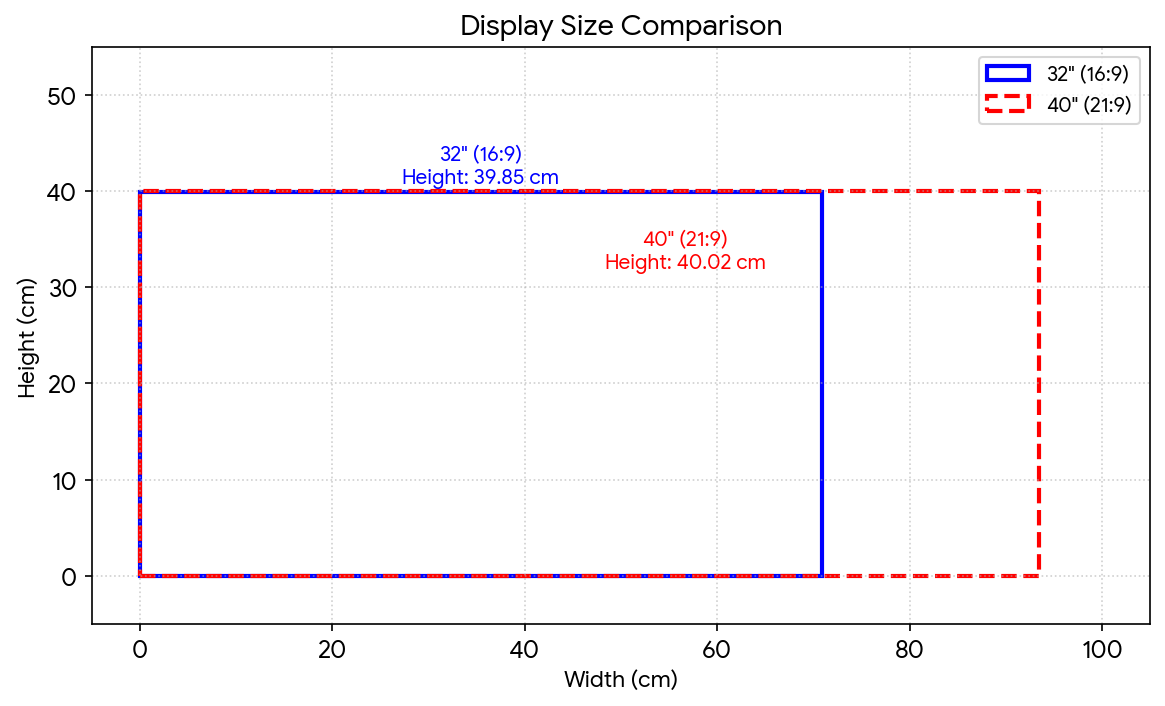
This means the user gains more than a 30% increase in usable screen area (horizontally) without altering the physical height of the monitor or their eye line.
Three: Thunderbolt Bandwidth. Back in 2019, when the Pro Display XDR (6K, 60Hz, 10-bit) was introduced, it utilised almost the entire bandwidth of Thunderbolt 3 (40 Gbit/s), with a data stream of around 38 Gbit/s. Today, we have Thunderbolt 5 with a Bandwidth Boost mode of up to 120 Gbit/s. If we take an 8K resolution, 220 PPI, 10-bit colour, and a 120Hz (ProMotion) refresh rate, the required data stream would be approximately 112 Gbit/s. This fits perfectly within the capabilities of the new interface. It's a logical step for Apple, much like the one they took in 2019.
Four: Display Technology. MicroLED: Apple recently scaled back its project to develop proprietary MicroLED screens for the Apple Watch due to complexity and cost. We are unlikely to see this technology in monitors anytime soon. OLED: Currently, there are no mass-produced OLED panels with the specifications of 40", 218 PPI, and 8K UltraWide. Furthermore, the risk of burn-in for the static interfaces professionals use remains a significant concern. Tandem OLED: The technology used in the iPad Pro is excellent for compact devices, but its brightness and longevity are not yet sufficient for a large professional monitor. This leaves Mini-LED: Apple's evolutionary path is to refine and perfect proven technologies. An IPS panel with a Mini-LED backlight and thousands of local dimming zones is the most realistic candidate.
Based on all of the above, here is a monitor I would buy without hesitation. Here are its specifications:
Diagonal: 40 inches
Panel Type: IPS with Mini-LED technology
Aspect Ratio: 21:9 (UltraWide)
Resolution: 8192 × 3510 (8K horizontally)
Pixel Density: 218 PPI (perfect Retina 2x for macOS)
Backlighting: ~4600 local dimming zones for deep HDR (UltraXDR?)
Brightness: 2000 nits (typical), 3000 nits (peak HDR)
Refresh Rate: 120Hz
Colour Depth: 10-bit (1.07 billion colours), full P3 gamut
Interface: Thunderbolt 5 (single cable for video, data, and laptop charging up to 140W+)
Data Stream: ~112 Gbit/s — fits perfectly within the 120 Gbit/s limit
Form Factor: Flat (curves distort geometry, which is critical for designers and architects)
Chassis: Aluminium for efficient cooling of the dense Mini-LED array
Purpose: To replace multi-monitor setups for video editing (an 8K timeline across the full width), coding, working with massive spreadsheets, and financial dashboards.
Price
In its base configuration (without a stand?), such a monitor would carry a frighteningly realistic price tag of $6999.
Apple Pro Display Ultra 40-inch like this to replace two Studio Displays.
I've been following the evolution of Apple's monitor lineup for a while, and I've come to the conclusion that the next professional display could look exactly like this.
Apple is bound by several strict limitations when it comes to its monitors, and these limitations shape the potential appearance of any new product.
One: macOS Scaling. macOS uses integer scaling: @1x = 110 PPI, @2x = 220 PPI. This is the gold standard for Retina density. A display with a density of 330 PPI (@3x) is currently unfeasible, not only due to manufacturing complexity but also because of the lack of graphical processing power required to handle such resolutions comfortably for a wide range of tasks.
Two: The Retina and Diagonal Size Equation. This leads to a simple piece of arithmetic: A density of ~220 PPI at 5K resolution gives you a 27-inch diagonal (Studio Display). The same density at 6K gives you 32 inches (Pro Display XDR). Finally, at 8K, we arrive at a 40-inch diagonal. However, there's a crucial detail: a 40-inch display with a 16:9 aspect ratio would be massive and unwieldy. This is where the 21:9 (UltraWide) aspect ratio makes perfect sense. Why? The height of a 32-inch 16:9 display is approximately 40cm. The height of a 40-inch ultra-wide 21:9 display is also approximately 40cm.
This means the user gains more than a 30% increase in usable screen area (horizontally) without altering the physical height of the monitor or their eye line.
Three: Thunderbolt Bandwidth. Back in 2019, when the Pro Display XDR (6K, 60Hz, 10-bit) was introduced, it utilised almost the entire bandwidth of Thunderbolt 3 (40 Gbit/s), with a data stream of around 38 Gbit/s. Today, we have Thunderbolt 5 with a Bandwidth Boost mode of up to 120 Gbit/s. If we take an 8K resolution, 220 PPI, 10-bit colour, and a 120Hz (ProMotion) refresh rate, the required data stream would be approximately 112 Gbit/s. This fits perfectly within the capabilities of the new interface. It's a logical step for Apple, much like the one they took in 2019.
Four: Display Technology. MicroLED: Apple recently scaled back its project to develop proprietary MicroLED screens for the Apple Watch due to complexity and cost. We are unlikely to see this technology in monitors anytime soon. OLED: Currently, there are no mass-produced OLED panels with the specifications of 40", 218 PPI, and 8K UltraWide. Furthermore, the risk of burn-in for the static interfaces professionals use remains a significant concern. Tandem OLED: The technology used in the iPad Pro is excellent for compact devices, but its brightness and longevity are not yet sufficient for a large professional monitor. This leaves Mini-LED: Apple's evolutionary path is to refine and perfect proven technologies. An IPS panel with a Mini-LED backlight and thousands of local dimming zones is the most realistic candidate.
Based on all of the above, here is a monitor I would buy without hesitation. Here are its specifications:
Diagonal: 40 inches
Panel Type: IPS with Mini-LED technology
Aspect Ratio: 21:9 (UltraWide)
Resolution: 8192 × 3510 (8K horizontally)
Pixel Density: 218 PPI (perfect Retina 2x for macOS)
Backlighting: ~4600 local dimming zones for deep HDR (UltraXDR?)
Brightness: 2000 nits (typical), 3000 nits (peak HDR)
Refresh Rate: 120Hz
Colour Depth: 10-bit (1.07 billion colours), full P3 gamut
Interface: Thunderbolt 5 (single cable for video, data, and laptop charging up to 140W+)
Data Stream: ~112 Gbit/s — fits perfectly within the 120 Gbit/s limit
Form Factor: Flat (curves distort geometry, which is critical for designers and architects)
Chassis: Aluminium for efficient cooling of the dense Mini-LED array
Purpose: To replace multi-monitor setups for video editing (an 8K timeline across the full width), coding, working with massive spreadsheets, and financial dashboards.
Price
In its base configuration (without a stand?), such a monitor would carry a frighteningly realistic price tag of $6999.
Apple Pro Display Ultra 40-inch like this to replace two Studio Displays.
Last edited: