Become a MacRumors Supporter for $50/year with no ads, ability to filter front page stories, and private forums.
Isn't anybody going to mention the arguably even more fundamental problem? Where is AI going to get its inputs when it's driven everyone who actually produced it out of business? When newspapers go bust because people are just asking Grok to steal the news for them, then who will actually be on the ground digging up new information? Until AI can do that, then it seems to be sowing the seeds of its own destruction, whilst unfortunately taking a lot down with it.
 
Isn't anybody going to mention the arguably even more fundamental problem? Where is AI going to get its inputs when it's driven everyone who actually produced it out of business? When newspapers go bust because people are just asking Grok to steal the news for them, then who will actually be on the ground digging up new information? Until AI can do that, then it seems to be sowing the seeds of its own destruction, whilst unfortunately taking a lot down with it.
Robot reporters will take care of that problem. Musk has thought of evrythang.
 
The whole thing reminds me of the dot com bubble. There were crazy evaluations of companies losing money, and everyone was overexcited. The bubble burst and a lot went bust, but what followed was a new generation of companies that were profitable. I suspect something similar will happen with AI.

Also not forgetting that machine learning is not just LLMs, and there is already a lot of useful implementation in background services.

And then finally, if you’ve got good enough language models that can run locally (which do appear to be on the way) then that obviates the need for the huge data centres.
My understanding of the dot com bubble is that it at least left us with solid internet infrastructure which would then go onto enable the next generation of businesses (eg: Netflix, Spotify, Twitch, Uber, Amazon etc) which relied on ready access to fast internet in order to be viable.

What infrastructure is AI supposed to leave for us? Half-used GPUs? What exactly is the business model for running a tiny LLM locally on your smartphone?
 
I don’t know, this article assumes that nobody finds anything useful with AI, and that’s just not true. I agree, the current consumption based licensing is going to have to change and perhaps local LLMs is where Apple really makes a difference.

I also find it funny that this is an article kind of spelling the demise of AI and then seeing the term “load bearing” at the end of the article, which is a pretty good sign that AI was used minimally to proofread it.
 
  • Like
Reactions: gleepskip
There is no bubble, just a buildout of a critical infrastructure for humanity survival.
Oh it is a bubble, whether or not it is a slow deflation or a supernova level burst is a important question. But I do think that we may be seeing the initial stages of it, seeing how hard a lot of tech stocks have been getting hit the past week or so, ESPECIALLY how hard Tesla and SpaceX's stock has been getting hammered.
 
Tech jumped the gun because they were all desperate for the ‘next big thing’…now? Looks like they’ll reap what they sowed.

The tech bubble bursted before and the tech companies had to learn the hard way, looks like it’s well on its way to happening again.
 
My understanding of the dot com bubble is that it at least left us with solid internet infrastructure which would then go onto enable the next generation of businesses (eg: Netflix, Spotify, Twitch, Uber, Amazon etc) which relied on ready access to fast internet in order to be viable.

What infrastructure is AI supposed to leave for us? Half-used GPUs? What exactly is the business model for running a tiny LLM locally on your smartphone?
So what you’ve done is pretty much quoted exactly what Ed Zitron says, because I’ve heard him a few times before (he pops up on podcasts a lot).

Without companies developing machine learning we wouldn’t have it at all, and as I mentioned AI is not just LLMs, machine learning does have its use and place. So that’s the ‘infrastructure’ if you will, the development and knowledge of these systems that can be leveraged by companies in the future.

In terms of why a LLM might be useful on your smartphone, it is useful to be able to interact with it in a simple manner using simple commands to get it to complete what would be otherwise complex tasks. So the business model is for it to be a feature and selling point for companies like Apple.

Machine learning has its place, it is useful, companies like OpenAI are massively overvalued and it has a long and challenging road to profitability if it even makes it at all. All of this can be true at once.

Ed Zitron is very sceptical about AI. There are a lot of people that are bullish about it. The reality is probably somewhere in the middle.
 
Last edited:
Isn't anybody going to mention the arguably even more fundamental problem? Where is AI going to get its inputs when it's driven everyone who actually produced it out of business? When newspapers go bust because people are just asking Grok to steal the news for them, then who will actually be on the ground digging up new information? Until AI can do that, then it seems to be sowing the seeds of its own destruction, whilst unfortunately taking a lot down with it.

Not sure grok is guilty of stealing news when 10 different news sources will literally publish the same exact story word for word.
 
  • Like
Reactions: JohnWick1954
In terms of why a LLM might be useful on your smartphone, it is useful to be able to interact with it in a simple manner using simple commands to get it to complete what would be otherwise complex tasks. So the business model is for it to be a feature and selling point for companies like Apple.
I guess I don't see having a local LLM on my smartphone as something that would enable the next generation of businesses model. Also, I was thinking more in terms of physical infrastructure (which I don't view GPUs as because they will quickly become outdated and need to be constantly replaced).

Cheap fabs could have been one, but at the moment, ram companies seem hesitant to expand supply because they don't want to be caught with a glut of memory that they cannot sell (which implies that even they suspect that this current AI mania will be short lived). So my guess is that once the AI bubble does burst, ram pricing goes back to normal, and nothing will have changed.

To go back to my earlier argument, a concept like Netflix or Youtube (streaming content on the go) would not have been possible without 4g internet speeds. It allowed people to stream themselves live regardless of where they are, and to call for a ride to their exact location. I imagine that if we had tried to do this on 3g, the experience would simply have been too poor to have been viable.

What exactly would AI or an LLM allow a third party to do on my phone that couldn't already be done today? AI is not infrastructure, not when it needs to be constantly updated in order to stay current. I could very well be wrong, but I just have this sneaking suspicion that when the AI bubble does burst, the whole world will be in for a world of hurt, we will have a massive recession on our hands, we will be dealing with the fallout from using AI-generated content for ages to come, and there won't be any upside to show for it.
 
I guess I don't see having a local LLM on my smartphone as something that would enable the next generation of businesses model.
Remembering that machine learning is more than just LLMs, why does it have to ‘enable the next generation of business model’ at all? I appreciate that’s what some people hyperbolically promote it as, but why can’t it just be a useful addition to existing business models? Machine learning has already provided benefits in medicine, logistics, retail and plenty of other areas.

What exactly would AI or an LLM allow a third party to do on my phone that couldn't already be done today?
I’ll give you a couple of personal anecdotal uses for a LLM on your phone or PC. It’s not earth shattering, but I haven’t claimed it would be, rather that it would be a useful feature to have.

I’ve tried to use shortcuts before, and for anything but the most incredibly basic tasks I’ve found them too difficult to get working. I absolutely could have spent the time to learn, research, build and test, but frankly I couldn’t be bothered. So I just put them down and have never used them. Being able to explain what I want in plain english would work very well for me and people like me.

Likewise I sometimes have to perform file manipulation on my Mac. The task itself is pretty simple for a human like me to understand, but getting my Mac to do it requires Terminal, writing a bunch of arcane commands, outputting a list and then manipulating that list. I can’t be bothered learning that either, so just being able to ask in natural language would work very well.

Lots of people would have their own personal examples.
 
Last edited:
  • Like
Reactions: Mescagnus
@JMalone Then go ahead and make the unbelievable spending and complete lack of profits make sense.

They have no sustainable business model even if they 10x the price of subscriptions! You can't just say something is profitable without any evidence. If you're coding inefficiently and painfully for a week straight and choosing to offload your brain cycles to a model, you will just end up incurring technical debt and pain later when the model starts hallucinating and you never had a good grasp on the code. What is truly inefficient and exhausting is reading through and verifying hundreds of lines of slop at time. LGTM

Just because you feel a productivity boost doesn't mean it's not an illusion. Did you read the linked article on the RCT that found LLMs slowing down software development?

Calling Zitron a parrot while talking about language models is mad ironic. Parroting is fundamentally all LLMs can do.


Memory prices have doubled, Macs and iPads have gone up, and iPhones are expected to follow. Ed Zitron – who writes the Where's Your Ed At newsletter, hosts the Better Offline podcast, and has been described by Politico as the AI boom's most "acerbic gadfly" – has spent years arguing the buildout driving those costs will never pay for itself.

We asked him what happens to Apple if he's right.

Apple-Intelligence-Comes-Under-Fire-Feature.jpg

You've been calling AI a bubble since before it was fashionable. For MacRumors readers who mostly know it as ChatGPT or Apple Intelligence on their iPhone, what, in plain terms, is actually broken about the economics of the LLM industry?

At their very core, Large Language Models' costs run contrary to basically every model of selling software.

Consumers and enterprises alike have been trained to pay a monthly fee for a service, and while these services might have limits or strictures, basically nobody buying software expects to have a metered service, let alone one that's both metered and with hard to measure costs.

LLMs burn tokens at a per-million rate regardless of whether or not you get the response you want, or whether it does what you ask it to do. If you ask a coding agent to do some sort of software task and it goes off and spins its wheels in a loop, you're paying for the tokens regardless.

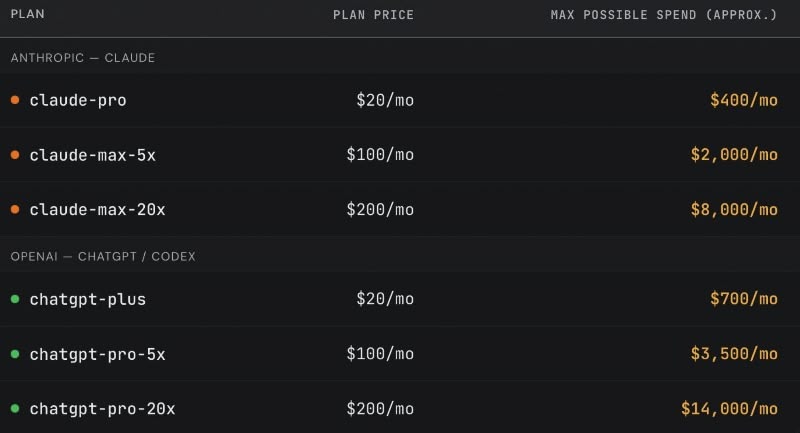
AI companies knew that consumers would never pay the actual cost of their AI services, so they have, for the most part, sold them monthly subscriptions with vague rate limits that allow them to burn way more in tokens than the cost of their subscription. SemiAnalysis found that you can burn hundreds of dollars on a $20-a-month subscription and thousands of dollars on a $200-a-month subscription, and while AI boosters will claim that these companies have "70% gross margins on tokens," there is little proof that this is the case, and my own reporting shows that OpenAI lost $20.9 billion on $13.07 billion in revenue in 2025.

claude-chatgpt-subsidies.jpg

Image credit: SemiAnalysis


This means the very basic economics are broken. If Anthropic and OpenAI believed customers would actually pay the real cost of AI tokens, they wouldn't have to give away 20 to 40 times the amount of tokens to subscribers.

Meanwhile, back in March of this year, both moved their enterprise customers over to token-based billing. Within a few weeks, it came out that Uber had spent its entire annual token budget in the space of a quarter, and its COO said that it was getting "harder to justify" the cost of AI because it was hard to track the cost of AI to any actual useful features shipping. Sam Altman would eventually say it was a "huge issue" but declined to say how it might be fixed.

This is a problem across basically every single AI-powered startup, which has to pay the per-million token rate. Perplexity, Cursor, GitHub Copilot (which moved to token-based billing in June) – every single AI startup is unprofitable because their users don't want to pay the actual cost of AI.

Another issue is that AI services are just not that useful or differentiated. While people get some sort of benefit out of AI-generated code, these tools actually end up making them slower, and are filling codebases full of slop. Otherwise, an LLM is an LLM is an LLM – it can generate, it can summarize, it can search, and that's about it, which means that every AI service is effectively the same. That's why 89% of all AI revenues are Anthropic and OpenAI, and why every AI startup talks in terms of "annualized revenue" (monthx12) – because actual revenues are very depressing. Even then, most are barely at $100 million annualized.

Then there are the data centers. An AI data center is very, very expensive to build, takes 18 to 36 months, and costs billions of dollars, which means effectively anyone building one will be raising debt and only get paid once a customer moves in... except there aren't really any customers for AI data centers outside of Anthropic and OpenAI, both of whom are so unprofitable that they've had to raise hundreds of billions of dollars even when Microsoft, Google and Amazon built all their infrastructure.

The only reason everybody isn't freaking out about this is because AI-related stocks have done well, even though none of the hyperscalers actually share their AI revenues.

You've argued that AI's demand story is essentially a mirage – that most of the data center capacity is being absorbed by OpenAI and Anthropic themselves, which is masking the absence of real enterprise demand. If that's right, who do you think will actually bear the cost when the whole thing unravels?

Honestly, it's going to be a lot of private credit funds, because they're the ones funding the data centers, and they're funded by pension funds like the SF teachers fund or CalPERS, which makes me really, really worried about the systemic contagion.

People will argue that this means there's going to be a bailout, but this isn't really a bailoutable thing. These data centers are funded by project financing, which means that the money is basically gone and the only way to "make them whole" would be to either buy out the debt or feed them revenues. While you could theoretically bail out these special purpose vehicles (SPVs), doing so would be to the tune of hundreds of billions of dollars and be political cancer.

I also fundamentally believe that Oracle gets killed by OpenAI. Its revenues have been stagnating for 20 years, and the only way it's kept its head above water is $85bn+ in acquisitions, and even then, that's just kept things flat. Its bets on AI data centers – $340bn+ with hundreds of billions in debt – require OpenAI to become t... Click here to read rest of article

Article Link: Apple Will 'Watch Everything Burn' When AI Bubble Bursts - Ed Zitron

That's a mouthful to literally CHOKE on and nothing could be closer to a foregone conclusion.
 
Can’t wait until AI replaces Zitron.
Why? Because he's the most vocal skeptic of AI? We NEED to have a skeptical nature of AI, regardless of if its the future or not. To blindly embrace it is highly dangerous and foolish. Maybe because I grew up with plenty of stories about AI being created and enslaving or destroying humanity, but I think a healthy skepticism is a good thing. As an artist, I have huge issues with the ethical nature of AI, with the fact that it's trained on the theft of work of fellow artists. Aside from that, I also have huge issues with the environmental costs of it. I mean all of you AI boosters out there, with has hot as it's been getting, are you really okay with your chatbots or LLMs potentially contributing to making things so much worse. I mean, it was already being an issue with the whole NFT bubble (everyone remember that a couple of years ago? Have people forgotten about that? A lot of the AI bros were hyping about how that was the future and that crashed and burned)
 
Well, I think there are two bubbles people are talking about:

With the bubble you refer to, regarding whether a massive number of people currently using AI will lose their interest in and use for it, you're right, that won't happen. At the very least, many people now losing interest are likely to change their minds once AI has been better ironed out, and people who permanently don't want anything to do with it won't be needed by the AI companies to stay in business.

The other bubble many people see on the horizon is the financial one, which is what Ed Zitron is addressing in this interview, in which the massive capital expenditure by current AI companies probably can't pay off in the form of profits, or likely even break even, at which point the massive investments propping up these companies will taper off, maybe very fast, and some of these companies might be forced to sell themselves at a great loss (though their founders and early investors will make out like bandits).

That would be fine, in a sense, if the result is what happened with the early railroads, the initial large buildout of fiber optic cables, etc., in that they eventually became essentially utilities after their crash, but AI data centers as currently constituted with today's technology use too many resources every second they're running for their transition to utilities to follow quite the same path as the railroads, etc. That excessive, unsustainable resource consumption is another contributor to the seemingly inevitable bust. For AI as a utility to really take off will require developing much lower power chips, more efficient AI software, etc., and using them to replace all the chips and software currently sitting in the AI data centers. This is kind of like the hardware transition that was needed to get the Internet to really take off, in which dialup modems, routers, and copper wires were replaced with DSL modems, then high-speed cable, satellite, optical fiber, etc.

The problem is that LLM AI won't get "better ironed out." It is fundamentally flawed. It's a brute force mechanism, and adding more brute and more force can't make it better. Also, the next point is salient...

Isn't anybody going to mention the arguably even more fundamental problem? Where is AI going to get its inputs when it's driven everyone who actually produced it out of business? When newspapers go bust because people are just asking Grok to steal the news for them, then who will actually be on the ground digging up new information? Until AI can do that, then it seems to be sowing the seeds of its own destruction, whilst unfortunately taking a lot down with it.

Because LLM AI is incapable of actual creativity, it depends entirely on the existence of intellectual property created by others for it to work at all. As the output of erroneous AI-generated compilations of other people's IP pollutes the information environment (which AI scrapes for its "training"), a feedback loop of misinformation builds. Simultaneously, as sources of non-AI-generated content are competitively driven from the marketplace by the prevalence of AI, that decreases the supply of reliable information. Those two vectors point towards a crash.

Currently, a lot of people use AI, but public polling already indicates that there is an extremely negative perception of it. As the quality of information generated by AI continues to deteriorate, even current users will abandon it as its unreliability becomes more obvious.

An example would be students using AI to generate papers and homework. The struggle for instructors has been to determine whether students are turning in AI materials or their own work. If instructors are instead able to skip that step, simply grade what's turned in, and fail students based on the erroneous AI content, students will stop using it. When students' objective to skip the work but get the grades no longer yields the desired results, they will skip the AI and do the work instead.
 
There is profitable and there is profitable enough to start paying back the investment. They may be the former, but they are a longs ways from the latter.
I believe with investments like this, investors get equity in the company. So it isn't like a proper loan where they owe the money back.
 
I'm one of the few lucky ones whose retirement savings kept rising throughout the Great Recession because I was pouring pretty much everything into AAPL. I have diversified since but not by selling my AAPL holdings. Now it looks like AAPL has immunized me again, this time from the AI apocalypse. Apple really is the best managed company in the world today.
 
Today's data centers are like the optical fiber that was being lain in the aughts. The companies that put them in the ground lost their shirts because nobody needed that much fiber back then. But all that dark fiber is being used now. And it has benefited us greatly.

One difference though is that fiber didn't go obsolete as it sat in the ground. Data on the other hand become obsolete as the next generations of AI chips and other hardware get introduced.
 
People who say this are usually profiting directly or indirectly from Ai. I have a brother in law and a cousin who are graphics designer/artists who got laid off and replaced with Ai. His point is very valid.

My own career is on the line potentially and I still think it's the proper path. Automation will always cost jobs.

Why should we waste our lives doing menial labor? It's like insisting on walking everywhere, regardless of distance, when aircraft exist.
 
I don't believe that is true for the private equity companies. That might be the liquidation option in case of loan default, but the sums are just too big to just blindly accept equity when you don't really know what those companies are worth.

What you are describing is angel investing, which may have been true up front, but again the sums are too large.
 
WOW! I have to say this is the most interesting subject I've encountered on Mac Rumors. Over the last three days I've read every one of the comments so far (It's 16.30 here... I'm #247) and they seem to be divided into three basic groups regarding the 'Bubble'. and each has merit. Much better educated and better trained minds than mine are saying "Yes, No, and Maybe". Some are humorous; some are downright snarky. All have a grain of truth, but what shines thru is that we all are, or all will be affected ! (Even yours truly once give all the items in my 'frig to GTP and came up with an OK soup.)
Given how quickly the tech world changes, it does seem a bit foolhardy to invest highly in something that could be extinct or double in cost (to build/maintain) next week; even tomorrow. I hear the term "Future-proofing" a lot during tech discussions.
How does that song go? oops. #252
 
Right now these tools are making most people lazy and stupid. And it’s a disaster for the environment that’s already struggling.
Maybe they should have just kept this technology for certain fields that find it useful, not some bozo that wants to make disgusting videos and images.
 
Register on MacRumors! This sidebar will go away, and you'll see fewer ads.