Norse Son said:
I guess I'll comment before going to bed - it's late and I work tomorrow...
Okay, you're braver than me. I wasn't going to piss off the entire forum by saying they didn't know what they were talking about...
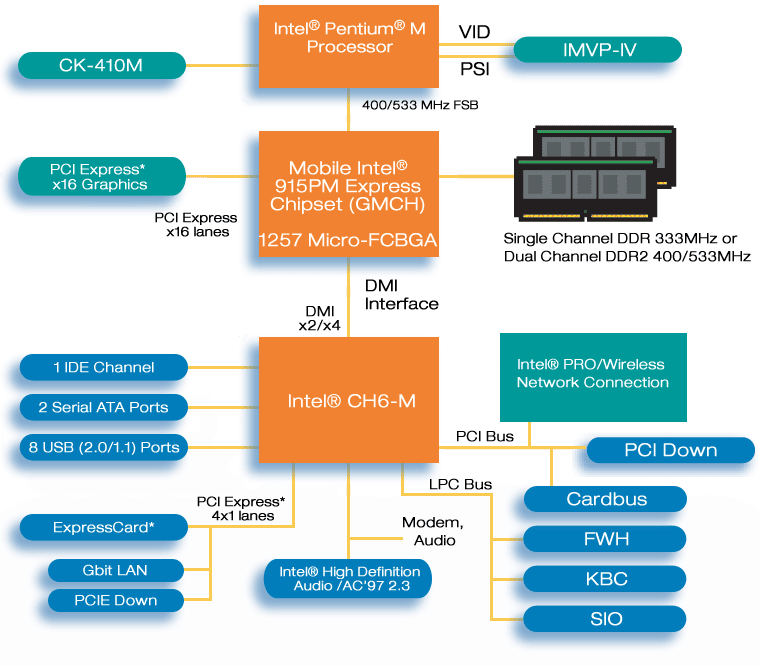
Next, the linked-info to the Acer laptop stated that the GPU had 256MB of attached VRAM and "access" to another 256MB from main memory - I guess it's apples & oranges as far as battery life,... "tomato" & "tomato" (which doesn't work if you don't hear them pronounced differently). But I'm still not convinced that Apple could deliver a dual-core Yonah iBook for less than what they charge now. Would they ignore the advanced features that Napa will offer "on board", such as SATA, GSM & WiMax options, PCI-Exp x16, etc.? Will they use Intel integrated video? And all while maintaining (as much as possible) their industry-high profit margins...
I guess it depends on just what kind of discounts they get for buying those 1,000-quantity lots of Yonah by the barge-full... Still, I don't see the mini - at its present size and pricepoint - getting a dual-core Yonah AND all these fancy DVR functions people are hoping for...
And, yes, I was referring to engineering it in a laptop: the iMac G5 received DDR2 & PCI-Exp x16 in Sept.(?), when the iTMS announced the Disney deal, while the PowerMac G5 was updated the following month (including the dual-core 970s). However, I think that it's different in the laptops. The form factors are too similar as compared to the iMac G5 & PowerMac G5 variance. There's limited expansion options either way in the laptops, so it boils down to what's on board.
And even if the PowerBook stayed G4 for another 3 months (so-called "performance" version of Yonah) or as long as 8 months (dual-core, 64bit Merom), things like FrWr 800, Gig-eth., screen res and GPU will not mask the fact that the consumer laptop has a dual-core CPU on a 667MHz bus that makes the pathetic G4 on its 167MHz bus (or is it still 66MHz!?!) look like its frozen in time.
I just don't see Apple doing that. Especially as the iBook has been steadily nibbling away at the "vast gulf" between it and the PowerBook. Nor do I buy the argument that Apple will wait until pro-apps are available in Intel versions before switching the PowerBook to Intel... Looking at the specs on this Acer (their new "top-line" model) you just know Apple's PC competitors would be laughing all the way to the bank to deposit the receipts from all those dual-core Yonahs they sold to eager-walleted customers.
You said it yourself, jbouklas, Rosetta is surprising people with its apparent performance, and that a 1.6GHz Yonah blows past the developer kits... It just opens too wide a gulf between the iBook and the then-geriatric PowerBook.
Well, lets take a look at the numbers. Keeping basic components equal (DVD drive, screen, etc) to current iBooks, Apple is looking at replacing its motherboard and processor, and possibly its current wireless hardware (I don't know enough about the integration of wireless into the Yonah chipset). The mobos will likely be cheaper than what Apple is getting now for the reason that it will be mostly a mainstream board; I think I read the board might be manufactured by Asus. This not only cuts Apple's R&D costs for the board and chipset, which were proprietary in the past, it also allows them to buy these readily available components from companies that produce them in huge volumes. Bigger volumes of production = cheaper to produce.
Anyway, it looks like when the Celeron M chip was introduced, the price per thousand was something like $167 for its fastest offering. We're comparing that to the 1.66GHz Yonah dual-core chip, priced at something like $240 price per thousand. I don't think that a $70 difference between a low-end chip and a mid-range performer will break the bank.
As far as incorporating SATA and PCIe graphics: SATA will not be necessary performance-wise. Benchmarks in PCs show that there is definitely an improvement when you move to SATA, but it's not huge. Couple that with the fact that laptop hard drives typically don't go past 5400rpm, especially on low-end models, and you probably won't see any speed benefit at all from using SATA, which allows Apple to continue to use PATA, at no supposed cost hit. As for PCIe graphics, I don't think there's anything inherently more expensive about it, though I could be wrong. Though should Apple opt to use AGP, I again doubt there'd by any performance hit. The extra bandwidth helps with the highest end equipment, and even then, not a whole lot. If Apple gives us 128MB mid-range graphics equipment, AGP will still be suited to the task.
Though I do see your point about their historic profit margins. They tend to make a lot more per-unit than other PC manufacturers. This will change, albeit a small amount and just in the short term, I think. Also, it's entirely possible that they got a better deal from Intel than, say, Dell, as part of negotations when Apple jumped IBM's ship.
We'll know by Monday, but I'm banking on Yonah showing up in the next iBook at the same price points.
For that last point you made, I refer back to the PowerBook "goodies" that iBooks don't have: Gigabit ethernet, FireWire 800, thin enclosures, high-resolution, large displays, backlit keyboards, auto-dimming crap, higher capacity hard drives, etc. They're not marketing the PowerBook for its speed, but for its bells and whistles that Pros like. Ha, of course in about 4 days this will all be moot.
-Jim