
Got a tip for us?
Let us know
Become a MacRumors Supporter for $50/year with no ads, ability to filter front page stories, and private forums.
Palm Pre Roundup: Public Launch Tomorrow, iTunes 8.2 Syncing
- Thread starter MacRumors
- Start date
- Sort by reaction score
You are using an out of date browser. It may not display this or other websites correctly.
You should upgrade or use an alternative browser.
You should upgrade or use an alternative browser.

celtikmind
macrumors 6502
I totally agree with this post. Very level-headed. I don't know why, as consumers, we should care about this. Is the Pre's ability to sync with iTunes affecting your iPhone experience? Exactly how would the Pre negatively affect your iPhone experience if its sales took off?
Oh, you wouldn't believe the things that ticks some fanboys off... Just putting a plastic apple sticker in the seemingly normal place can send them off in a full-blown frenzy!
It can be quite funny sometimes if you're ever bored... 😀

kas23
macrumors 603
I just find it sad that a couple of days before WWDC the top rumaor is about the Pre and how it might or might not sync
Where is the good old days?
True. Looks like somebody has stole Apple's spotlight. WWDC is in a few days and a bunch of babies on here are crying about why/how the Pre is able to sync with iTunes. Pathetic.
fr33 loader
macrumors regular
I said stopped supporting NEW players. In other words they did not add any new models to that list. These 15 players on that list are still supported but no player released after 2003 (or somewhere there about) is supported. Really, look at that list, about 15 devices that is a tiny fraction of all non-Apple MP3 players ever released.When you say they "stopped supporting" do you mean that the devices in that list will not sync with iTunes any longer? The date of the last update on that list was July 2008. That implies to me that they are still supported as of then and the iPod has been out for what 7 or 8 years?
HOMBRESINIESTRO
macrumors newbie
I know this is a bit offtopic, but imho Apple has nothing to fear from the Pre in the long run. Why? Because the Pre depends too much on non-touch stuff, like Cut, Copy & Paste that's done holding down keys on the keyboard, or like that gesture area.
The really unique thing about the iPhone is, that it is completely built to be touch-only. Apple tries to implement every feature in a way that defines new paradigms for touch-only devices, so that they have a solid base for their future product line (Look e.g. at Apple's great implementation of cut, copy & paste).
That's why I always thought that a physical keyboard could never have been an option for the iPhone.
To conclude my sermon, Apple should let Palm suck on its iTunes integration, because in the long run, Apple will win, and I don't really see any competition on the market.
The really unique thing about the iPhone is, that it is completely built to be touch-only. Apple tries to implement every feature in a way that defines new paradigms for touch-only devices, so that they have a solid base for their future product line (Look e.g. at Apple's great implementation of cut, copy & paste).
That's why I always thought that a physical keyboard could never have been an option for the iPhone.
To conclude my sermon, Apple should let Palm suck on its iTunes integration, because in the long run, Apple will win, and I don't really see any competition on the market.

Keeval
macrumors member
The thing is though that the Pre doesn't put the words "Apple iPod" in a string anywhere - it's the operating system / iTunes that identifies the pre as an iPod based on the vendor / device ID which is just a couple of hex numbers. Semantics maybe but an important difference because Apple don't have copyright over the vendor / device ID (vendor / device IDs are public because otherwise no-one would be able to integrate with any USB device).
Actually it looks like they DO tell iTunes that it's an iPod...
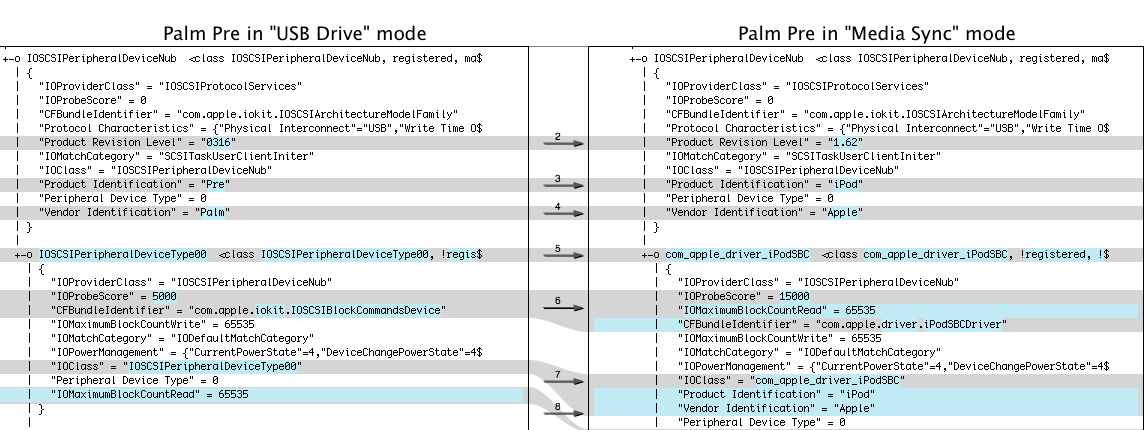
from http://www.intomobile.com/2009/06/05/palm-pre-itunes-sync-confirmed-as-usb-hack.html
I'm not sure if this could be a basis for any kind of legal challenge, or even if Apple would wish to.
We shall have to wait and see.
Apple can very easily change that by creating special signatures on both sides, which is iPod/iPhone and iTunes. This way they can stop every other device to be connected to iTunes. Its just need one more update ahead; thats all what need to be done to achieve it.
Why Apple is silent about this remain mystery at this moment but I am convinced that Apple believe in better profits from iTunes sales if they leave it as it is.
Why Apple is silent about this remain mystery at this moment but I am convinced that Apple believe in better profits from iTunes sales if they leave it as it is.
Actually it looks like they DO tell iTunes that it's an iPod...
from http://www.intomobile.com/2009/06/05/palm-pre-itunes-sync-confirmed-as-usb-hack.html
I'm not sure if this could be a basis for any kind of legal challenge, or even if Apple would wish to.
We shall have to wait and see.
looks like you shut up thoes people who said" palm didnt choose to put it as an ipod thats just how itunes recognized it" ..
they were wrong .. palm IS fooling itunes to think its an ipod
Now I understand why others think of Mac users as Mactards. It's a shame, really.
Now, why do you guys feel so threatened by the Pre? Why do you have a problem with *gasp*interoperability*gasp*? Do you really want to live on your Apple-only island, not playing nice with the neighbors? Sad.
You mean just like WINE makes Windows apps think they're running on Windows? Imagine that.
Now, why do you guys feel so threatened by the Pre? Why do you have a problem with *gasp*interoperability*gasp*? Do you really want to live on your Apple-only island, not playing nice with the neighbors? Sad.
looks like you shut up thoes people who said" palm didnt choose to put it as an ipod thats just how itunes recognized it" ..
they were wrong .. palm IS fooling itunes to think its an ipod
You mean just like WINE makes Windows apps think they're running on Windows? Imagine that.

*LTD*
macrumors G4
The EU is already knocking on Apple's door for being a monopoly in the online music world. Microsoft was being dragged through the mud for nothing more than bundling a freaking web browser with Windows. Microsoft never said only IE can run on Windows, we will block Firefox. All they did was include their browser in Windows and a few years later and millions of dollars in legal fees they're still in court!
It doesn't matter that Apple invented iTunes/iPod one bit, they're by far in first place when it comes to online music and some court somewhere is going to soon have a problem with that. Apple would be best to play nice and not rattle any cages.
Honestly, there are tons of media sync applications out there that'd work great with the Pre. iTunes without the store really isn't that feature rich. If I didn't own an iPhone, I wouldn't use iTunes personally. I'm switching my iPhone to a Pre and porting my number to Sprint tomorrow. Since all my music is already synced via iTunes I'll simply use it, but rest assured I'm not upgrading my iTunes until I confirm it's Pre safe. 😀 When I upgrade to Win7 I'm not installing iTunes on it and I'll use something else like Mediamonkey.
Besides, it's not like anybody was sitting around thinking "Gee, I was going to buy a Pre until I found out it doesn't work with iTunes".
THe EU/Apple pricing issue was put to bed 2 years ago.
No one is legally contesting Apple's iTunes strategy and succeeding. The issue has already been decided more than once in th US (2001 and 2008), and I'm not sure which current investigation you're referring to . . . since there isn't one.
I'm 100% sure. Look again. There is an option without a credit card. It has been there for a while now. I have two accounts. One with a credit card and one without.
OK, if you say so. It was quite while since I signed up (and I did it within iTunes itself) so I guess that must have changed then.
They changed it a while back. There is a community that is to young to have a credit card, but gets iTunes gift cards to purchase stuff. Apple allows you to create an account without a credit card and credit the account with gift cards.

Phil A.
Moderator emeritus
looks like you shut up thoes people who said" palm didnt choose to put it as an ipod thats just how itunes recognized it" ..
they were wrong .. palm IS fooling itunes to think its an ipod
No-one is disputing that the Pre pretends to be an iPod, but you have to understand how this works - The Pre does identify itself as an iPod but only through the VendorID and ProductID strings which are hex numbers (the rest of the text that's in the screenshot comes from the Apple provided drivers within the OS). The text "Apple" and "iPod" comes from the iPod drivers that recognize the Pre as an iPod based on the VendorID and ProductID strings.
This might not sound like an important difference, but it is because iPod and Apple are trademarks of Apple, Inc and can't be reproduced without permission. whereas the VendorID and productID aren't.
The USB Consortium ask people not to mis identify their products but the worst they can do if Palm are breaking their rules is to ban Palm from using the USB logo anywhere on their packaging / devices.
Now I understand why others think of Mac users as Mactards. It's a shame, really.
Now, why do you guys feel so threatened by the Pre? Why do you have a problem with *gasp*interoperability*gasp*? Do you really want to live on your Apple-only island, not playing nice with the neighbors? Sad.
I personally don't care either way about this iTunes thing on the Pre. I have no interest in the Pre. I see poor design and a lot of copying on Palm's part.
My argument lies in the fact that Apple has every right to protect its intellectual property rights. That is hardly fanboism! I just see it as decent business practices. Apple's iTunes is the leader in media jukebox platforms. Apple has a lot of money invested in that platform. Why should they let anyone ride on its coattails? Apple does all the work and Palm uses it as a feature to make money selling its new handset. In my mind, unless you have Apple approval, it's theft and Apple has every right to disable the Pre's ability to sync with iTunes.
There is nothing anti-competitive about it. Consumers have options. If you want the ease and elegance of iTunes you go with iPod or iPhone. You don't like iPods or iPhones then you go with something else but you don't get iTunes. I don't understand why people don't see this for what it is.

Glideslope
macrumors G3
Apple can very easily change that by creating special signatures on both sides, which is iPod/iPhone and iTunes. This way they can stop every other device to be connected to iTunes. Its just need one more update ahead; thats all what need to be done to achieve it.
Why Apple is silent about this remain mystery at this moment but I am convinced that Apple believe in better profits from iTunes sales if they leave it as it is.
I'm not convinced the silence is unplanned. We really do not know what Rubinstein can use from his Apple days. Personally, I think Apple may let this go on and evaluate it from a business standpoint. The App Store/Video Store? is the future. The Pre can't run apps from the App Store.
I also find the Pre's keyboard no better than the iPhones. My youngest in college is a massive SMS person. He found the Pre's keyboard awkward. His opinion is if you need the physical keys you use an LG enV.
So let's just relax. After this month the Pre will be Prawn. June will be a month to remember for a long time. 😎
WebOS:
"Simply put, webOS is absolutely gorgeous. As far as phones go, it's not just the only device we've seen which competes with the iPhone for looks, but we'd go as far to say that it bests the iPhone in some categories. The selection of fonts and font styling, use of transparencies, unified look of all of the elements, smooth transitions, and detailed application icons tie together in a really elegant way."
Browser:
"The webOS browser is obviously central to the operation of the OS as a whole. Since many apps on the device leverage web standards for their core operation, it could be said that the browser is the OS. But in terms of a straight-up web browsing, we found the Pre's out of the box option fantastic -- not only in speed and navigation, but with rendering and compatibility. Built atop WebKit (just as Apple's Mobile Safari), the webOS browser displays pages almost exactly as the iPhone does, though due to the fact that Palm is implementing a lot of hiding icons and app controls, it actually feels like you're seeing more content despite the smaller display. Additionally, its cache management seems better to us, allowing for fairly speedy back and forth through multiple pages. "
Multimedia:
"Palm definitely scores with its concepts about handling media in webOS, particularly when it comes to music. First, they've given users more than a single option to load media onto the device, allowing for a straight iTunes sync (more on that in a moment), but also giving you the option of loading media onto the Pre in mass storage mode. The phone automatically recognizes file types and throws them into the appropriate application regardless of location in memory (which means you can organize however you like)."
Navigation:
"We won't go into detail on every Sprint app included (especially not the NASCAR app), but we wanted to briefly talk about Sprint Navigation. Since most other smartphones of this class either don't come with on-board GPS navigation, or charge you for it, we felt it was notable that Sprint and Palm are giving away what feels like a very usable GPS app with the Pre. We used the software -- which does turn-by-turn / text-to-speech directions -- while driving from San Diego to LA, and it worked flawlessly."
Camera:
"Look, we're just going to say it: we love the Pre's camera. There are two things happening here that make it lovable. First, it's 3.2 megapixels, which makes it at least competitive with its contemporaries. Second, Palm has done something totally radical in webOS -- they've made it so the image processing is backloaded when you're shooting. What that means is that you can snap away without having to sit through the shutter lag you're probably used to, allowing you to actually use the thing like a real camera. Furthermore, the image quality we saw was more than sufficient for on-the-scene shots, with particular clarity and color in daylight shots, though a surprising amount of definition in low light situations as well. Oh, and did we mention it has a flash?"
Conclusion:
"Ultimately -- carriers and developers notwithstanding -- what Palm has done is not only a major feat for a company of its size (and its dire position), and we think it's an important step in the evolution of mobile computing. Just like the iPhone's notches up the ladder, and the G1's contributions, the Pre moves the game forward in a very real way. We know this won't be the last of the webOS devices, and we know that as Palm improves its products, so will Apple, RIM, Microsoft, Google, and the rest of the smartphone gang. Unfortunately for them, their work just got a little bit tougher."
More: http://www.engadget.com/2009/06/03/palm-pre-review-part-1-hardware-webos-user-interface/
"Simply put, webOS is absolutely gorgeous. As far as phones go, it's not just the only device we've seen which competes with the iPhone for looks, but we'd go as far to say that it bests the iPhone in some categories. The selection of fonts and font styling, use of transparencies, unified look of all of the elements, smooth transitions, and detailed application icons tie together in a really elegant way."
Browser:
"The webOS browser is obviously central to the operation of the OS as a whole. Since many apps on the device leverage web standards for their core operation, it could be said that the browser is the OS. But in terms of a straight-up web browsing, we found the Pre's out of the box option fantastic -- not only in speed and navigation, but with rendering and compatibility. Built atop WebKit (just as Apple's Mobile Safari), the webOS browser displays pages almost exactly as the iPhone does, though due to the fact that Palm is implementing a lot of hiding icons and app controls, it actually feels like you're seeing more content despite the smaller display. Additionally, its cache management seems better to us, allowing for fairly speedy back and forth through multiple pages. "
Multimedia:
"Palm definitely scores with its concepts about handling media in webOS, particularly when it comes to music. First, they've given users more than a single option to load media onto the device, allowing for a straight iTunes sync (more on that in a moment), but also giving you the option of loading media onto the Pre in mass storage mode. The phone automatically recognizes file types and throws them into the appropriate application regardless of location in memory (which means you can organize however you like)."
Navigation:
"We won't go into detail on every Sprint app included (especially not the NASCAR app), but we wanted to briefly talk about Sprint Navigation. Since most other smartphones of this class either don't come with on-board GPS navigation, or charge you for it, we felt it was notable that Sprint and Palm are giving away what feels like a very usable GPS app with the Pre. We used the software -- which does turn-by-turn / text-to-speech directions -- while driving from San Diego to LA, and it worked flawlessly."
Camera:
"Look, we're just going to say it: we love the Pre's camera. There are two things happening here that make it lovable. First, it's 3.2 megapixels, which makes it at least competitive with its contemporaries. Second, Palm has done something totally radical in webOS -- they've made it so the image processing is backloaded when you're shooting. What that means is that you can snap away without having to sit through the shutter lag you're probably used to, allowing you to actually use the thing like a real camera. Furthermore, the image quality we saw was more than sufficient for on-the-scene shots, with particular clarity and color in daylight shots, though a surprising amount of definition in low light situations as well. Oh, and did we mention it has a flash?"
Conclusion:
"Ultimately -- carriers and developers notwithstanding -- what Palm has done is not only a major feat for a company of its size (and its dire position), and we think it's an important step in the evolution of mobile computing. Just like the iPhone's notches up the ladder, and the G1's contributions, the Pre moves the game forward in a very real way. We know this won't be the last of the webOS devices, and we know that as Palm improves its products, so will Apple, RIM, Microsoft, Google, and the rest of the smartphone gang. Unfortunately for them, their work just got a little bit tougher."
More: http://www.engadget.com/2009/06/03/palm-pre-review-part-1-hardware-webos-user-interface/

Compile 'em all
macrumors 601
Just another "iPhone killer".

ibosie
macrumors 6502
I will have more respect to apple if they don't block the palm. May the better phone win!
Here here. Apple doesn't need to block anything all they need to do is stay ontop of their game and quality will serve them well.
Here here. Apple doesn't need to block anything all they need to do is stay ontop of their game and quality will serve them well.
That's just it, Apple is on top of its game. They have iTunes, it rocks. Why should Palm get to use Apple's quality software product to sell the Pre? It's proprietary!

Starflyer
macrumors 6502a
Apple would be wrong to block the Pre from syncing. It would be bad PR. It would almost look like anti competitive. In the end it is bad for the consumer to have crap so restrictive as itunes sync.
We applaud openness and free choice but we accept anything that the likes of apple or Google give us. Pretty lame if you ask me.
You sound like the guy from Psystar.
celtikmind
macrumors 6502
That's just it, Apple is on top of its game. They have iTunes, it rocks. Why should Palm get to use Apple's quality software product to sell the Pre? It's proprietary!
Then why should Apple be allowed to use mice with their computers - doesn't that one belong to Xerox? 😛
Heck, let Apple redesign the internet and make world peace come true while they're at it! Why have any communication at all across borders?! Let's all hunker up in gated communities and defend everything to the teeth! 🙄
Guys, I really think Apple can survive this without taking any childish route. Then again it's Apple we're talking about... 😛
My argument lies in the fact that Apple has every right to protect its intellectual property rights. That is hardly fanboism! I just see it as decent business practices. Apple's iTunes is the leader in media jukebox platforms. Apple has a lot of money invested in that platform. Why should they let anyone ride on its coattails? Apple does all the work and Palm uses it as a feature to make money selling its new handset. In my mind, unless you have Apple approval, it's theft and Apple has every right to disable the Pre's ability to sync with iTunes.
What did Palm steal? Identifying as another device for purposes of interoperability is hardly stealing. Remember, iTunes is just a media player that happens to sync with iPod and iPhone.
There's also another issue here: Rubinstein and his team worked on the iPod (and presumably iTunes), the very device Pre identifies as. Is it right to "ride on Apple's coattails"?
There is nothing anti-competitive about it. Consumers have options. If you want the ease and elegance of iTunes you go with iPod or iPhone. You don't like iPods or iPhones then you go with something else but you don't get iTunes. I don't understand why people don't see this for what it is.
I shouldn't be forced to buy an iPod or an iPhone just to have iTunes syncing.
I think apple would be happy it can sync to the Pre. They make more money in the long run from people buying content from their store than the devices. I could care less if it syncs since I rarely listen to music on my phones. If I do I will just stream pandora. My iPods only sit in my car hooked up to my iDrive NAV.
Then why should Apple be allowed to use mice with their computers - doesn't that one belong to Xerox? 😛
Is that a proprietary device? Do they have patent protection on that device? Then yes there should be a conversation around that.
celtikmind said:Heck, let Apple redesign the internet and make world peace come true while they're at it! Why have any communication at all across borders?! Let's all hunker up in gated communities and defend everything to the teeth! 🙄
Being snotty hardly defends your argument.
celtikmind said:Guys, I really think Apple can survive this without taking any childish route. Then again it's Apple we're talking about... 😛
I don't see how Apple monetizing its own software and protecting that monetization is childish. That is the business they are in. Software is just a means to monetizing Apple's overpriced hardware.

Cameront9
macrumors 65816
Then why should Apple be allowed to use mice with their computers - doesn't that one belong to Xerox? 😛
Point of order: Apple paid Xerox with Stock options for the right to use their GUI stuff, the mouse, etc. That's a completely different situation than what is happening here.